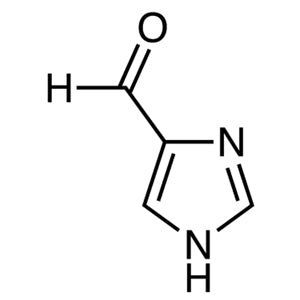
Imidazole-4-carboxaldehyde is a chemical compound widely used in organic synthesis reactions within laboratory settings. It belongs to the class of heterocyclic compounds, which are essential in constructing complex molecular structures. This compound plays a critical role in various chemical processes, including condensation and substitution reactions, making it a versatile tool for chemists. Its unique structure allows it to participate in multiple reaction pathways, enabling the synthesis of a wide range of functional molecules.
The chemical properties of Imidazole-4-carboxaldehyde make it a preferred choice for synthetic applications. It exhibits stability under controlled conditions but remains highly reactive to environmental factors such as temperature and humidity. This reactivity allows it to interact with a variety of functional groups, enhancing its utility in creating compounds with specific structural and functional characteristics. Its ability to form stable intermediates and participate in multiple reaction mechanisms further solidifies its position as a key reagent in organic chemistry.
In Indonesian laboratories, Imidazole-4-carboxaldehyde is commonly used in research focused on organic chemistry. It is particularly valuable in the development of new compounds or the modification of existing ones. Many research institutions and universities rely on this compound to meet the demands of precise synthetic experiments. Its role in advancing chemical research makes it an essential component in both academic and industrial laboratory settings.
Related TCI products
- TCI I0809 10111-08-7 Imidazole-2-carboxaldehyde
- TCI B4064 68282-49-5 2-Butyl-1H-imidazole-5-carboxaldehyde
- TCI B2914 83857-96-9 2-Butyl-5-chloro-1H-imidazole-4-carboxaldehyde
- TCI T1985 2232-08-8 1-(p-Toluenesulfonyl)imidazole
- TCI B3941 37734-89-7 1-Benzyl-2-phenyl-1H-imidazole
- TCI B1043 54925-64-3 1-(tert-Butyldimethylsilyl)imidazole [tert-Butyldimethylsilylating Agent]
- Organic synthesis research - This item is ideal for creating complex molecules due to its reactivity and ability to form diverse chemical structures.
- Drug development projects - Its use in synthesizing pharmacological compounds makes it a valuable tool in pharmaceutical research.
- Heterocyclic compound modification - The compound's structure allows for the development of new heterocyclic derivatives with tailored properties.
- Functional group chemistry studies - Its reactivity with various functional groups supports in-depth investigations into chemical reactivity.
- Industrial chemical production - It is used in the synthesis of industrial chemicals, providing a reliable building block for large-scale applications.
| Brand | TCI |
|---|---|
| CAS number | 3034-50-2 |
| Molecular formula | — |
| Purity | — |
| Category | Chemistry > Building Blocks > Heterocyclic Building Blocks |
| Pack sizes | Available in various quantities as per supplier specifications |
| Physical form | Solid |
| Storage | Store in a cool, dry place away from moisture and direct sunlight |
Imidazole-4-carboxaldehyde should be stored in a cool, dry environment to maintain its chemical stability. It is recommended to keep the compound in airtight containers to prevent exposure to moisture and air, which can affect its reactivity. Due to its sensitivity to environmental conditions, it should be handled in a controlled laboratory setting with appropriate personal protective equipment. Avoid prolonged exposure to high temperatures or humidity to ensure the compound remains effective for its intended applications. Proper storage and handling are essential to preserve its chemical integrity and ensure safe usage in laboratory experiments.
—
Produk Terkait
-
Imidazole-2-carboxaldehyde TCI I0809
Regular price From Rp 769.650,00Regular price -
2-Butyl-1H-imidazole-5-carboxaldehyde TCI B4064
Regular price From Rp 3.658.200,00Regular price -
2-Butyl-5-chloro-1H-imidazole-4-carboxaldehyde TCI B2914
Regular price Rp 1.115.100,00Regular price -
1-(p-Toluenesulfonyl)imidazole TCI T1985
Regular price From Rp 1.087.800,00Regular price -
1-Benzyl-2-phenyl-1H-imidazole TCI B3941
Regular price From Rp 875.700,00Regular price -
1-(tert-Butyldimethylsilyl)imidazole[tert-ButyldimethylsilylatingAgent] TCI B1043
Regular price From Rp 2.439.150,00Regular price -
5-Amino-1H-imidazole-4-carboxamide TCI A3078
Regular price From Rp 1.618.050,00Regular price -
2-Amino-4,5-dicyano-1H-imidazole TCI A1292
Regular price Rp 3.870.300,00Regular price


![54925-64-3 1-(tert-Butyldimethylsilyl)imidazole [tert-Butyldimethylsilylating Agent] - AMI Scientific](http://amiscientific.com/cdn/shop/files/TCI2510B1043_62a593eb-d572-4812-b0c7-1817f56f84d9.jpg?v=1767230995&width=533)