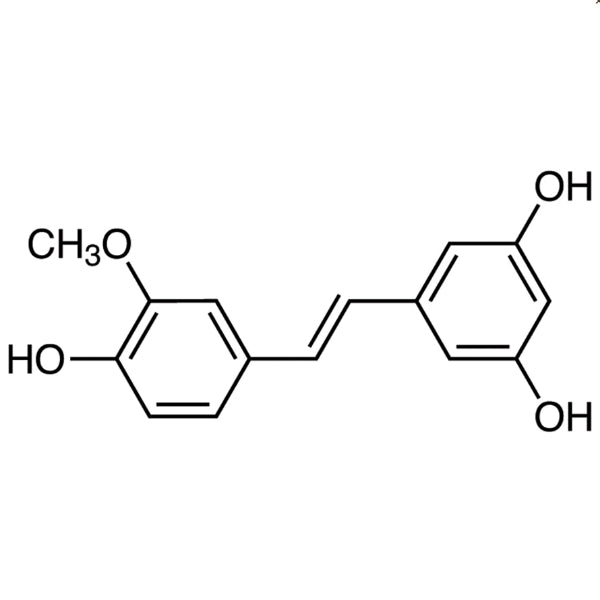
TCI I0804 Isorhapontigenin, CAS 32507-66-7, is a naturally occurring stilbenoid compound — a structural relative of resveratrol that carries an additional methoxy group on one of its aromatic rings. The compound belongs to the phenylpropanoids and aromatic polyketides, a class of plant secondary metabolites formed through the phenylpropanoid biosynthetic pathway. In the laboratory, isorhapontigenin is used primarily as a reference compound and test substance: it serves as an identification standard in the analysis of plant extracts, and as a pure material for investigating biological activity in cell and enzyme systems.
The property that makes this compound a frequent choice is its fully conjugated stilbene skeleton. The double bond system linking the two aromatic rings produces strong ultraviolet absorption, so the compound is readily detected by high performance liquid chromatography with UV or photodiode array detection even at low concentrations. The phenolic hydroxyl groups provide hydrogen atom donating capability, which forms the basis of its antioxidant activity, while the methoxy group alters its polarity and metabolic behaviour compared with resveratrol. These small structural differences are precisely what make the compound worth studying alongside its better known analogue.
In Indonesian laboratories, isorhapontigenin is typically encountered in natural product chemistry and pharmacognosy work, where research groups screen local plant materials for stilbenoid content. University and institutional laboratories use it to confirm peak identity in extract profiling, while biochemical and pharmacological groups employ it as a defined pure substance in activity assays. Because it is supplied as a research chemical in small quantities, it is handled as an analytical-scale reagent rather than a bulk material.
- Reference standard in HPLC analysis of plant extracts, where its strong ultraviolet absorption and defined identity allow reliable peak assignment and confirmation of stilbenoid content in complex botanical samples.
- Phytochemical profiling of natural product isolates, since a pure authenticated stilbenoid is required to distinguish isorhapontigenin from resveratrol and other closely related analogues present in the same extract.
- Antioxidant activity evaluation, because the phenolic hydroxyl groups donate hydrogen atoms in a well defined manner, making the compound a suitable test substance in radical scavenging and related assay formats.
- Cell based biological activity studies, where a pure, structurally characterised compound is needed so that observed effects can be attributed to isorhapontigenin rather than to unidentified extract components.
- Enzyme assay investigations and structure-activity comparison work, in which the additional methoxy group relative to resveratrol provides a controlled structural variation for examining how substitution influences biological response.
| Brand | TCI (Tokyo Chemical Industry) |
|---|---|
| CAS number | 32507-66-7 |
| Molecular formula | — |
| Purity | — |
| Category | Life Science > Biochemicals and Reagents > Phenylpropanoids, Aromatic Polyketides |
| Pack sizes | available in research-scale quantities; please confirm the current pack options when ordering |
| Physical form | — |
| Storage | store under the conditions stated on the manufacturer's label and accompanying documentation |
- Catalogue Code: I0804
Store the container tightly closed in a cool, dark and dry place, following the storage conditions indicated on the manufacturer's label. Amber glass vials or the original supplier container are suitable, since the conjugated stilbene chromophore makes the compound sensitive to prolonged light exposure. Protect the material from moisture and allow closed containers to equilibrate to room temperature before opening to reduce condensation on the contents. Handle in a well ventilated area or fume hood using gloves, safety glasses and a laboratory coat, and avoid generating dust when weighing. Use clean, dry spatulas to prevent contamination of the stock, and consult the manufacturer's safety data sheet before first use and before disposal of residues.
—
Produk Terkait
-
Rhapontigenin TCI R0089
Regular price Rp 6.784.050,00Regular price -
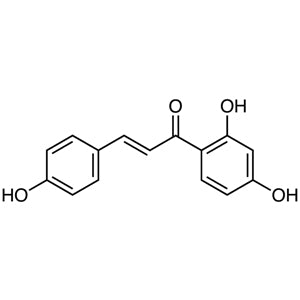
Isoliquiritigenin TCI I0822
Regular price From Rp 1.035.300,00Regular price -
Tetrahydrocurcumin TCI T3587
Regular price From Rp 2.386.650,00Regular price -
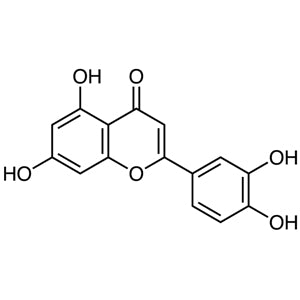
3',4',5,7-Tetrahydroxyflavone TCI T2682
Regular price From Rp 1.565.550,00Regular price -
Butein TCI B3803
Regular price From Rp 3.048.150,00Regular price -
Silybin(mixtureofSilybinAandSilybinB) TCI S0508
Regular price From Rp 2.227.050,00Regular price -
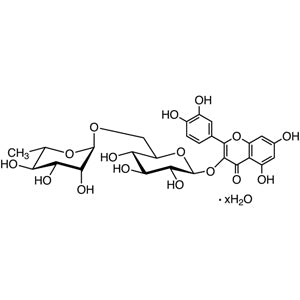
RutinHydrate TCI R0035
Regular price Rp 1.378.650,00Regular price -
Phloretin TCI P1966
Regular price From Rp 1.644.300,00Regular price