

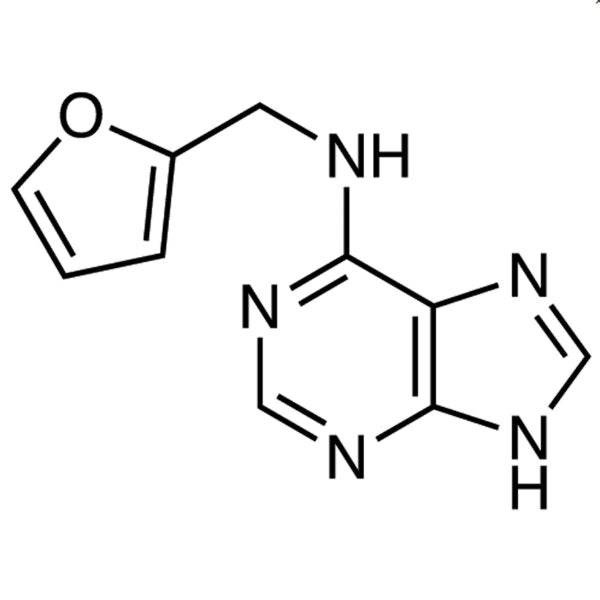
Kinetin is a chemical compound classified under nucleosides, playing a crucial role in the synthesis of DNA and RNA. As a key biochemical reagent, it is widely used in laboratory experiments, particularly in studies related to cell growth, differentiation, and enzymatic activity. Its complex chemical structure requires precise processing to ensure accurate experimental results. Kinetin is a valuable tool for researchers in life sciences, offering a reliable source for molecular analysis and biological compound synthesis.
Kinetin is chemically stable under specific conditions but is sensitive to UV light and high temperatures. These properties make it a preferred choice for high-precision research, such as molecular analysis and the synthesis of bioactive compounds. Its purity and controlled form allow researchers to maintain accurate concentrations, enhancing the reliability of experimental data. The stability and sensitivity of kinetin make it suitable for applications where precision and reproducibility are essential.
In Indonesian laboratories, kinetin is extensively used across various scientific disciplines, including biotechnology, pharmacology, and molecular biology. It is particularly relevant in research related to plant growth, drug development, and cellular mechanisms. Its presence in pure form enables precise control over experimental parameters, supporting high-quality scientific outcomes. Kinetin is a fundamental component in many biochemical and molecular studies conducted in Indonesia.
Advantages (TCI brochure)
- Reported as an accelerator for xylem differentiation
TCI brochures (PDF)
- Xylem Differentiation-Inducing Polyamine Xylemin 2024-11-15 · p. 2
- Plant Hormones 2025-01-30 · p. 1
- Agrochemical Ingredients for Research and Experimental Use 2026-01-08 · p. 7
- Nucleosides, Nucleotides, Nucleic Acids and Related Reagents 2026-03-23 · p. 9
- Plant Research Reagents 2026-02-24 · p. 13
- Reagents for Biological Research 2025-03-11 · p. 55
- Molecular biology research utilizes kinetin for DNA and RNA synthesis due to its role as a nucleoside building block.
- Enzymatic activity studies benefit from kinetin as it supports biochemical reactions essential for metabolic pathways.
- Cell growth and differentiation experiments rely on kinetin to investigate cellular processes in controlled environments.
- Pharmaceutical research incorporates kinetin in the development of bioactive compounds for therapeutic applications.
- Plant growth studies use kinetin to explore its effects on cellular development and tissue regeneration in botanical research.
From the TCI brochure
- Combined with 2,4-D, bikinin and xylemin in ectopic xylem differentiation of A. thaliana cotyledons
| Brand | TCI |
|---|---|
| CAS number | 525-79-1 |
| Molecular formula | — |
| Purity | — |
| Category | Life Science > Biochemicals and Reagents > Nucleosides, Nucleotides, Oligonucleotides |
| Pack sizes | — |
| Physical form | — |
| Storage | Store in a cool, dark place away from UV light and high temperatures. |
Data from the TCI brochure
| Kemasan | 1g / 5g |
|---|
Source: TCI brochure LL071 (2024-11-15)
Kinetin should be stored in a cool, dark environment to prevent degradation caused by UV exposure and high temperatures. It is recommended to use airtight containers to minimize moisture and contamination risks. Proper labeling and secure storage are essential to maintain product integrity. Laboratory personnel should handle kinetin with care, using appropriate protective equipment when necessary. Avoid exposure to direct sunlight and ensure storage conditions remain consistent to preserve its chemical stability. Regular monitoring of storage conditions ensures the compound remains suitable for use in scientific experiments.
—
Produk Terkait
-
Adenine TCI A0149
Regular price From Rp 1.696.800,00Regular price -
trans-Zeatin TCI Z0012
Regular price Rp 6.520.500,00Regular price -
N6-Benzyladenine TCI B1088
Regular price From Rp 903.000,00Regular price -
Xanthine TCI X0004
Regular price Rp 1.803.900,00Regular price -
AMI-331Hydrochloride TCI A3352
Regular price Rp 14.018.550,00Regular price -
Allopurinol TCI A0907
Regular price Rp 1.273.650,00Regular price -
NU2058 TCI N0958
Regular price From Rp 1.087.800,00Regular price -
3-Methyladenine TCI M2518
Regular price Rp 3.419.850,00Regular price


