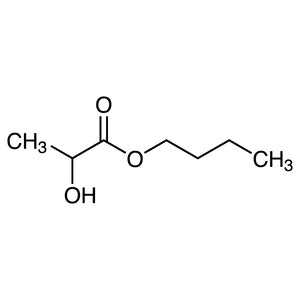
TCI L0002 Butyl Lactate is an ester formed from lactic acid and butanol, and it belongs to the group of non-heterocyclic building blocks used in synthetic chemistry. The molecule carries both an ester group and a secondary hydroxyl group within a single structure, which allows it to be treated as a bifunctional intermediate. In the laboratory, butyl lactate serves as a synthetic starting material, as a solvent with good dissolving power for organic compounds, and as a model substance in studies of chemistry based on renewable resources, since lactic acid can be obtained through fermentation.
The characteristics that lead chemists to select butyl lactate are the combination of its solvent behaviour and its chemical reactivity. As a butyl-chain ester, the compound has a higher boiling point and slower evaporation than short-chain lactate esters, which makes it suitable for processes that require the solvent to remain in the system for a longer period. Its hydroxyl group can be esterified, oxidised, or converted into other functional groups, while the ester group can be hydrolysed or transesterified, so a broad range of modification routes remains available. The compound also possesses a chiral centre.
In Indonesian laboratories, this grade is typically held as a general-purpose reagent and solvent on the organic synthesis bench, where the same bottle may serve a preparative reaction one week and a dissolution or formulation trial the next. Its position within the non-heterocyclic building blocks category means it is usually stocked alongside other bifunctional intermediates by academic research groups, industrial R&D units, and analytical development teams that prepare their own intermediates rather than purchasing them finished.
- Organic synthesis starting material — the molecule supplies both an ester and a secondary hydroxyl handle, so a single reagent can be carried through several sequential transformation steps.
- Solvent for organic compounds — its good dissolving power toward organic substances makes it appropriate for dissolution, reaction media, and work-up stages in preparative chemistry.
- Extended-duration solvent processes — the higher boiling point and slower evaporation of the butyl chain suit procedures where the solvent must persist in the system rather than escape early.
- Renewable-resource chemistry studies — because lactic acid can be produced by fermentation, this ester serves as a model substance for teaching and investigating bio-based synthetic routes.
- Functional group transformation work — the hydroxyl can be esterified, oxidised, or converted, while the ester can be hydrolysed or transesterified, giving many derivatisation pathways.
| Brand | TCI |
|---|---|
| CAS number | 138-22-7 |
| Molecular formula | — |
| Purity | — |
| Category | Chemistry > Building Blocks > Non-Heterocyclic Building Blocks |
| Pack sizes | available in the packaging options listed by TCI for this catalogue item; please confirm the size required when ordering |
| Physical form | — |
| Storage | keep in a tightly closed container as described in the handling section below |
- Product code: L0002
- Structural note: bifunctional ester bearing a secondary hydroxyl group and a chiral centre
Store the container tightly closed in a cool, dry, and well-ventilated area, kept away from heat, open flame, and direct sunlight, and separated from strong oxidising agents. The original supplier bottle is the preferred container; where transfer is necessary, use clean glass or another vessel compatible with organic esters, and label it clearly. Handle the material in a fume hood, wear safety goggles, gloves, and a laboratory coat, and avoid contact with skin and eyes as well as inhalation of vapour. Close the container immediately after each use to limit moisture uptake and evaporation, and consult the manufacturer's safety data sheet before first use and before disposal.
—
Produk Terkait
-
TetradecylLactate TCI T2231
Regular price Rp 848.400,00Regular price -
SodiumDL-Lactate(60%inWater) TCI S0928
Regular price Rp 823.200,00Regular price -
PropylLactate TCI L0121
Regular price Rp 2.545.200,00Regular price -
IsoamylLactate TCI L0117
Regular price Rp 1.353.450,00Regular price -
MethylLactate TCI L0004
Regular price From Rp 903.000,00Regular price -
EthylLactate TCI L0003
Regular price From Rp 505.050,00Regular price -
HexadecylLactate TCI H1159
Regular price From Rp 584.850,00Regular price -
Sodium3-(4-Hydroxy-3-methoxyphenyl)lactate TCI H0538
Regular price From Rp 3.392.550,00Regular price