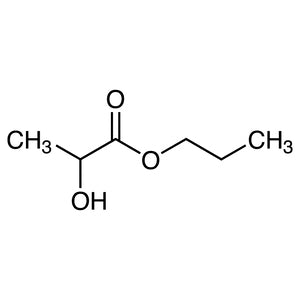
Propyl Lactate (TCI L0121), with CAS number 616-09-1, is an organic compound widely used in various chemical applications within laboratory settings. As a fundamental building block in chemistry, it plays a crucial role in the synthesis of more complex molecules. Its simple yet essential structure makes it a versatile reagent for a range of chemical processes. This compound is particularly valued for its ability to participate in reactions such as esterification, hydrolysis, and substitution, making it a key component in organic synthesis.
Propyl Lactate is preferred due to its chemical stability and moderate reactivity, which allow it to be used in a wide array of experimental conditions. Its solubility in various organic solvents enhances its utility in different synthetic pathways. The compound’s compatibility with multiple solvents and its ability to interact effectively in chemical reactions make it a reliable choice for researchers. These properties ensure that it remains a valuable tool in both academic and industrial laboratory environments.
In Indonesian laboratories, Propyl Lactate is commonly used in chemical research, including pharmaceutical compound development, cosmetic formulation, and studies on organic compound properties. Its versatility and reliability make it an essential reagent for researchers seeking to explore chemical synthesis and functional material development. The compound's broad applications support its continued use in diverse scientific investigations.
- Pharmaceutical research for the synthesis of active pharmaceutical ingredients due to its reactivity and compatibility with organic solvents.
- Cosmetic formulation development as a precursor for ester-based compounds used in fragrance and skincare products.
- Organic chemistry experiments involving esterification and hydrolysis reactions due to its chemical stability and reactivity.
- Material science studies for the creation of functional polymers and coatings through chemical modification.
- Analytical chemistry applications for use as a solvent or standard in chromatographic and spectroscopic analyses.
| Brand | TCI |
|---|---|
| CAS number | 616-09-1 |
| Molecular formula | — |
| Purity | — |
| Category | Chemistry > Building Blocks > Non-Heterocyclic Building Blocks |
| Pack sizes | Available in various quantities as per standard laboratory supply options |
| Physical form | Liquid |
| Storage | Store in a cool, dry place away from direct sunlight and incompatible materials |
Propyl Lactate should be stored in a cool, dry environment to maintain its chemical stability. It is recommended to keep the compound in a tightly sealed container to prevent evaporation and contamination. Due to its organic nature, it should be stored away from strong oxidizing agents and incompatible substances. The container should be made of a material that is resistant to chemical degradation, such as glass or high-density polyethylene. Always ensure proper ventilation when handling the compound to avoid inhalation of vapors. Regular monitoring of storage conditions is essential to maintain the integrity and effectiveness of the material in laboratory settings.
—
Produk Terkait
-
TetradecylLactate TCI T2231
Regular price Rp 848.400,00Regular price -
IsoamylLactate TCI L0117
Regular price Rp 1.353.450,00Regular price -
HexadecylLactate TCI H1159
Regular price From Rp 584.850,00Regular price -
Sodium3-(4-Hydroxy-3-methoxyphenyl)lactate TCI H0538
Regular price From Rp 3.392.550,00Regular price -
SodiumDL-Lactate(60%inWater) TCI S0928
Regular price Rp 823.200,00Regular price -
MethylLactate TCI L0004
Regular price From Rp 903.000,00Regular price -
EthylLactate TCI L0003
Regular price From Rp 505.050,00Regular price -
ButylLactate TCI L0002
Regular price From Rp 505.050,00Regular price