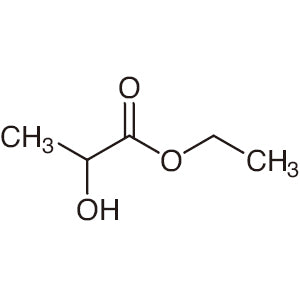
TCI L0003 Ethyl Lactate is the ethyl ester of lactic acid, classified as a non-heterocyclic building block and at the same time widely recognised as an organic solvent. The molecule carries both an ester group and a secondary hydroxyl group, so it can be treated as a bifunctional intermediate in synthesis. In the laboratory, ethyl lactate serves as a solvent for a broad range of organic compounds, as a starting material for the preparation of lactate derivatives, and as a subject of study in green chemistry research, since its feedstock can be obtained from the fermentation of renewable resources.
The property that makes ethyl lactate a frequent choice is its ability to mix with water as well as with organic solvents, which gives it flexibility in mixed-solvent systems, in extraction work, and in the cleaning of glassware. Compared with conventional solvents based on halogenated hydrocarbons, ethyl lactate is regarded as a gentler option for everyday laboratory use, and this is precisely what has encouraged its adoption as an alternative solvent. From the standpoint of reactivity, its hydroxyl group remains open to a variety of chemical transformations, while its ester group is readily hydrolysed or transesterified.
In Indonesian laboratories, this combination of solvent behaviour and synthetic utility makes ethyl lactate a practical item to keep on the bench. It is used where a water-miscible organic solvent is needed for dissolving or extracting organic compounds, where lactate derivatives are being prepared from a bifunctional intermediate, and where research groups are evaluating greener alternatives to conventional halogenated solvents in routine preparative and cleaning work.
- Solvent for organic compounds — its capacity to dissolve a wide range of organic substances makes it a general-purpose working solvent for preparative and analytical bench procedures.
- Preparation of lactate derivatives — as the ethyl ester of lactic acid, it serves directly as the starting material from which further lactate derivatives are synthesised.
- Bifunctional intermediate in synthesis — the ester group and the secondary hydroxyl group can be addressed separately, allowing chemists to build more elaborate structures from the lactate skeleton.
- Mixed-solvent systems and extraction — miscibility with both water and organic solvents lets it bridge aqueous and organic phases in solvent blends and extraction protocols.
- Green chemistry research — because its feedstock can come from the fermentation of renewable resources, it is studied as an alternative to halogenated hydrocarbon solvents.
| Brand | TCI |
|---|---|
| CAS number | 97-64-3 |
| Molecular formula | — |
| Purity | — |
| Category | Chemistry > Building Blocks > Non-Heterocyclic Building Blocks |
| Pack sizes | available in the pack sizes listed for this catalogue item; please refer to the packaging options shown on this page. |
| Physical form | — |
| Storage | keep in a closed container under the storage conditions stated on the manufacturer's label. |
- Product code: L0003
Store ethyl lactate in its original tightly closed container, kept upright in a cool, dry and well-ventilated chemical store away from heat sources, direct sunlight and incompatible materials. Containers should be chemically compatible and clearly labelled, and they should be reclosed immediately after each use to limit evaporation and moisture pick-up, since the material is miscible with water. Handle the solvent in a fume hood or in an adequately ventilated area, wearing a laboratory coat, chemical splash goggles and suitable gloves. Transfer and dispense with clean, dry glassware, avoid ignition sources during handling, and collect solvent waste in a designated container for disposal in line with your institution's chemical waste procedures. Always consult the manufacturer's safety data sheet before first use.
—
Produk Terkait
-
TetradecylLactate TCI T2231
Regular price Rp 848.400,00Regular price -
SodiumDL-Lactate(60%inWater) TCI S0928
Regular price Rp 823.200,00Regular price -
PropylLactate TCI L0121
Regular price Rp 2.545.200,00Regular price -
IsoamylLactate TCI L0117
Regular price Rp 1.353.450,00Regular price -
MethylLactate TCI L0004
Regular price From Rp 903.000,00Regular price -
ButylLactate TCI L0002
Regular price From Rp 505.050,00Regular price -
HexadecylLactate TCI H1159
Regular price From Rp 584.850,00Regular price -
Sodium3-(4-Hydroxy-3-methoxyphenyl)lactate TCI H0538
Regular price From Rp 3.392.550,00Regular price