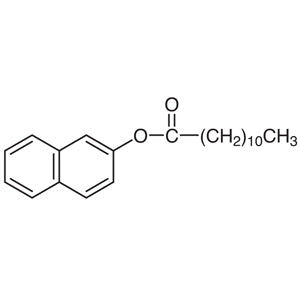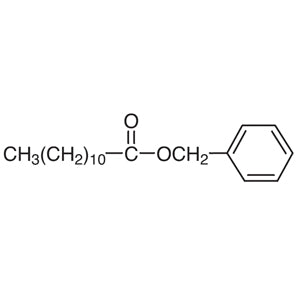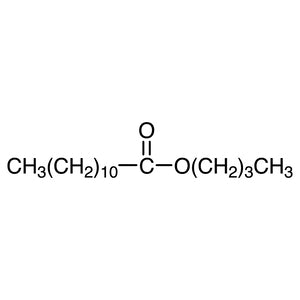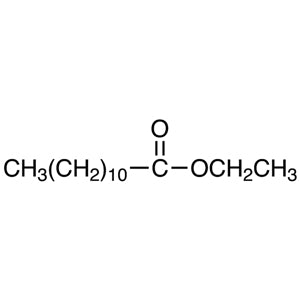
Ethyl Laurate is the ethyl ester of lauric acid, supplied as a liquid, and it ranks among the most frequently encountered non-heterocyclic building blocks in fatty ester research. The compound is formed by the reaction of lauric acid with ethanol, two readily available starting materials, which is why it is also a classic worked example of Fischer esterification in teaching laboratories. Beyond its role as a synthetic intermediate, Ethyl Laurate serves as a reference compound in aroma analysis, in studies of ethyl-ester-based biodiesel, and in enzymatic research involving lipases.
The properties that make this ester a preferred choice begin with its characteristically soft, mild odour, its low viscosity, and its good stability under normal storage conditions. It is highly soluble in organic solvents while showing very low solubility in water, a combination that simplifies extraction and phase-separation work. The ester group is reactive enough to undergo base hydrolysis and transesterification, yet stable enough to be handled routinely without special treatment. That balance makes it an ideal substrate for ester reaction kinetics studies, since changes in concentration are straightforward to follow, while its consistent physical behaviour supports its use as an internal standard.
In Indonesian laboratories, Ethyl Laurate is typically found in university teaching benches where Fischer esterification is demonstrated, in biodiesel research groups working on ethyl ester routes, and in analytical laboratories that require a dependable reference compound for aroma profiling. Enzyme laboratories investigating lipase activity also use it as a model substrate. Its routine handling requirements make it practical for shared facilities where a single material is used across several ongoing projects.
TCI brochures (PDF)
- Lipids 2025-12-17 · p. 10
- Fischer esterification teaching experiments: prepared from lauric acid and ethanol, two readily obtained materials, it makes the classical esterification demonstration reproducible and accessible for undergraduate practical classes.
- Synthetic intermediate work: as a non-heterocyclic building block, the ester functionality provides a defined handle for further transformation in fatty ester synthesis programmes and preparative route development.
- Aroma analysis reference standard: its distinctive mild odour and consistent physical behaviour allow it to serve as a dependable reference compound when characterising and comparing ester aroma profiles.
- Biodiesel research on ethyl ester systems: as a representative fatty acid ethyl ester it supports transesterification investigations and comparative studies of ethyl-ester-based fuel chemistry in research laboratories.
- Lipase and enzymatic studies: the reactivity of the ester group toward hydrolysis and transesterification makes it a practical model substrate for enzyme activity measurement and reaction kinetics work.
| Brand | TCI |
|---|---|
| CAS number | 106-33-2 |
| Molecular formula | — |
| Purity | — |
| Category | Chemistry > Building Blocks > Non-Heterocyclic Building Blocks |
| Pack sizes | — |
| Physical form | liquid |
| Storage | stable under normal storage conditions; pack sizes available on request |
- Catalogue number: L0013
Store Ethyl Laurate in tightly closed containers in a cool, dry, well-ventilated area away from direct sunlight and sources of ignition, since the material remains stable under normal storage conditions without requiring special treatment. Glass bottles or other containers compatible with organic esters are suitable, and closures should be checked regularly to limit evaporation and moisture ingress. Handle the liquid in a fume hood or a well-ventilated workspace, wearing safety glasses, gloves, and a laboratory coat. Keep it separated from strong bases and strong oxidising agents, as the ester group is susceptible to base hydrolysis. Clean any spills promptly with absorbent material and dispose of residues according to institutional chemical waste procedures.
—
Produk Terkait
-
2-NaphthylLaurate TCI L0122
Regular price From Rp 1.696.800,00Regular price -
BenzylLaurate TCI L0107
Regular price Rp 2.174.550,00Regular price -
VinylLaurate(stabilizedwithMEHQ) TCI L0090
Regular price From Rp 557.550,00Regular price -
IsobutylLaurate TCI L0084
Regular price From Rp 769.650,00Regular price -
ButylLaurate TCI L0083
Regular price From Rp 477.750,00Regular price -
MethylLaurate TCI L0015
Regular price From Rp 505.050,00Regular price -
IsoamylLaurate TCI L0014
Regular price Rp 903.000,00Regular price -
AmylLaurate TCI L0012
Regular price From Rp 1.908.900,00Regular price