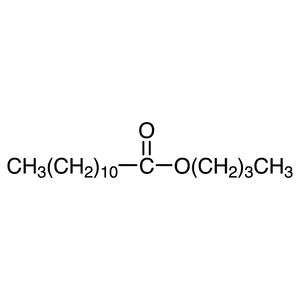
Butyl Laurate is an ester formed from lauric acid, a saturated twelve-carbon fatty acid, and n-butanol. The compound belongs to the group of medium-chain fatty acid esters that are widely used as non-heterocyclic building blocks in organic synthesis. In the laboratory, its roles include service as a model substrate for esterification and transesterification reactions, as a solvent and high-capacity carrier for lipophilic compounds, and as a comparison material in studies of lubricants and renewable-based plasticisers.
The properties that make Butyl Laurate a frequent choice are the combination of a long hydrocarbon chain with a relatively stable ester group, producing an oily liquid with low vapour pressure, a mild odour, and good lubricating behaviour. Unlike short-chain esters that evaporate readily, this ester persists at working temperatures without disappearing quickly, which makes it convenient for experiments that run for extended periods. Its good solubility in organic solvents and its insolubility in water also simplify phase separation during purification of reaction products.
In Indonesian laboratories, Butyl Laurate has a close connection to industry-oriented work, particularly where fatty acid esters derived from local raw materials are of interest. It is handled in academic, institutional, and industrial laboratories that carry out synthesis, formulation studies, and comparative evaluation of ester-based materials, where a stable and readily available medium-chain ester provides a practical reference point for experimental work.
TCI brochures (PDF)
- Lipids 2025-12-17 · p. 13
- Esterification reaction studies: it serves as a well-defined model ester product, allowing researchers to track conversion and compare reaction conditions using a compound with predictable behaviour.
- Transesterification research: its ester linkage between a twelve-carbon acid and a butyl group makes it a convenient substrate for examining alcohol exchange and catalyst performance in the laboratory.
- Solvent and carrier for lipophilic compounds: the long hydrocarbon chain dissolves non-polar substances effectively, supporting formulation trials where water-based solvents are unsuitable for the material.
- Lubricant evaluation work: the good lubricating character and low vapour pressure allow it to act as a reference liquid when comparing ester-based lubricant candidates under laboratory conditions.
- Plasticiser and renewable materials comparison: as a medium-chain fatty acid ester, it provides a baseline material for assessing renewable-based plasticiser alternatives against a stable, consistent standard.
| Brand | TCI |
|---|---|
| CAS number | 106-18-3 |
| Molecular formula | — |
| Purity | — |
| Category | Chemistry > Building Blocks > Non-Heterocyclic Building Blocks |
| Pack sizes | available in standard TCI laboratory packaging; please refer to the pack size options listed for this catalogue item |
| Physical form | oily liquid with a mild odour |
| Storage | keep in a tightly closed container in a cool, dry, well-ventilated place |
Store Butyl Laurate in its original tightly closed container in a cool, dry, and well-ventilated area, away from heat sources, open flames, and strong oxidising agents. Containers of glass or other chemically compatible material are suitable, and closures should be checked regularly to limit contamination and moisture uptake. Handle the material in a fume hood or in an adequately ventilated workspace, wearing safety goggles, gloves, and a laboratory coat. Because it is an oily liquid, spills can create slipping hazards and should be absorbed and cleaned up promptly. Always consult the manufacturer safety data sheet before use.
—
Produk Terkait
-
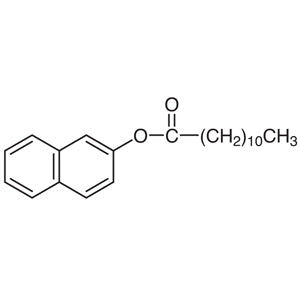
2-NaphthylLaurate TCI L0122
Regular price From Rp 1.696.800,00Regular price -
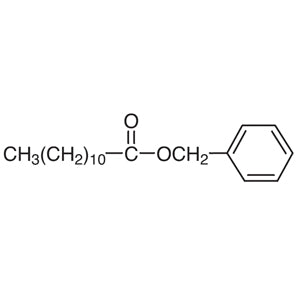
BenzylLaurate TCI L0107
Regular price Rp 2.174.550,00Regular price -
VinylLaurate(stabilizedwithMEHQ) TCI L0090
Regular price From Rp 557.550,00Regular price -
IsobutylLaurate TCI L0084
Regular price From Rp 769.650,00Regular price -
MethylLaurate TCI L0015
Regular price From Rp 505.050,00Regular price -
IsoamylLaurate TCI L0014
Regular price Rp 903.000,00Regular price -
EthylLaurate TCI L0013
Regular price From Rp 505.050,00Regular price -
AmylLaurate TCI L0012
Regular price From Rp 1.908.900,00Regular price