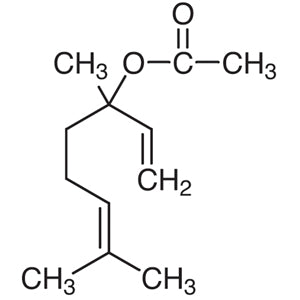
TCI L0049 Linalyl Acetate is the acetate ester of linalool, supplied as a liquid, and is one of the principal aroma components found in lavender oil and bergamot oil. The compound holds an important position both as an analytical standard and as a building block in organic synthesis. In the laboratory, linalyl acetate is frequently used to assess the quality and authenticity of essential oils, since the ratio of its content relative to linalool serves as one of the characteristic indicators routinely examined in commercial aromatic materials.
The characteristic that makes linalyl acetate a preferred choice is its stability, which is generally better than that of its parent alcohol, because the reactive tertiary hydroxyl group has been capped in ester form. Even so, the double bonds along its chain remain available for addition, oxidation, and cyclization reactions. Its ester group can be hydrolyzed or transesterified under controlled conditions, making it a good substrate for studying the kinetics of ester reactions. Its suitable volatility allows direct analysis by gas chromatography, while its soft, sweet aroma makes it a valuable sensory reference in aroma profile assessment.
In Indonesian laboratories, this material fits naturally into work on essential oils and aromatic raw materials, where authenticity checks and compositional profiling are routine concerns. It is used as a reference compound when analysts compare chromatographic results against expected component ratios, and as a starting material in synthetic work that requires a well-defined terpenoid ester. Academic, quality-control, and research settings that handle natural product analysis all find regular use for it.
TCI brochures (PDF)
- Terpenes 2025-09-22 · p. 3
- Essential oil authenticity testing: serves as a reference component because the ratio of linalyl acetate to linalool is a characteristic indicator commonly examined in commercial aromatic materials.
- Gas chromatography analysis: its volatility is suitable for direct GC analysis, allowing it to function as a dependable standard for identification and quantification in aroma component work.
- Organic synthesis building block: the double bonds along its chain remain available for addition, oxidation, and cyclization reactions, giving synthetic chemists a well-defined terpenoid starting point.
- Ester reaction kinetics studies: the ester group can be hydrolyzed or transesterified under controlled conditions, making it a good substrate for investigating reaction rates and mechanisms.
- Sensory profile assessment: its soft and sweet aroma makes it a valuable sensory reference when evaluating and comparing aroma profiles of natural and formulated materials.
| Brand | TCI |
|---|---|
| CAS number | 115-95-7 |
| Molecular formula | — |
| Purity | — |
| Category | Chemistry > Building Blocks > Non-Heterocyclic Building Blocks |
| Pack sizes | available in standard TCI catalogue pack sizes; please confirm the option required |
| Physical form | liquid |
| Storage | store in a tightly closed container, protected from light and heat |
Store linalyl acetate in a tightly closed container, kept away from direct light, heat, and ignition sources, and keep the original container sealed when not in active use to limit evaporation of this volatile liquid. Amber glass bottles with chemically resistant closures are appropriate, and the material should be returned to its designated storage location promptly after dispensing. Handle in a well-ventilated area or within a fume hood, wear standard laboratory personal protective equipment including gloves, safety glasses, and a laboratory coat, and avoid prolonged inhalation of vapours. Keep the compound separate from strong oxidizing agents and from strong acids or bases that could promote hydrolysis of the ester group. Consult the manufacturer's safety data sheet before first use.
—
Produk Terkait
-
NerylAcetate TCI N0463
Regular price Rp 1.060.500,00Regular price -
GeranylAcetate TCI G0028
Regular price From Rp 823.200,00Regular price -
LinalylPropionate TCI L0265
Regular price Rp 1.193.850,00Regular price -
BornylAcetate(containsca.20%IsobornylAcetate) TCI B0526
Regular price Rp 717.150,00Regular price -
TerpinylAcetate(mixtureofisomers) TCI T0023
Regular price From Rp 477.750,00Regular price -
(+/-)-MenthylAcetate TCI M3399
Regular price Rp 1.803.900,00Regular price -
Citral(cis-andtrans-mixture) TCI D0762
Regular price Rp 637.350,00Regular price -
CitronellicAcid TCI C1708
Regular price Rp 2.809.800,00Regular price