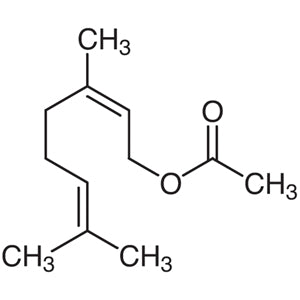
Neryl Acetate is a chemical compound widely used in laboratory settings for various chemical reactions and the synthesis of complex molecules. As a key building block in organic chemistry, it plays a crucial role in the development of other organic compounds due to its simple yet versatile molecular structure. Its presence in chemical synthesis allows researchers to create a wide range of functional derivatives, making it an essential reagent in both academic and industrial laboratories. This compound is particularly valuable for its ability to participate in ester hydrolysis, condensation, and other organic transformations, supporting the creation of more complex chemical structures.
Neryl Acetate is characterized by its volatile nature, colorless appearance, and liquid form, which make it suitable for reactions requiring controlled conditions. Its ester functional group enables it to react with acids, bases, and metals, enhancing its applicability across different chemical processes. These properties contribute to its flexibility and reliability in laboratory applications, allowing it to be used in diverse synthetic pathways. The compound’s stability and ease of handling further support its use in both routine and specialized chemical experiments.
In Indonesian laboratories, Neryl Acetate is commonly utilized in organic chemistry research, pharmaceutical development, and cosmetic ingredient production. Its availability and predictable behavior make it a practical choice for researchers and technicians working in educational institutions and industrial settings. The compound’s role in creating functional derivatives supports its continued use in the development of new chemical products and formulations. Its presence in laboratory workflows highlights its importance in advancing scientific and industrial applications in Indonesia.
- Organic Chemistry Research: Neryl Acetate is widely used in the synthesis of complex organic molecules due to its reactivity and versatility in chemical reactions.
- Pharmaceutical Development: It serves as a building block in the creation of pharmaceutical compounds, supporting the development of new drug formulations.
- Cosmetic Ingredient Production: The compound is utilized in the formulation of cosmetic products, contributing to the creation of fragrance and texture components.
- Analytical Chemistry: Its volatile nature makes it suitable for use in analytical techniques that require controlled evaporation or distillation processes.
- Industrial Chemical Synthesis: Neryl Acetate is employed in industrial settings for the production of various chemical intermediates and specialty products.
| Brand | TCI |
|---|---|
| CAS number | 141-12-8 |
| Molecular formula | — |
| Purity | — |
| Category | Chemistry > Building Blocks > Non-Heterocyclic Building Blocks |
| Pack sizes | Available in various quantities as per supplier specifications |
| Physical form | Liquid |
| Storage | Store in a cool, dry place away from direct sunlight and incompatible materials |
Neryl Acetate should be stored in a cool, dry environment, away from direct sunlight and sources of heat. It is recommended to keep the compound in a tightly sealed container to prevent evaporation and contamination. Due to its volatile nature, it should be stored in a well-ventilated area to minimize exposure to airborne vapors. Avoid contact with strong acids or bases, as these can cause chemical reactions. Always use appropriate personal protective equipment, such as gloves and safety goggles, when handling the compound. Proper storage ensures the stability and safety of the material in laboratory settings.
—
Produk Terkait
-
TCI B5774 5,10-Bis(4,4,5,5-tetramethyl-1,3,2-dioxaborolan-2-yl)naphtho[1,2-c:5,6-c']bis([1,2,5]oxadiazole)
Regular price Rp 10.255.350,00Regular price -
Dihydroiodide TCI B6569
Regular price From Rp 1.936.200,00Regular price -
Trifluoromethanesulfonate TCI B7003
Regular price From Rp 1.936.200,00Regular price
![5,10-Bis(4,4,5,5-tetramethyl-1,3,2-dioxaborolan-2-yl)naphtho[1,2-c:5,6-c']bis([1,2,5]oxadiazole) - TCI B5774 - AMI Scientific](http://amiscientific.com/cdn/shop/files/TCI2510B5774.jpg?v=1769180228&width=533)