

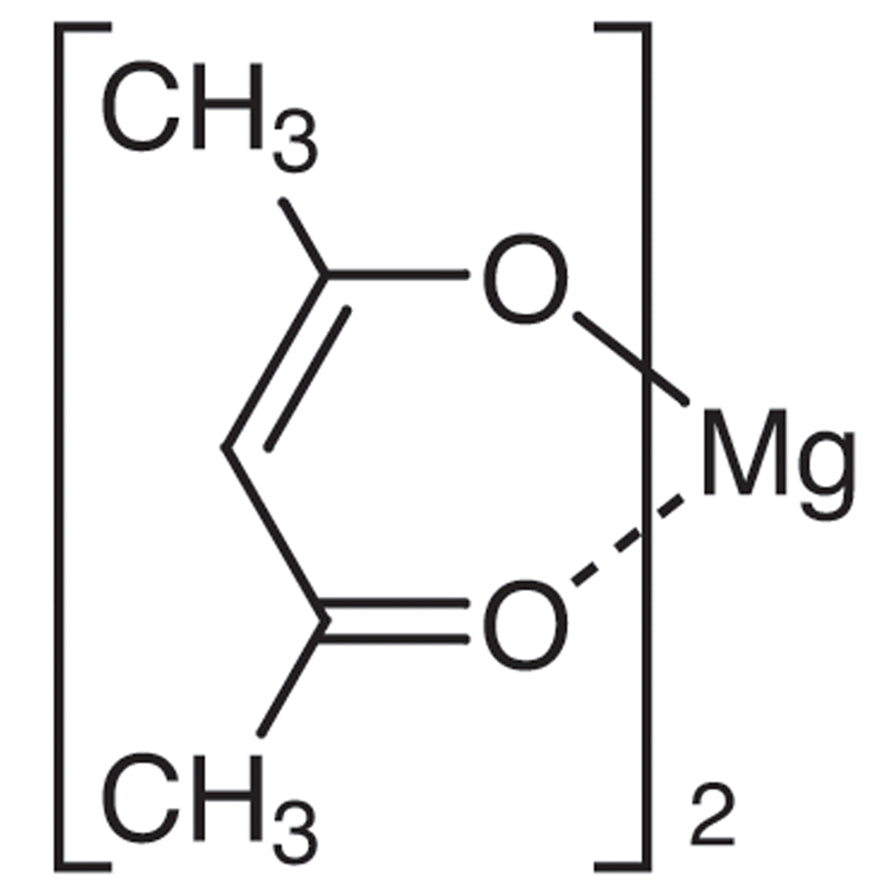
Bis(2,4-pentanedionato)magnesium(II) is an organometallic compound widely used in chemical reactions, particularly in catalysis and inorganic chemistry. This compound plays a crucial role in laboratory settings by acting as a catalyst in various organic reactions that require electronic or structural activation. Its unique structure, consisting of a magnesium ion coordinated by two molecules of 2,4-pentanedionate, makes it highly effective in facilitating chemical transformations. It is especially valuable in research involving transition metals as activation centers, where its reactivity and ability to interact with diverse substrates are essential.
The compound is preferred due to its chemical stability under specific conditions and its ability to participate in complex reactions. Its reactivity and sensitivity to moisture and air make it a versatile yet carefully handled material. The complex structure allows it to be an effective catalyst in reactions requiring metal-based activation, making it a key component in advanced chemical research. Its availability in solid form and ease of suspension make it suitable for use in a wide range of experimental scales.
In Indonesian laboratories, this compound is commonly used in organic and inorganic chemistry research, especially in catalysis and the synthesis of complex compounds. Its ability to function as a catalyst in various reactions makes it a preferred choice for researchers working on advanced chemical processes. The compound is frequently utilized in academic and industrial settings where precise and efficient catalytic activity is required.
Related TCI products
- TCI Z0002 14024-63-6 Bis(2,4-pentanedionato)zinc(II)
- TCI T3652 14405-43-7 Tris(2,4-pentanedionato)gallium(III)
- TCI T0650 16919-46-3 Bis(2,4-pentanedionato)tin(IV) Dichloride
- TCI L0080 18115-70-3 (2,4-Pentanedionato)lithium
- TCI I0020 14405-45-9 Tris(2,4-pentanedionato)indium(III)
- TCI C0930 19372-44-2 Bis(2,4-pentanedionato)calcium(II)
- Catalytic Reactions: This compound is ideal for catalytic processes due to its ability to activate substrates through metal-based mechanisms, enhancing reaction efficiency.
- Organic Synthesis: It is widely used in organic synthesis to facilitate complex transformations, particularly in reactions requiring electronic or structural activation.
- Inorganic Chemistry Research: Its role in inorganic chemistry is significant, especially in reactions involving transition metal centers and complex coordination structures.
- Transition Metal Activation Studies: The compound is often employed in studies focused on transition metal activation, where its reactivity and coordination properties are essential.
- Complex Compound Synthesis: It is a key reagent in the synthesis of complex compounds, where its unique structure and reactivity contribute to the formation of desired products.
| Brand | TCI |
|---|---|
| CAS number | 14024-56-7 |
| Molecular formula | — |
| Purity | — |
| Category | Chemistry > Catalysis and Inorganic Chemistry > Main-group Elements [Catalysis and Inorganic Chemistry] |
| Pack sizes | Available in various pack sizes as per standard laboratory supply |
| Physical form | Solid |
| Storage | Store in a dry, cool place away from moisture and air |
This compound should be stored in a dry, cool environment to prevent degradation due to its sensitivity to moisture and air. It is recommended to use airtight containers to minimize exposure to humidity and atmospheric gases. Laboratory personnel should handle the material with care, using appropriate personal protective equipment to ensure safety. The compound should be kept away from incompatible substances to avoid any potential chemical interactions. Proper storage conditions are essential to maintain its chemical stability and effectiveness in catalytic applications. Regular monitoring of storage conditions is advised to ensure optimal performance and safety in laboratory settings.
—
Produk Terkait
-
Bis(2,4-pentanedionato)zinc(II) TCI Z0002
Regular price From Rp 2.782.500,00Regular priceRp 1.945.650,00Sale price From Rp 2.782.500,00 -
Tris(2,4-pentanedionato)gallium(III) TCI T3652
Regular price From Rp 1.856.400,00Regular priceRp 1.297.800,00Sale price From Rp 1.856.400,00 -
Bis(2,4-pentanedionato)tin(IV)Dichloride TCI T0650
Regular price Rp 9.116.100,00Regular priceRp 6.374.550,00Sale price Rp 9.116.100,00 -
(2,4-Pentanedionato)lithium TCI L0080
Regular price Rp 1.565.550,00Regular priceRp 1.094.100,00Sale price Rp 1.565.550,00 -
Tris(2,4-pentanedionato)indium(III) TCI I0020
Regular price Rp 3.472.350,00Regular priceRp 2.427.600,00Sale price Rp 3.472.350,00 -
Bis(2,4-pentanedionato)calcium(II) TCI C0930
Regular price Rp 1.538.250,00Regular priceRp 1.075.200,00Sale price Rp 1.538.250,00 -
Tris(2,4-pentanedionato)aluminum(III) TCI A0241
Regular price From Rp 689.850,00Regular priceRp 481.950,00Sale price From Rp 689.850,00 -
Tetrakis(2,4-pentanedionato)zirconium(IV) TCI Z0006
Regular price From Rp 1.353.450,00Regular priceRp 946.050,00Sale price From Rp 1.353.450,00


