

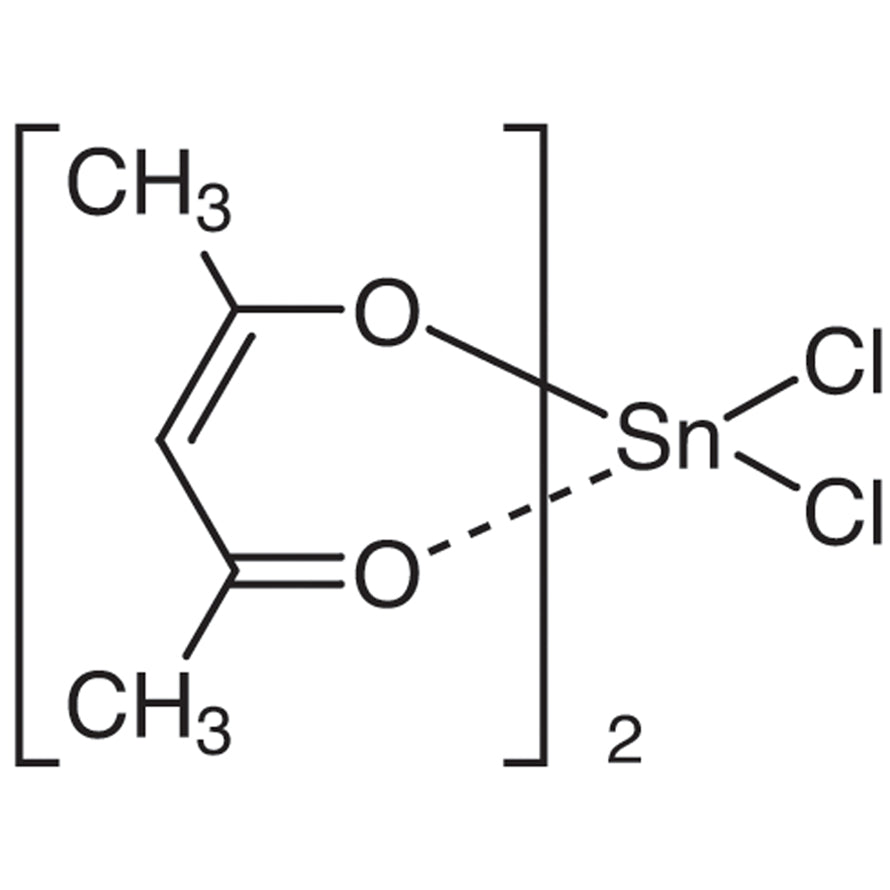
Bis(2,4-pentanedionato)tin(IV) dichloride is a chemical compound widely used in laboratory settings, particularly in catalytic and inorganic chemistry applications. As a tin-based complex, it plays a crucial role in facilitating chemical reactions by acting as a catalyst. Its unique structure allows it to interact effectively with various substrates, making it a valuable tool for researchers. This compound is commonly employed in synthetic processes where metal activation is required, contributing to the efficiency and selectivity of chemical transformations. Its versatility makes it a preferred choice for both organic and inorganic chemical studies.
The compound is known for its high reactivity and stability under controlled conditions, which are essential for maintaining the integrity of chemical reactions. Its complex structure enables it to participate in multiple reaction mechanisms, enhancing its utility in diverse experimental setups. Additionally, its chemical properties make it suitable for use in a wide range of laboratory applications, from basic research to advanced synthetic processes. The compound’s ability to remain stable in certain environments while being sensitive to moisture and oxidation further highlights its importance in controlled chemical environments.
In Indonesian laboratories, this compound is frequently used in chemical research, especially in catalysis and organic synthesis. Its role in activating metal-based reactions has made it a standard component in many research protocols. Due to its high purity and consistent performance, it is trusted for experiments requiring precision and reliability. Its application in both academic and industrial research settings underscores its significance in the chemical sciences.
Related TCI products
- TCI Z0002 14024-63-6 Bis(2,4-pentanedionato)zinc(II)
- TCI T3652 14405-43-7 Tris(2,4-pentanedionato)gallium(III)
- TCI M0001 14024-56-7 Bis(2,4-pentanedionato)magnesium(II)
- TCI L0080 18115-70-3 (2,4-Pentanedionato)lithium
- TCI I0020 14405-45-9 Tris(2,4-pentanedionato)indium(III)
- TCI C0930 19372-44-2 Bis(2,4-pentanedionato)calcium(II)
- Catalytic Reactions: This compound is ideal for catalytic processes due to its ability to activate metal-based reactions, enhancing reaction efficiency and selectivity.
- Organic Synthesis: It is widely used in organic synthesis for its capacity to facilitate complex chemical transformations with high yield and purity.
- Inorganic Chemistry Research: Its unique structure makes it a valuable tool for studying inorganic reactions and metal-based compounds.
- Metal Activation Studies: The compound is frequently employed in experiments that require the activation of metal catalysts for various chemical processes.
- Analytical Chemistry: It serves as a reagent in analytical procedures where precise metal ion interactions are required for accurate results.
| Brand | TCI |
|---|---|
| CAS number | 16919-46-3 |
| Molecular formula | — |
| Purity | — |
| Category | Chemistry > Catalysis and Inorganic Chemistry > Main-group Elements |
| Pack sizes | Available in various quantities as per supplier specifications |
| Physical form | Solid |
| Storage | Store in a dry, cool place away from moisture and oxidizing agents |
This compound should be stored in a dry, cool environment to prevent degradation due to moisture and oxidation. It is recommended to use airtight containers made of materials that do not react with the compound, such as glass or high-density polyethylene. Laboratory personnel should handle the material with care, using appropriate personal protective equipment to avoid direct contact. Due to its reactivity, it should be kept away from incompatible substances and stored in a well-ventilated area. Regular monitoring of storage conditions is essential to maintain its chemical integrity and ensure safe handling in laboratory settings.
—
Produk Terkait
-
Bis(2,4-pentanedionato)zinc(II) TCI Z0002
Regular price From Rp 2.782.500,00Regular priceRp 1.945.650,00Sale price From Rp 2.782.500,00 -
Tris(2,4-pentanedionato)gallium(III) TCI T3652
Regular price From Rp 1.856.400,00Regular priceRp 1.297.800,00Sale price From Rp 1.856.400,00 -
Bis(2,4-pentanedionato)magnesium(II) TCI M0001
Regular price Rp 980.700,00Regular priceRp 685.650,00Sale price Rp 980.700,00 -
(2,4-Pentanedionato)lithium TCI L0080
Regular price Rp 1.565.550,00Regular priceRp 1.094.100,00Sale price Rp 1.565.550,00 -
Tris(2,4-pentanedionato)indium(III) TCI I0020
Regular price Rp 3.472.350,00Regular priceRp 2.427.600,00Sale price Rp 3.472.350,00 -
Bis(2,4-pentanedionato)calcium(II) TCI C0930
Regular price Rp 1.538.250,00Regular priceRp 1.075.200,00Sale price Rp 1.538.250,00 -
Tris(2,4-pentanedionato)aluminum(III) TCI A0241
Regular price From Rp 689.850,00Regular priceRp 481.950,00Sale price From Rp 689.850,00 -
Tetrakis(2,4-pentanedionato)zirconium(IV) TCI Z0006
Regular price From Rp 1.353.450,00Regular priceRp 946.050,00Sale price From Rp 1.353.450,00


