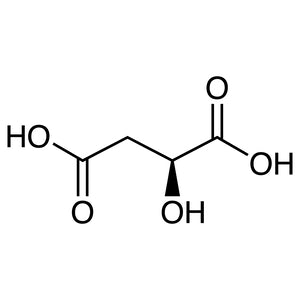
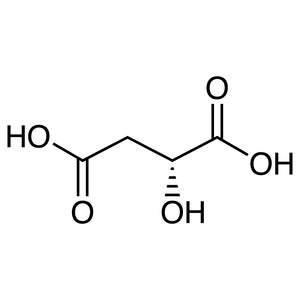
L-(-)-Malic Acid is a chiral organic compound widely utilized in chemical applications, particularly in asymmetric synthesis. It plays a crucial role in laboratories where the development of chiral compounds is essential. This compound is a fundamental building block in the synthesis of molecules with specific biological activities, making it indispensable in pharmaceutical research and development. Its unique molecular structure allows for precise control over stereochemistry, which is vital in creating active pharmaceutical ingredients with desired properties.
L-(-)-Malic Acid is favored for its high purity, stable physical and chemical properties, and compatibility with various reagents under controlled conditions. These characteristics ensure consistent performance in experimental settings, making it a reliable choice for researchers. Its availability in multiple packaging formats further enhances its usability across different experimental scales. The compound’s reliability and consistency make it a preferred material for those requiring high-quality reagents in their work.
In Indonesian laboratories, L-(-)-Malic Acid is commonly used in pharmacological, organic chemistry, and complex compound synthesis research. It supports academic and industrial applications, contributing to both education and innovation. Its relevance in these contexts underscores its importance as a key reagent in modern chemical research and development efforts.
- Asymmetric Synthesis: L-(-)-Malic Acid is ideal for asymmetric synthesis due to its chiral structure, enabling the creation of enantiomerically pure compounds essential in pharmaceutical development.
- Pharmaceutical Research: Its use in drug development allows for the synthesis of active pharmaceutical ingredients with specific stereochemical configurations.
- Organic Chemistry Experiments: The compound is widely used in organic chemistry for its reactivity and compatibility with various reagents, supporting a range of synthetic pathways.
- Educational Purposes: It is a valuable teaching tool in academic settings, helping students understand chiral synthesis and stereochemistry principles.
- Complex Compound Synthesis: Its role in creating complex molecules with defined stereochemistry makes it a key component in advanced chemical research.
| Brand | TCI |
|---|---|
| CAS number | 97-67-6 |
| Molecular formula | — |
| Purity | — |
| Category | Chemistry > Asymmetric Synthesis > Chiral Building Blocks |
| Pack sizes | Available in multiple packaging formats for different experimental needs |
| Physical form | Solid |
| Storage | Store in a cool, dry place away from moisture and direct sunlight |
L-(-)-Malic Acid should be stored in a cool, dry environment to maintain its stability and purity. It is recommended to keep the compound in airtight containers to prevent moisture absorption, which could affect its quality. Avoid exposure to direct sunlight and high humidity to ensure long-term stability. When handling, use appropriate personal protective equipment such as gloves and safety goggles to prevent skin contact or inhalation. The compound is generally non-hazardous but should be handled with care in a well-ventilated area. Proper storage and handling practices help preserve its chemical integrity and ensure safe usage in laboratory settings.
—
Produk Terkait
-
D-(+)-MalicAcid TCI M0021
Regular price From Rp 717.150,00Regular price -
(-)-O-Acetyl-L-malicAnhydride TCI A1101
Regular price From Rp 1.140.300,00Regular price -
DL-MalicAcid TCI M0020
Regular price From Rp 477.750,00Regular price -
DimethylD-(-)-Tartrate TCI T1659
Regular price From Rp 584.850,00Regular price -
(S)-(+)-2,2,2-Trifluoro-1-(9-anthryl)ethanol[eeDeterminationReagentbyNMR] TCI T1521
Regular price From Rp 1.644.300,00Regular price -
(R)-(-)-2,2,2-Trifluoro-1-(9-anthryl)ethanol[e.e.DeterminationReagentbyNMR] TCI T1520
Regular price Rp 2.571.450,00Regular price -
DiisopropylD-(-)-Tartrate TCI T1387
Regular price From Rp 1.881.600,00Regular price -
DiethylD-(-)-Tartrate TCI T1195
Regular price From Rp 1.115.100,00Regular price

![60646-30-2 (S)-(+)-2,2,2-Trifluoro-1-(9-anthryl)ethanol [e.e. Determination Reagent by NMR] - AMI Scientific](http://amiscientific.com/cdn/shop/files/TCI2510T1521.jpg?v=1767141776&width=533)
![60646-30-2 (S)-(+)-2,2,2-Trifluoro-1-(9-anthryl)ethanol [e.e. Determination Reagent by NMR] - AMI Scientific](http://amiscientific.com/cdn/shop/files/TCI2510T1521_7c166274-ef1b-4925-8be6-53863c4594b4.jpg?v=1772424133&width=533)
![53531-34-3 (R)-(-)-2,2,2-Trifluoro-1-(9-anthryl)ethanol [e.e. Determination Reagent by NMR] - AMI Scientific](http://amiscientific.com/cdn/shop/files/TCI2510T1520.jpg?v=1767141772&width=533)