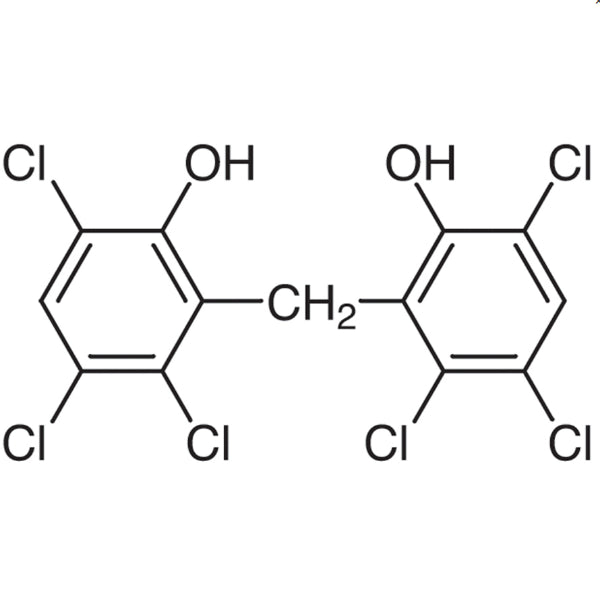
TCI M0219 Hexachlorophene is a chlorinated bisphenol compound supplied as a crystalline powder and widely recognised as a classical antibacterial agent, particularly against Gram-positive bacteria. Within this catalogue the compound is positioned as a pharmaceutical research reagent intended strictly for experimental use, not for clinical application or consumption. In the laboratory it serves as a reference compound in antimicrobial activity testing, as a study material for investigating the mode of action of phenolic compounds, and as a probe for tracing biochemical pathways that are sensitive to disruption of the cell membrane.
The property that makes this material an attractive research reagent is its bisphenol structure carrying six chlorine atoms, which renders the molecule strongly lipophilic. That lipophilicity allows it to insert readily into cell membranes and to interfere with the function of the electron transport chain in microorganisms. The strength of this effect means the compound is frequently employed as a pharmacological tool for studying the uncoupling of oxidative phosphorylation and the disruption of mitochondrial membrane potential. Its phenolic groups additionally confer hydrogen-donating ability, making the compound relevant to antioxidant studies and to structure-activity relationship work across the bisphenol series.
In Indonesia this reagent is generally used within academic and institutional research settings, where it supports laboratory work in microbiology, biochemistry and pharmaceutical science. It is handled as an experimental-use research chemical rather than as a formulation ingredient, and is typically requested by university laboratories, research institutes and analytical facilities that require a well-characterised reference material from an established catalogue source for comparative antimicrobial and mechanistic studies.
TCI brochures (PDF)
- Pharmaceutical Ingredients for Research and Experimental Use 2026-03-09 · p. 46
- Antimicrobial activity testing — used as a comparison compound against Gram-positive bacteria, giving researchers a well-characterised classical antibacterial benchmark for evaluating new candidate compounds.
- Mode-of-action studies of phenolic compounds — its well-documented behaviour as a chlorinated bisphenol makes it a suitable model for investigating how phenolic structures interact with bacterial targets.
- Membrane disruption research — the highly lipophilic molecule inserts readily into cell membranes, making it a practical tool for tracing biochemical pathways sensitive to membrane integrity loss.
- Oxidative phosphorylation uncoupling studies — the compound is frequently applied as a pharmacological tool to examine uncoupling behaviour and the loss of mitochondrial membrane potential.
- Antioxidant and structure-activity relationship studies — the hydrogen-donating capacity of its phenolic groups supports comparative work across bisphenol compounds and their relative activity profiles.
| Brand | TCI |
|---|---|
| CAS number | 70-30-4 |
| Molecular formula | — |
| Purity | — |
| Category | Life Science > Biochemicals and Reagents > Pharmaceutical Research Reagents (for Experimental Use) |
| Pack sizes | available in standard catalogue pack sizes; please confirm the currently listed option when ordering |
| Physical form | crystalline powder |
| Storage | store in a tightly closed container in a cool, dry and well-ventilated area |
- Catalogue number: M0219
Store the container tightly closed in a cool, dry and well-ventilated place, away from direct sunlight, heat sources and incompatible materials. Original supplier packaging or a clean, chemically resistant and clearly labelled container is recommended for storage and for any working aliquots. Handle only in a properly ventilated laboratory area, preferably within a fume hood, and use appropriate personal protective equipment including gloves, safety goggles and a laboratory coat. Avoid generating dust when weighing the crystalline powder, and avoid contact with skin and eyes. This material is designated for experimental laboratory use only and must not be used for clinical purposes or consumption. Consult the manufacturer's safety data sheet before use, and dispose of residues and contaminated materials in accordance with applicable laboratory waste procedures.
—
Product Categories
Produk Terkait
-
AmmoniumHexachloroplatinate(IV) TCI A3667
Regular price Rp 5.672.100,00Regular price -
HydrogenHexachloroplatinate(IV)Hexahydrate TCI H1287
Regular price Rp 2.969.400,00Regular price -
Ibudilast TCI I0740
Regular price From Rp 1.908.900,00Regular price -
IvabradineHydrochloride TCI I0847
Regular price From Rp 4.611.600,00Regular price -
Carbazochrome TCI A0176
Regular price From Rp 2.227.050,00Regular price -
L-Adrenaline TCI A0173
Regular price Rp 1.298.850,00Regular price -
Zonisamide TCI Z0026
Regular price From Rp 2.147.250,00Regular price -
Xipamide TCI X0079
Regular price Rp 5.114.550,00Regular price