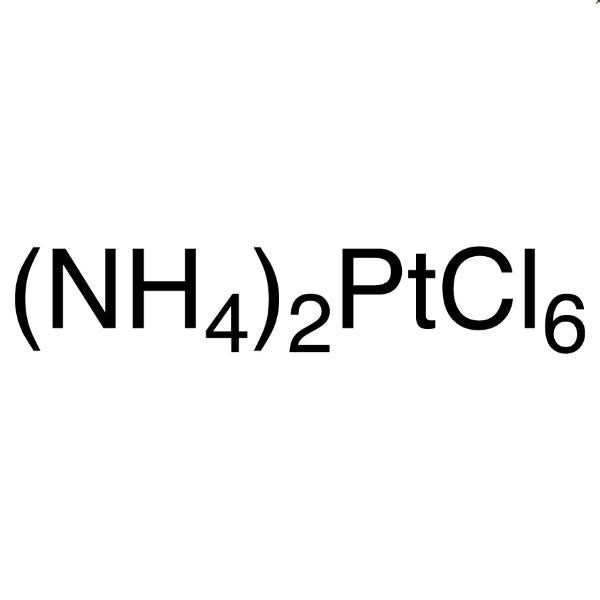
Ammonium Hexachloroplatinate(IV) is a chemical compound widely used in catalytic reactions and organic synthesis within laboratory settings. This compound is a complex salt containing platinum(IV) ions coordinated with chloride ions and ammonium ions. It plays a crucial role in activating chemical reactions that require high catalytic efficiency, particularly in oxidation and reduction processes. Its unique structure allows it to interact effectively with various substrates, making it a versatile tool for chemists working in both inorganic and catalytic research.
The compound is valued for its chemical stability under controlled conditions and its reactivity in aqueous environments. These properties make it an ideal choice for applications where precise control over reaction conditions is essential. Its ability to act as a catalyst in a wide range of chemical transformations has made it a preferred material in both academic and industrial research. Additionally, its compatibility with various reaction systems enhances its utility in laboratory experiments.
In Indonesian laboratories, Ammonium Hexachloroplatinate(IV) is commonly used in academic and research institutions focused on inorganic chemistry and catalysis. It is particularly popular in studies involving metal-based catalysts and in the development of new chemical compounds. Its availability through reliable suppliers like AMI Scientific ensures that researchers have access to this essential material for their experiments.
TCI brochures (PDF)
- Transition Metal Catalysts 2026-04-10 · p. 15
Related TCI products
- TCI H1287 18497-13-7 Hydrogen Hexachloroplatinate(IV) Hexahydrate
- TCI A3668 13820-41-2 Ammonium Tetrachloroplatinate(II)
- TCI M0219 70-30-4 Hexachlorophene
- TCI T2485 14221-02-4 Tetrakis(triphenylphosphine)platinum(0)
- TCI B3115 15170-57-7 Bis(2,4-pentanedionato)platinum(II)
- TCI P3306 7440-06-4 Platinum 5% on Carbon (wetted with ca 55% Water)
- Catalytic Oxidation Reactions: This compound is highly effective in promoting oxidation processes due to its ability to activate electron transfer pathways, making it ideal for oxidation reactions in organic synthesis.
- Reductive Processes: Its reactivity allows it to facilitate reduction reactions, particularly in the synthesis of complex organic molecules where controlled electron transfer is required.
- Inorganic Chemistry Research: It is a key reagent in studies involving transition metals, especially in the investigation of platinum-based compounds and their reactivity.
- Metal-Based Catalyst Development: Its role as a metal complex makes it a valuable tool in the design and testing of new catalysts for industrial and academic applications.
- Analytical Chemistry Applications: It is used in analytical techniques where the presence of platinum compounds needs to be detected or quantified in various chemical matrices.
| Brand | TCI |
|---|---|
| CAS number | 16919-58-7 |
| Molecular formula | — |
| Purity | — |
| Category | Chemistry > Catalysis and Inorganic Chemistry > Transition Elements |
| Pack sizes | Available in various quantities as per supplier specifications |
| Physical form | Solid powder |
| Storage | Store in a cool, dry place away from moisture and direct light |
Ammonium Hexachloroplatinate(IV) should be stored in a cool, dry environment to maintain its chemical stability. It is recommended to keep it in airtight containers to prevent exposure to moisture, which can affect its reactivity. Due to its potential reactivity with water, it should be handled in a well-ventilated area to minimize any risk of inhalation. Laboratory personnel should wear appropriate personal protective equipment, such as gloves and safety goggles, when handling this compound. It is important to avoid contact with skin and eyes, and to ensure that spillage is promptly cleaned up using suitable safety protocols. Proper storage and handling practices ensure the safety of both the material and the laboratory environment.
—
Produk Terkait
-
HydrogenHexachloroplatinate(IV)Hexahydrate TCI H1287
Regular price Rp 3.021.900,00Regular priceRp 2.128.350,00Sale price Rp 3.021.900,00 -
AmmoniumTetrachloroplatinate(II) TCI A3668
Regular price Rp 5.221.650,00Regular priceRp 3.666.600,00Sale price Rp 5.221.650,00 -
Hexachlorophene TCI M0219
Regular price From Rp 1.724.100,00Regular priceRp 1.205.400,00Sale price From Rp 1.724.100,00 -
Tetrakis(triphenylphosphine)platinum(0) TCI T2485
Regular price Rp 3.180.450,00Regular priceRp 2.239.650,00Sale price Rp 3.180.450,00 -
Bis(2,4-pentanedionato)platinum(II) TCI B3115
Regular price From Rp 5.352.900,00Regular priceRp 3.759.000,00Sale price From Rp 5.352.900,00 -
Platinum5%onCarbon(wettedwithca55%Water) TCI P3306
Regular price From Rp 2.650.200,00Regular priceRp 1.853.250,00Sale price From Rp 2.650.200,00 -
Platinum3%onCarbon(wettedwithca55%Water)(ModifiedbySulfur) TCI P3305
Regular price From Rp 3.100.650,00Regular priceRp 2.168.250,00Sale price From Rp 3.100.650,00 -
Platinum2%onCarbon(wettedwithca55%Water) TCI P3304
Regular price From Rp 2.174.550,00Regular priceRp 1.520.400,00Sale price From Rp 2.174.550,00