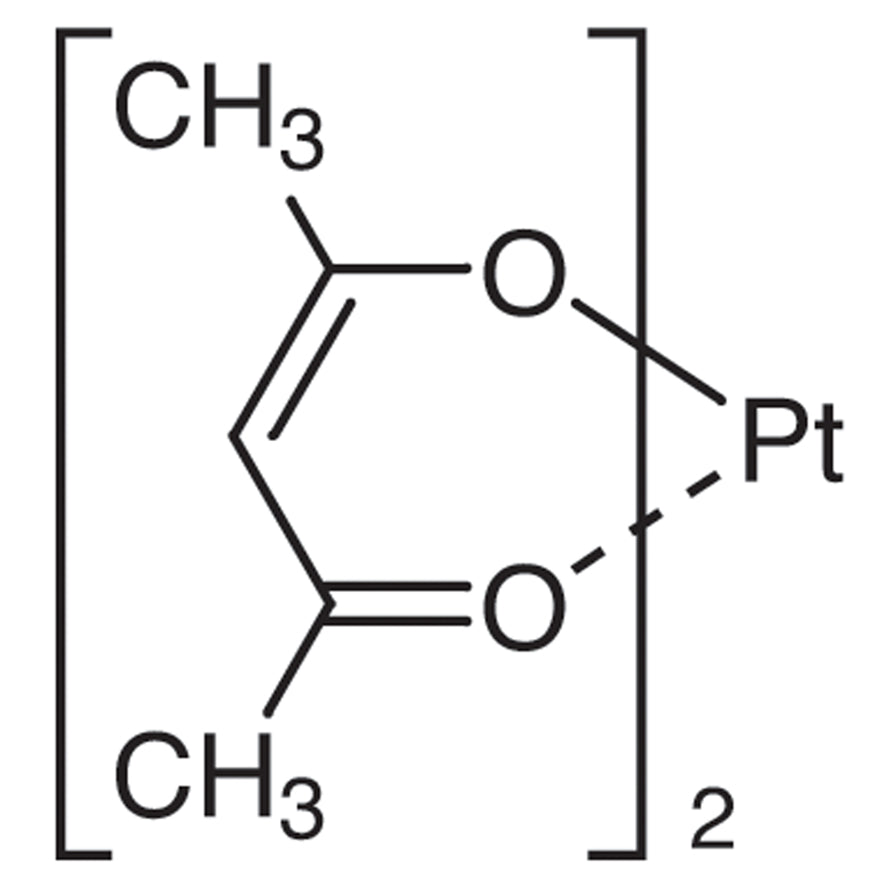
Bis(2,4-pentanedionato)platinum(II) is a chemical compound widely used in catalytic reactions and organic synthesis within laboratory settings. This compound serves as a transition metal complex, featuring a platinum(II) ion coordinated by two molecules of 2,4-pentanedionate. Its role in the laboratory is primarily catalytic, where it facilitates chemical reactions by lowering activation energy without being consumed in the process. This makes it an essential tool for researchers aiming to enhance reaction efficiency and reduce material waste.
The compound's unique properties, including its chemical stability under controlled conditions and its sensitivity to moisture and oxidation, make it a preferred choice for precise catalytic applications. Its complex structure provides stability against unwanted chemical reactions, ensuring consistent performance in various experimental setups. Additionally, its ability to bind with a wide range of substrates allows for versatile use across different chemical fields. These characteristics contribute to its reliability and effectiveness in laboratory environments.
In Indonesian laboratories, this compound is commonly used in organic chemistry research, catalysis studies, and the synthesis of various chemical compounds. Its role in accelerating reactions while maintaining selectivity is crucial for achieving desired outcomes in chemical processes. Researchers in Indonesia rely on this compound for its predictable behavior and compatibility with a broad range of experimental conditions.
TCI brochures (PDF)
- Transition Metal Catalysts 2026-04-10 · p. 15
Related TCI products
- TCI T2485 14221-02-4 Tetrakis(triphenylphosphine)platinum(0)
- TCI P3306 7440-06-4 Platinum 5% on Carbon (wetted with ca 55% Water)
- TCI P3305 7440-06-4 Platinum 3% on Carbon (wetted with ca 55% Water) (Modified by Sulfur)
- TCI P3304 7440-06-4 Platinum 2% on Carbon (wetted with ca 55% Water)
- TCI P3140 13454-96-1 Platinum(IV) Chloride
- TCI P2075 68478-92-2 Platinum(0) - 1,3-Divinyltetramethyldisiloxane Complex (19.0-21.5% as Pt) (contains 1,3-Divinyltetramethyldisiloxane)
- Organic synthesis reactions benefit from this compound's ability to activate electron-deficient substrates, enhancing reaction rates and selectivity.
- Catalytic oxidation processes utilize its redox properties to facilitate the conversion of organic compounds under controlled conditions.
- Transition metal-based catalysis applications leverage its stable complex structure for consistent performance in multi-step reactions.
- Heterogeneous catalytic systems incorporate it for its capacity to interact with various substrates, improving reaction efficiency.
- Analytical chemistry procedures use it as a reference material to study reaction mechanisms and catalytic behavior under different conditions.
| Brand | TCI |
|---|---|
| CAS number | 15170-57-7 |
| Molecular formula | — |
| Purity | — |
| Category | Chemistry > Catalysis and Inorganic Chemistry > Transition Elements [Catalysis and Inorganic Chemistry] |
| Pack sizes | Available in various quantities as per standard laboratory supply |
| Physical form | Solid powder |
| Storage | Store in a dry, cool, and dark place away from moisture and oxidizing agents |
This compound should be stored in a dry, cool, and dark environment to prevent degradation due to moisture and oxidation. It is recommended to use airtight containers made of glass or inert materials to minimize exposure to air and humidity. Laboratory personnel should handle the compound with care, using appropriate personal protective equipment such as gloves and safety goggles. Avoid contact with water or strong oxidizing agents to maintain its chemical integrity. Proper labeling and storage conditions are essential to ensure the compound remains effective for its intended applications.
—
Produk Terkait
-
Tetrakis(triphenylphosphine)platinum(0) TCI T2485
Regular price Rp 3.180.450,00Regular priceRp 2.239.650,00Sale price Rp 3.180.450,00 -
Platinum5%onCarbon(wettedwithca55%Water) TCI P3306
Regular price From Rp 2.650.200,00Regular priceRp 1.853.250,00Sale price From Rp 2.650.200,00 -
Platinum3%onCarbon(wettedwithca55%Water)(ModifiedbySulfur) TCI P3305
Regular price From Rp 3.100.650,00Regular priceRp 2.168.250,00Sale price From Rp 3.100.650,00 -
Platinum2%onCarbon(wettedwithca55%Water) TCI P3304
Regular price From Rp 2.174.550,00Regular priceRp 1.520.400,00Sale price From Rp 2.174.550,00 -
Platinum(IV)Chloride TCI P3140
Regular price From Rp 2.332.050,00Regular priceRp 1.646.400,00Sale price From Rp 2.332.050,00 -
Platinum(0)-1,3-DivinyltetramethyldisiloxaneComplex(19.0-21.5%asPt)(contains1,3-Divinyltetramethyldisiloxane) TCI P2075
Regular price From Rp 3.472.350,00Regular priceRp 2.443.350,00Sale price From Rp 3.472.350,00 -
Platinum(II)Chloride TCI P1920
Regular price Rp 4.531.800,00Regular priceRp 3.184.650,00Sale price Rp 4.531.800,00 -
Platinum(IV)Oxide TCI P1720
Regular price Rp 1.563.450,00Regular priceRp 1.108.800,00Sale price Rp 1.563.450,00