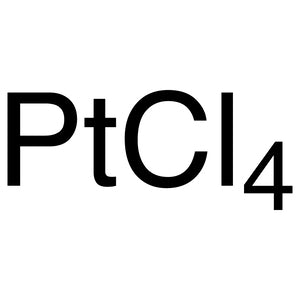
Platinum(IV) Chloride (TCI P3140), with the CAS number 13454-96-1, is a chemical compound widely utilized in laboratory settings for its catalytic properties. It plays a crucial role in various chemical reactions, especially in the fields of catalysis and inorganic chemistry. As a transition metal compound, it is particularly effective in oxidation and reduction reactions, making it a valuable tool for researchers aiming to accelerate chemical processes without being consumed in the final reaction. Its presence in the laboratory is essential for those working on complex chemical transformations and analytical procedures.
The compound is known for its high reactivity and stability in molecular structure, which makes it a preferred choice for many chemical applications. Its pale yellowish-white appearance and hygroscopic nature contribute to its sensitivity towards moisture and oxygen, requiring careful handling. These characteristics ensure that it remains effective in controlled environments, where precise conditions are necessary for successful chemical outcomes. Its ability to act as a catalyst without being consumed in the reaction makes it highly sought after in both academic and industrial research settings.
In Indonesian laboratories, Platinum(IV) Chloride is commonly used in chemical research, particularly in catalytic processes and analytical chemistry. Its availability and adherence to international quality standards make it a preferred material for scientists and researchers. Its role in facilitating chemical reactions and supporting analytical techniques underscores its importance in the scientific community, especially in the context of Indonesian academic and research institutions.
TCI brochures (PDF)
- Metallic Salts 2025-11-06 · p. 4
- Transition Metal Catalysts 2026-04-10 · p. 15
Related TCI products
- TCI P1920 10025-65-7 Platinum(II) Chloride
- TCI P1720 1314-15-4 Platinum(IV) Oxide
- TCI T2485 14221-02-4 Tetrakis(triphenylphosphine)platinum(0)
- TCI B3115 15170-57-7 Bis(2,4-pentanedionato)platinum(II)
- TCI P3306 7440-06-4 Platinum 5% on Carbon (wetted with ca 55% Water)
- TCI P3305 7440-06-4 Platinum 3% on Carbon (wetted with ca 55% Water) (Modified by Sulfur)
- Catalytic Oxidation Reactions – Platinum(IV) Chloride is ideal for oxidation processes due to its ability to facilitate electron transfer and enhance reaction rates without being consumed.
- Inorganic Synthesis – Its transition metal properties make it suitable for synthesizing complex inorganic compounds, offering stability and reactivity in controlled environments.
- Analytical Chemistry – The compound is used in analytical procedures for its ability to act as a catalyst in detection and quantification methods, enhancing accuracy and efficiency.
- Redox Reactions – Its high reactivity allows it to participate in redox processes, making it a valuable tool in studying electron transfer mechanisms and reaction pathways.
- Industrial Catalysis – It is applied in industrial settings where efficient and stable catalysts are required, supporting large-scale chemical production and process optimization.
| Brand | TCI |
|---|---|
| CAS number | 13454-96-1 |
| Molecular formula | — |
| Purity | — |
| Category | Chemistry > Catalysis and Inorganic Chemistry > Transition Elements |
| Pack sizes | Available in various quantities as per standard laboratory supply formats |
| Physical form | Pale yellowish-white solid |
| Storage | Requires desiccated storage to prevent moisture absorption and degradation |
Platinum(IV) Chloride should be stored in a cool, dry place away from moisture and oxygen to maintain its stability and reactivity. It is recommended to use airtight containers to prevent hygroscopic absorption, which can lead to degradation and loss of effectiveness. Due to its sensitivity, it should be handled in a controlled laboratory environment with appropriate safety measures, such as gloves and ventilation. The compound is best stored in a desiccator or sealed containers to ensure it remains in optimal condition for use. Proper storage is essential to preserve its catalytic properties and ensure safe handling in laboratory settings.
—
Produk Terkait
-
Platinum(II)Chloride TCI P1920
Regular price Rp 4.531.800,00Regular priceRp 3.184.650,00Sale price Rp 4.531.800,00 -
Platinum(IV)Oxide TCI P1720
Regular price Rp 1.563.450,00Regular priceRp 1.108.800,00Sale price Rp 1.563.450,00 -
Tetrakis(triphenylphosphine)platinum(0) TCI T2485
Regular price Rp 3.180.450,00Regular priceRp 2.239.650,00Sale price Rp 3.180.450,00 -
Bis(2,4-pentanedionato)platinum(II) TCI B3115
Regular price From Rp 5.352.900,00Regular priceRp 3.759.000,00Sale price From Rp 5.352.900,00 -
Platinum5%onCarbon(wettedwithca55%Water) TCI P3306
Regular price From Rp 2.650.200,00Regular priceRp 1.853.250,00Sale price From Rp 2.650.200,00 -
Platinum3%onCarbon(wettedwithca55%Water)(ModifiedbySulfur) TCI P3305
Regular price From Rp 3.100.650,00Regular priceRp 2.168.250,00Sale price From Rp 3.100.650,00 -
Platinum2%onCarbon(wettedwithca55%Water) TCI P3304
Regular price From Rp 2.174.550,00Regular priceRp 1.520.400,00Sale price From Rp 2.174.550,00 -
Platinum(0)-1,3-DivinyltetramethyldisiloxaneComplex(19.0-21.5%asPt)(contains1,3-Divinyltetramethyldisiloxane) TCI P2075
Regular price From Rp 3.472.350,00Regular priceRp 2.443.350,00Sale price From Rp 3.472.350,00