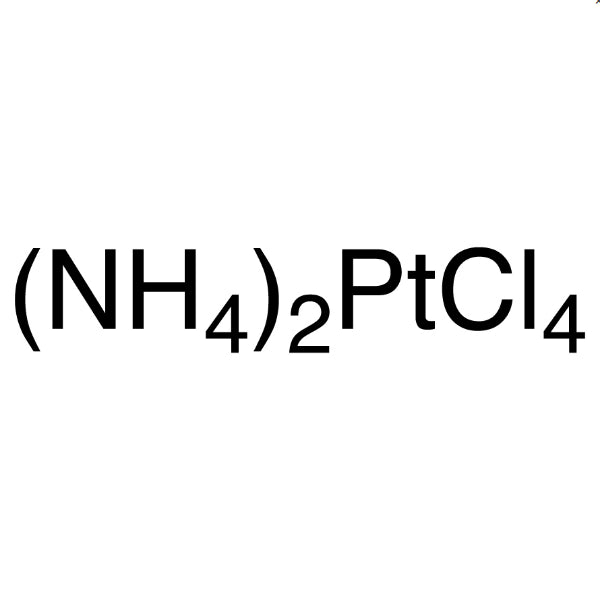
Ammonium Tetrachloroplatinate(II) is a chemical compound widely used in catalytic reactions and synthetic chemistry processes within laboratory settings. It is a coordination compound featuring platinum(II) ions coordinated with chloride and ammonium ions, making it a versatile catalyst for various chemical transformations. This compound is particularly valuable in applications requiring electron activation or redox reactions, where its catalytic properties significantly enhance reaction efficiency. Its role in both organic and inorganic synthesis makes it an essential reagent in modern chemical research and industrial processes.
The compound is preferred due to its high purity and consistent physical and chemical properties, which ensure reliable performance in experimental conditions. Its ability to form complexes with a variety of ligands enhances its adaptability across different catalytic systems. However, it is sensitive to moisture and oxidation, necessitating careful handling and storage. These characteristics make it a reliable choice for researchers seeking a stable and effective catalyst in controlled environments.
In Indonesian laboratories, Ammonium Tetrachloroplatinate(II) is commonly used in chemical research, including the development of new materials, green catalysis, and the synthesis of complex compounds. Many research institutions and universities in Indonesia rely on this compound for its effectiveness in catalytic processes, contributing to advancements in both academic and industrial chemical applications.
TCI brochures (PDF)
- Transition Metal Catalysts 2026-04-10 · p. 15
Related TCI products
- TCI A3667 16919-58-7 Ammonium Hexachloroplatinate(IV)
- TCI H1287 18497-13-7 Hydrogen Hexachloroplatinate(IV) Hexahydrate
- TCI T2378 50-74-8 2,3,4,5-Tetrachlorobenzoic Acid
- TCI T2379 42221-52-3 2,3,4,5-Tetrachlorobenzoyl Chloride
- TCI T2485 14221-02-4 Tetrakis(triphenylphosphine)platinum(0)
- TCI B3115 15170-57-7 Bis(2,4-pentanedionato)platinum(II)
- Green catalysis research benefits from this compound's efficiency in reducing energy consumption and waste in chemical reactions.
- Organic synthesis applications utilize its ability to activate electron transfer processes in complex molecule formation.
- Inorganic compound synthesis leverages its coordination properties to create stable metal complexes under controlled conditions.
- Material development projects incorporate its catalytic properties to fabricate advanced functional materials with specific chemical properties.
- Environmental chemistry studies use it to investigate redox reactions and their impact on pollutant degradation processes.
| Brand | TCI |
|---|---|
| CAS number | 13820-41-2 |
| Molecular formula | — |
| Purity | — |
| Category | Chemistry > Catalysis and Inorganic Chemistry > Transition Elements |
| Pack sizes | Available in various quantities as per standard laboratory supply standards |
| Physical form | Solid powder |
| Storage | Requires dry, cool, and well-ventilated storage to prevent moisture and oxidation |
Ammonium Tetrachloroplatinate(II) should be stored in a dry, cool, and well-ventilated area to prevent moisture absorption and oxidation. It is recommended to use airtight containers made of glass or polyethylene to maintain its chemical stability. Due to its sensitivity to humidity, it should be kept away from sources of moisture and direct sunlight. Laboratory personnel should handle the compound with care, using appropriate personal protective equipment such as gloves and safety goggles. Regular monitoring of storage conditions is advised to ensure the compound remains effective for its intended applications.
—
Produk Terkait
-
AmmoniumHexachloroplatinate(IV) TCI A3667
Regular price Rp 5.724.600,00Regular priceRp 4.018.350,00Sale price Rp 5.724.600,00 -
HydrogenHexachloroplatinate(IV)Hexahydrate TCI H1287
Regular price Rp 3.021.900,00Regular priceRp 2.128.350,00Sale price Rp 3.021.900,00 -
2,3,4,5-TetrachlorobenzoicAcid TCI T2378
Regular price From Rp 1.033.200,00Regular priceRp 738.150,00Sale price From Rp 1.033.200,00 -
2,3,4,5-TetrachlorobenzoylChloride TCI T2379
Regular price Rp 2.597.700,00Regular priceRp 1.832.250,00Sale price Rp 2.597.700,00 -
Tetrakis(triphenylphosphine)platinum(0) TCI T2485
Regular price Rp 3.180.450,00Regular priceRp 2.239.650,00Sale price Rp 3.180.450,00 -
Bis(2,4-pentanedionato)platinum(II) TCI B3115
Regular price From Rp 5.352.900,00Regular priceRp 3.759.000,00Sale price From Rp 5.352.900,00 -
Platinum5%onCarbon(wettedwithca55%Water) TCI P3306
Regular price From Rp 2.650.200,00Regular priceRp 1.853.250,00Sale price From Rp 2.650.200,00 -
Platinum3%onCarbon(wettedwithca55%Water)(ModifiedbySulfur) TCI P3305
Regular price From Rp 3.100.650,00Regular priceRp 2.168.250,00Sale price From Rp 3.100.650,00