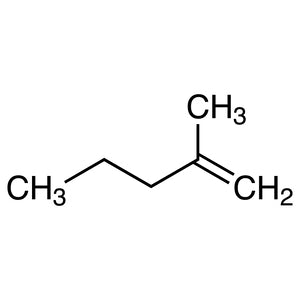
TCI M0245 2-Methyl-1-pentene is a branched six-carbon alkene carrying a terminal double bond substituted at the first carbon, which classifies it as a 1,1-disubstituted olefin. The material presents as a clear, colourless liquid that is highly volatile and readily flammable. In the laboratory it serves as a versatile building block for organic synthesis and as a monomer or comonomer in polymer research. Its terminal double bond provides an entry point for a wide range of addition reactions, while the methyl branch confers steric and electronic character that distinguishes it from ordinary linear alkenes across many catalytic transformations.
The characteristic that makes this compound a preferred choice is the substitution pattern at its double bond. As a 1,1-disubstituted alkene, it generates a tertiary carbocation when it undergoes electrophilic addition, so reactions proceed rapidly with firm and easily predicted Markovnikov regioselectivity. This behaviour makes it a highly informative substrate for reaction mechanism experiments, where the outcome can be rationalised cleanly against theory. The same double bond is also reactive toward hydroboration, epoxidation, olefin metathesis, hydroformylation, and catalysed polymerisation, giving a single reagent broad synthetic reach.
In Indonesian laboratories the compound is typically encountered in university organic chemistry teaching and research groups, in polymer and materials laboratories exploring branched olefin comonomers, and in catalysis groups screening new ligands and metal centres. Because it is volatile and flammable, it is generally handled in small quantities inside a fume hood, dispensed by syringe or cannula for moisture-sensitive work, and returned promptly to controlled storage after use.
- Organic synthesis building block: the terminal double bond accepts a broad range of addition chemistry, letting researchers elaborate a simple branched skeleton into more complex target molecules.
- Reaction mechanism teaching and study: the 1,1-disubstituted alkene forms a tertiary carbocation under electrophilic addition, producing clear Markovnikov regioselectivity that students and researchers can predict and verify.
- Polymer and copolymer research: the compound acts as a monomer or comonomer, allowing investigators to introduce methyl branching into polyolefin chains and study the resulting property changes.
- Catalysis screening studies: its steric and electronic profile differs from linear alkenes, making it a useful probe substrate for olefin metathesis, hydroformylation, and catalysed polymerisation systems.
- Functional group transformation work: hydroboration and epoxidation of the terminal double bond give access to alcohols and epoxides derived from a branched six-carbon framework.
| Brand | TCI (Tokyo Chemical Industry) |
|---|---|
| CAS number | 763-29-1 |
| Molecular formula | — |
| Purity | — |
| Category | Chemistry > Building Blocks > Non-Heterocyclic Building Blocks |
| Pack sizes | available in the standard catalogue pack sizes offered by the manufacturer |
| Physical form | clear, colourless liquid; highly volatile and flammable |
| Storage | keep cool in a tightly closed container, away from ignition sources |
- Product code: M0245
Store the container tightly closed in a cool, well ventilated area reserved for flammable liquids, away from open flames, hot surfaces, sparks, and other ignition sources. Use tightly sealed glass bottles or the original manufacturer packaging, and keep septum-capped bottles for syringe transfer where moisture-sensitive work is planned. Because the liquid is highly volatile, all dispensing and reaction setup should be carried out in a functioning fume hood. Wear safety glasses, chemical-resistant gloves, and a laboratory coat, ground equipment when transferring larger volumes to prevent static discharge, and keep suitable fire extinguishing equipment and spill absorbent nearby. Return the container to storage promptly after use and avoid leaving it open on the bench.
—
Produk Terkait
-
2,3,4-Trimethyl-2-pentene TCI T1080
Regular price Rp 1.246.350,00Regular price -
2,4,4-Trimethyl-2-pentene TCI T0780
Regular price From Rp 4.743.900,00Regular price -
2,4,4-Trimethyl-1-pentene TCI T0665
Regular price From Rp 1.405.950,00Regular price -
trans-2-Pentene TCI P0635
Regular price Rp 6.599.250,00Regular price -
1-Pentene TCI P0316
Regular price From Rp 955.500,00Regular price -
cis-2-Pentene TCI P0065
Regular price Rp 5.644.800,00Regular price -
2-Pentene(cis-andtrans-mixture) TCI P0064
Regular price From Rp 1.035.300,00Regular price -
3-Methyl-1-pentene TCI M0575
Regular price From Rp 1.405.950,00Regular price