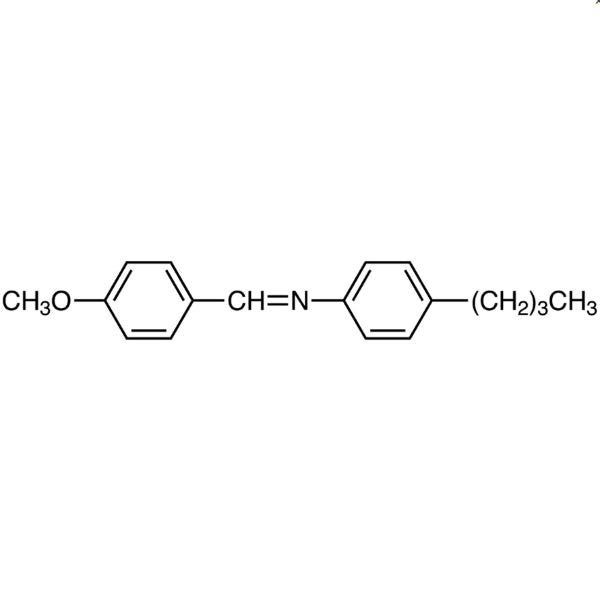
TCI M0275 is N-(4-Methoxybenzylidene)-4-butylaniline, a Schiff base compound widely known among researchers as one of the most classical and most extensively studied nematic liquid crystal materials. This material holds a special place in the history of liquid crystal display development because it served as an early reference point for a large body of electro-optical research. In the laboratory, the compound functions as a model medium for observing molecular orientational order, phase transitions, and the response of molecules to electric and magnetic fields — the very phenomena that underpin the operation of modern display devices.
The characteristic that keeps this material in continual demand is its structure, which combines a methoxy group, an imine bridge, and a butyl chain on the aniline ring. This combination produces a substantial molecular shape anisotropy, so that the nematic phase forms readily and can be observed with relative ease. Its optical and dielectric anisotropy allow measurements of birefringence, elastic constants, and rotational viscosity to be carried out using common laboratory instrumentation. The exceptionally abundant body of literature data available for this compound also makes experimental results easy to compare and validate against published work.
In Indonesian laboratories, this material is typically encountered in university physics and materials science groups, in soft matter and condensed matter research, and in postgraduate teaching laboratories where liquid crystal behaviour is demonstrated experimentally. It is commonly used in polarising microscopy sessions, in cell-filling experiments for electro-optical characterisation, and in thesis-level research projects on display physics. Because comparative literature is so widely available, it also suits laboratories that are establishing or calibrating new liquid crystal measurement capabilities.
TCI brochures (PDF)
- Liquid Crystal Materials 2026-04-01 · p. 9
Related TCI products
- TCI B0250 30633-94-4 N-(4-Methoxy-2-hydroxybenzylidene)-4-butylaniline
- TCI B0255 16833-17-3 Butyl 4-[(4-Methoxybenzylidene)amino]cinnamate
- TCI M0602 6421-30-3 Ethyl 4-[(4-Methoxybenzylidene)amino]cinnamate
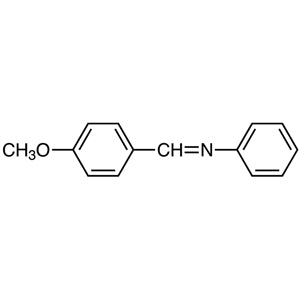
- TCI M0582 836-41-9 N-(4-Methoxybenzylidene)aniline
- TCI H0419 35280-78-5 4'-Hexyloxybenzylidene-4-cyanoaniline
- TCI B0711 1126-78-9 N-Butylaniline
- Nematic phase studies — the pronounced molecular shape anisotropy of this Schiff base allows the nematic phase to form and be observed reliably, making it a dependable model system for orientational order research.
- Electro-optical characterisation — its dielectric anisotropy lets researchers apply electric fields to liquid crystal cells and study molecular reorientation, which is the fundamental switching mechanism behind display devices.
- Birefringence measurement — the material's optical anisotropy makes it well suited to polarising microscopy and optical retardation work using instrumentation that is already common in most laboratories.
- Phase transition investigation — the compound serves as a model medium for tracking transitions between phases, supported by an abundant literature base that makes observed transition behaviour straightforward to compare.
- Magnetic field response experiments — molecular alignment under applied magnetic fields can be examined using this classical material, with published reference data available for validating the results obtained.
| Brand | TCI (Tokyo Chemical Industry) |
|---|---|
| CAS number | 26227-73-6 |
| Molecular formula | — |
| Purity | — |
| Category | Materials Science > Electronic Materials > Liquid Crystal (LC) Materials |
| Pack sizes | available in standard TCI research packaging; please confirm the required pack size when ordering |
| Physical form | — |
| Storage | keep in a cool, dark place in a tightly closed container |
- Chemical name: N-(4-Methoxybenzylidene)-4-butylaniline
Store the material in a cool, dark place inside a tightly closed original container, protected from light, moisture, and prolonged exposure to air. Schiff base compounds are sensitive to hydrolysis, so containers should be resealed promptly after each use and kept away from humid conditions. Handle in a well-ventilated area or fume hood, wearing safety glasses, gloves, and a laboratory coat. Avoid contact with skin and eyes, and avoid inhaling any vapour or dust generated during transfer. Keep the material separate from strong acids and strong oxidising agents. Always consult the manufacturer's safety data sheet before handling, and dispose of residues in accordance with institutional chemical waste procedures.
—
Produk Terkait
-
N-(4-Methoxy-2-hydroxybenzylidene)-4-butylaniline TCI B0250
Regular price Rp 7.023.450,00Regular price -
Butyl4-[(4-Methoxybenzylidene)amino]cinnamate TCI B0255
Regular price Rp 5.460.000,00Regular price -
Ethyl4-[(4-Methoxybenzylidene)amino]cinnamate TCI M0602
Regular price Rp 8.692.950,00Regular price -
N-(4-Methoxybenzylidene)aniline TCI M0582
Regular price From Rp 637.350,00Regular price -
4'-Hexyloxybenzylidene-4-cyanoaniline TCI H0419
Regular price Rp 3.790.500,00Regular price -
N-Butylaniline TCI B0711
Regular price Rp 530.250,00Regular price -
3,5-Di-tert-butylaniline TCI D2515
Regular price From Rp 1.670.550,00Regular price

![16833-17-3 Butyl 4-[(4-Methoxybenzylidene)amino]cinnamate - AMI Scientific](http://amiscientific.com/cdn/shop/files/TCI2510B0255.jpg?v=1768359023&width=533)
![16833-17-3 Butyl 4-[(4-Methoxybenzylidene)amino]cinnamate - AMI Scientific](http://amiscientific.com/cdn/shop/files/TCI2510B0255_69fdb2a3-eb77-4951-8356-ada2825b3f53.jpg?v=1772176989&width=533)
![6421-30-3 Ethyl 4-[(4-Methoxybenzylidene)amino]cinnamate - AMI Scientific](http://amiscientific.com/cdn/shop/files/TCI2510M0602.jpg?v=1768361341&width=533)