
![6421-30-3 Ethyl 4-[(4-Methoxybenzylidene)amino]cinnamate - AMI Scientific](http://amiscientific.com/cdn/shop/files/TCI2510M0602.jpg?v=1768361341&width=1946)
![6421-30-3 Ethyl 4-[(4-Methoxybenzylidene)amino]cinnamate - AMI Scientific](http://amiscientific.com/cdn/shop/files/TCI2510M0602.jpg?v=1768361341&width=1445)
Ethyl 4-[(4-Methoxybenzylidene)amino]cinnamate is a chemical compound widely used in laboratory research involving liquid crystal (LC) materials. This compound plays a crucial role in the development of electronic and optical materials, particularly in the field of display technology. Due to its complex molecular structure, it is capable of interacting with other molecules in controlled laboratory environments, making it a valuable tool for researchers. Its unique chemical properties allow it to be used as a building block for the synthesis of more complex compounds or as a component in LC material mixtures.
One of the key attributes that make this compound a preferred choice is its chemical stability. This stability ensures that it can be manipulated and used in various experimental setups without undergoing unwanted degradation. Additionally, its ability to form stable molecular structures under specific conditions makes it ideal for applications requiring precise control over molecular organization. These characteristics are especially beneficial in advanced research settings where accuracy and consistency are paramount.
In Indonesian laboratories, this compound is commonly used in applied technology research, particularly in the development of liquid crystal displays and optical components. Researchers in educational and research institutions rely on this material for experiments that aim to improve the performance and functionality of electronic devices. Its versatility and reliability make it a go-to material for scientists working on cutting-edge projects in materials science.
TCI brochures (PDF)
- Liquid Crystal Materials 2026-04-01 · p. 9
Related TCI products
- TCI B0255 16833-17-3 Butyl 4-[(4-Methoxybenzylidene)amino]cinnamate
- TCI B0250 30633-94-4 N-(4-Methoxy-2-hydroxybenzylidene)-4-butylaniline
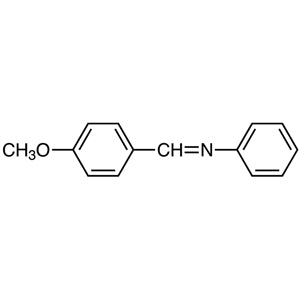
- TCI M0582 836-41-9 N-(4-Methoxybenzylidene)aniline
- TCI M0275 26227-73-6 N-(4-Methoxybenzylidene)-4-butylaniline
- TCI H0419 35280-78-5 4'-Hexyloxybenzylidene-4-cyanoaniline
- TCI E0262 29743-08-6 4'-Ethoxybenzylidene-4-butylaniline
- Liquid Crystal Display Development: This compound is essential for creating LC materials that are used in modern display technologies, offering precise control over molecular alignment and optical properties.
- Optical Component Fabrication: Its stable molecular structure enables it to be integrated into optical components, enhancing their performance in various light-manipulating applications.
- Electronic Material Synthesis: Researchers use it as a precursor for synthesizing other complex compounds, contributing to the advancement of electronic material science.
- Research in Material Science: It is frequently employed in studies aimed at understanding molecular interactions and structural behavior in different environments.
- Advanced Technology Innovation: Indonesian laboratories leverage this compound to develop next-generation technologies, particularly in the fields of display and optical engineering.
| Brand | TCI |
|---|---|
| CAS number | 6421-30-3 |
| Molecular formula | — |
| Purity | — |
| Category | Materials Science > Electronic Materials > Liquid Crystal (LC) Materials |
| Pack sizes | Available in various quantities as per standard laboratory supply practices |
| Physical form | Solid, typically in crystalline or powder form |
| Storage | Store in a cool, dry place away from direct sunlight and moisture |
This compound should be stored in a cool, dry environment to maintain its chemical stability and prevent degradation. It is recommended to use airtight containers to protect it from moisture and contaminants. Due to its chemical nature, it should be handled with appropriate personal protective equipment, such as gloves and safety goggles, to ensure laboratory safety. It is important to avoid exposure to heat and direct light, as these conditions can affect its structural integrity. Proper labeling of storage containers is essential for safe handling and easy identification. Regular inspection of storage conditions is advised to ensure the compound remains in optimal condition for research use.
—
Produk Terkait
-
Butyl4-[(4-Methoxybenzylidene)amino]cinnamate TCI B0255
Regular price Rp 5.460.000,00Regular price -
N-(4-Methoxy-2-hydroxybenzylidene)-4-butylaniline TCI B0250
Regular price Rp 7.023.450,00Regular price -
N-(4-Methoxybenzylidene)aniline TCI M0582
Regular price From Rp 637.350,00Regular price -
N-(4-Methoxybenzylidene)-4-butylaniline TCI M0275
Regular price Rp 1.538.250,00Regular price -
4'-Hexyloxybenzylidene-4-cyanoaniline TCI H0419
Regular price Rp 3.790.500,00Regular price -
4'-Ethoxybenzylidene-4-butylaniline TCI E0262
Regular price Rp 1.670.550,00Regular price -
4-[(4-Methoxybenzylidene)amino]cinnamicAcid TCI M0588
Regular price Rp 1.961.400,00Regular price -
2-[(4-Methoxybenzylidene)amino]fluorene TCI M0586
Regular price Rp 3.392.550,00Regular price
![16833-17-3 Butyl 4-[(4-Methoxybenzylidene)amino]cinnamate - AMI Scientific](http://amiscientific.com/cdn/shop/files/TCI2510B0255.jpg?v=1768359023&width=533)
![16833-17-3 Butyl 4-[(4-Methoxybenzylidene)amino]cinnamate - AMI Scientific](http://amiscientific.com/cdn/shop/files/TCI2510B0255_69fdb2a3-eb77-4951-8356-ada2825b3f53.jpg?v=1772176989&width=533)



![25959-50-6 4-[(4-Methoxybenzylidene)amino]cinnamic Acid - AMI Scientific](http://amiscientific.com/cdn/shop/files/TCI2510M0588.jpg?v=1767123282&width=533)
![5424-78-2 2-[(4-Methoxybenzylidene)amino]fluorene - AMI Scientific](http://amiscientific.com/cdn/shop/files/TCI2510M0586.jpg?v=1767123278&width=533)