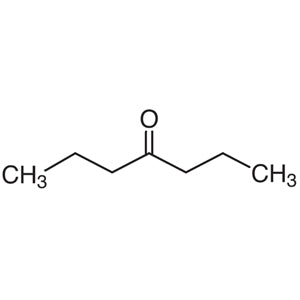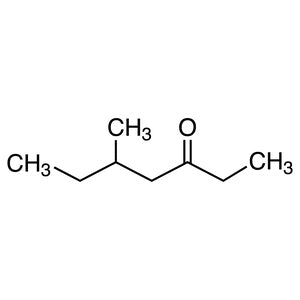
5-Methyl-3-heptanone from TCI is a branched aliphatic ketone also known as ethyl amyl ketone. The compound carries its carbonyl group in the middle of a seven-carbon chain with a methyl branch, giving it a balance between the polarity of the carbonyl function and the hydrophobic character of the alkyl chain. In the laboratory it serves as a high-solvency solvent for resins and coatings, as a reference compound in flavour and fragrance analysis, and as a model substrate in studies of carbonyl reactions such as reduction, nucleophilic addition, and enolate formation.
The property that most often decides its selection is its relatively slow evaporation rate compared with light ketones such as acetone, which makes it well suited to formulations that require a longer working time. It presents as a colourless liquid with the characteristic ketone odour, dissolves readily in common organic solvents, and is only slightly soluble in water. Because the carbonyl sits in an unsymmetrical position with branching nearby, the molecule offers two distinct alpha positions — a situation that is particularly useful for studying the regioselectivity of kinetic versus thermodynamic enolate formation.
Indonesian laboratories typically call on this material in organic synthesis groups, coating and resin formulation work, and analytical units that need a defined ketone standard. Its predictable behaviour and its position within the non-heterocyclic building blocks category make it a practical choice for both routine preparative work and teaching exercises where students compare the reactivity of different ketones under controlled conditions.
- Solvent for resins and coatings — its high solvency and slow evaporation keep formulations workable for longer, which suits film-forming trials and viscosity studies.
- Reference compound in flavour and fragrance analysis — the characteristic ketone profile of this branched compound provides a defined comparison point when identifying or quantifying related analytes.
- Model substrate in carbonyl reduction studies — the accessible mid-chain carbonyl allows researchers to follow reduction chemistry on a well-behaved aliphatic ketone framework.
- Substrate for nucleophilic addition research — the balance of carbonyl polarity and surrounding alkyl bulk makes it useful for probing steric influence on addition reactions.
- Regioselectivity work on enolate formation — its two chemically distinct alpha positions make it a natural test case for comparing kinetic and thermodynamic enolate conditions.
| Brand | TCI |
|---|---|
| CAS number | 541-85-5 |
| Molecular formula | — |
| Purity | — |
| Category | Chemistry > Building Blocks > Non-Heterocyclic Building Blocks |
| Pack sizes | available in the standard TCI catalogue pack sizes; please confirm the size required when ordering |
| Physical form | colourless liquid with a characteristic ketone odour |
| Storage | keep tightly closed in a cool, well-ventilated place away from ignition sources |
Store the container tightly closed in a cool, dry, well-ventilated area, away from heat, sparks, open flames, and other ignition sources, and keep it separated from strong oxidising agents. The original supplier packaging or a compatible tightly sealed glass or approved solvent container is appropriate; avoid containers or closures that may be attacked by organic solvents. Handle in a fume hood to limit inhalation of vapour, and wear safety glasses, chemically resistant gloves, and a laboratory coat. Ground containers when transferring larger volumes, close them immediately after use to limit evaporation and odour, and consult the manufacturer safety data sheet before first use and before disposal of residues.
—
Produk Terkait
-
3-Methyl-4-heptanone TCI M1267
Regular price Rp 7.712.250,00Regular price -
6-Methyl-2-heptanone TCI M0700
Regular price From Rp 2.704.800,00Regular price -
2-Methyl-4-heptanone TCI M0694
Regular price Rp 4.399.500,00Regular price -
2-Methyl-3-heptanone TCI M0693
Regular price Rp 4.213.650,00Regular price -
4-Heptanone TCI H0039
Regular price From Rp 689.850,00Regular price -
3-Heptanone TCI H0038
Regular price Rp 795.900,00Regular price -
2-Heptanone TCI H0037
Regular price From Rp 530.250,00Regular price -
2,6-Dimethyl-4-heptanone TCI D0733
Regular price From Rp 452.550,00Regular price