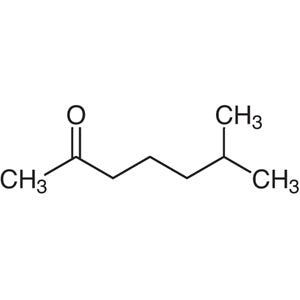
6-Methyl-2-heptanone is an organic compound widely used as a foundational building block in the synthesis of complex chemical structures. It plays a crucial role in laboratory settings by serving as a versatile intermediate in various chemical reactions. This compound is particularly valuable in the creation of esters, aldehydes, and aromatic compounds due to its ability to participate in multiple reaction pathways. Its structural simplicity allows for easy modification, making it a preferred choice for chemists seeking to develop new synthetic routes.
The compound's stability and controlled reactivity make it a reliable option for a wide range of chemical applications. Its molecular structure provides flexibility, enabling it to react with diverse reagents under varying conditions. Additionally, its relatively high boiling point allows for its use in distillation processes or reactions that require elevated temperatures. These properties ensure consistent performance across different experimental setups, enhancing its utility in both research and educational environments.
In Indonesian laboratories, 6-Methyl-2-heptanone is commonly used in both academic and industrial research settings. It is a staple in chemistry departments at universities and research institutions, supporting both teaching and experimental work. Its availability and reliability make it an essential component in the toolkit of chemists working on complex molecular synthesis and analytical studies.
- Organic synthesis applications benefit from 6-Methyl-2-heptanone due to its reactivity and structural versatility, enabling the creation of complex molecules.
- It is ideal for esterification reactions because of its ketone functionality, which can undergo nucleophilic attack and form ester derivatives.
- In the preparation of aldehydes, this compound serves as a useful intermediate through oxidation or reduction reactions, offering a reliable starting point.
- Its use in aromatic compound synthesis is supported by its ability to participate in electrophilic substitution reactions, enhancing the diversity of products.
- Educational laboratories rely on this compound for teaching fundamental organic chemistry concepts, providing students with hands-on experience in synthetic chemistry.
| Brand | TCI |
|---|---|
| CAS number | 928-68-7 |
| Molecular formula | — |
| Purity | — |
| Category | Chemistry > Building Blocks > Non-Heterocyclic Building Blocks |
| Pack sizes | Available in various quantities as per supplier specifications |
| Physical form | Liquid |
| Storage | Store in a cool, dry, and well-ventilated area away from direct sunlight |
6-Methyl-2-heptanone should be stored in a cool, dry, and well-ventilated area to maintain its stability and prevent degradation. It is recommended to use airtight containers made of materials compatible with organic solvents, such as glass or high-density polyethylene. Due to its flammable nature, it should be kept away from heat sources and open flames. Proper labeling of containers is essential for safety and identification. In laboratory settings, personal protective equipment such as gloves and safety goggles should be worn when handling the compound to minimize exposure risks. Regular monitoring of storage conditions ensures the compound remains safe and effective for use in chemical experiments.
—
Produk Terkait
-
3-Methyl-4-heptanone TCI M1267
Regular price Rp 7.712.250,00Regular price -
2-Methyl-4-heptanone TCI M0694
Regular price Rp 4.399.500,00Regular price -
2-Methyl-3-heptanone TCI M0693
Regular price Rp 4.213.650,00Regular price -
5-Methyl-3-heptanone TCI M0335
Regular price From Rp 505.050,00Regular price -
4-Heptanone TCI H0039
Regular price From Rp 689.850,00Regular price -
3-Heptanone TCI H0038
Regular price Rp 795.900,00Regular price -
2-Heptanone TCI H0037
Regular price From Rp 530.250,00Regular price -
2,6-Dimethyl-4-heptanone TCI D0733
Regular price From Rp 452.550,00Regular price