

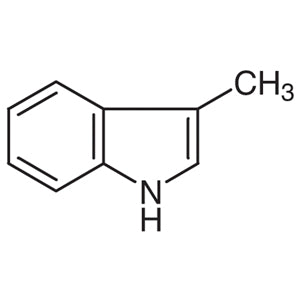
3-Methylindole, with CAS number 83-34-1, is a heterocyclic compound widely used in various chemical reactions within the laboratory. It belongs to the category of building blocks, which are fundamental components for the synthesis of more complex chemical structures. This compound is derived from the indole ring with a methyl group substituted at the third position, giving it unique reactivity and structural versatility. Its presence in laboratory settings is crucial for the development of new chemical entities and the exploration of synthetic pathways.
The chemical properties of 3-Methylindole make it a preferred choice for researchers. It exhibits stability under certain conditions but remains highly reactive in substitution and condensation reactions. Its molecular structure allows it to participate in a range of reactions such as Diels-Alder, Friedel-Crafts, and electrophilic substitution. These characteristics make it a valuable tool in organic chemistry and pharmacological research. The compound’s ability to engage in multiple reaction mechanisms enhances its utility in the synthesis of aromatic and heterocyclic compounds.
In Indonesian laboratories, 3-Methylindole is extensively used in organic chemistry research, particularly in the development of pharmaceutical compounds and industrial chemicals. Many research institutions and universities rely on this compound for its versatility and reactivity. Its application spans across both academic and industrial sectors, supporting the advancement of chemical sciences in the region.
- Organic synthesis applications benefit from 3-Methylindole due to its reactivity in forming complex heterocyclic structures.
- Pharmaceutical research utilizes this compound for the development of new drug molecules and bioactive compounds.
- Industrial chemical production relies on 3-Methylindole for the synthesis of aromatic and heterocyclic intermediates.
- Analytical chemistry experiments use this compound as a standard for identifying and quantifying heterocyclic compounds.
- Teaching laboratories incorporate 3-Methylindole to demonstrate key reaction mechanisms in organic chemistry courses.
| Brand | TCI |
|---|---|
| CAS number | 83-34-1 |
| Molecular formula | — |
| Purity | — |
| Category | Chemistry > Building Blocks > Heterocyclic Building Blocks |
| Pack sizes | Available in various quantities as per supplier specifications |
| Physical form | Solid, crystalline |
| Storage | Store in a cool, dry place away from light and moisture |
3-Methylindole should be stored in a cool, dry environment, away from direct light and moisture to maintain its chemical integrity. It is recommended to use airtight containers made of glass or high-density polyethylene to prevent contamination and degradation. Due to its reactivity, it should be handled with appropriate personal protective equipment, including gloves and safety goggles. The compound is not flammable but may react with strong oxidizing agents. Proper ventilation is essential when working with this material to ensure safe laboratory practices. Always follow standard chemical safety protocols to minimize risks during handling and experimentation.
—
Produk Terkait
-
2,3,3,5-Tetramethylindolenine TCI T3458
Regular price From Rp 1.803.900,00Regular price -
5-Amino-2-methylindole TCI A1539
Regular price From Rp 1.353.450,00Regular price -
2,3,3-Trimethylindolenine TCI T0766
Regular price From Rp 1.405.950,00Regular price -
4-Methylindole TCI M1745
Regular price Rp 1.298.850,00Regular price -
7-Methylindole TCI M1702
Regular price From Rp 823.200,00Regular price -
1-Methylindole-2-carboxylicAcid TCI M1519
Regular price From Rp 1.193.850,00Regular price -
2-Methylindole-3-carboxaldehyde TCI M1485
Regular price From Rp 2.121.000,00Regular price -
6-Methylindole TCI M1430
Regular price From Rp 1.565.550,00Regular price


