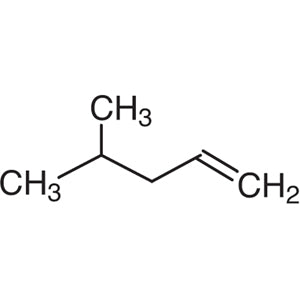
TCI M0392 4-Methyl-1-pentene is a branched alkene supplied as a clear, highly volatile liquid, with the double bond positioned at the end of the carbon chain and a methyl group on the fourth carbon. As a non-heterocyclic building block, this compound offers a highly reactive terminal double bond together with a branched carbon skeleton that gives a distinctive character to its reaction products. In the laboratory, its most prominent role is as a model monomer for coordination polymerisation and as a test substrate in catalysis research, and it is also used as a starting material for the synthesis of functionalised aliphatic compounds.
The property that most determines its selection is the terminal position of the double bond. Terminal alkenes approach the active centre of a catalyst far more easily than internal alkenes, so hydroformylation, hydrosilylation, epoxidation, and metathesis reactions proceed more rapidly and with clearer regioselectivity. The methyl branch at the fourth position provides controlled steric hindrance that influences the tacticity of the resulting polymer, a characteristic exploited in the preparation of transparent polyolefin polymers. Its low boiling point also means that residual monomer is easily removed from the reaction product.
In Indonesian laboratories, 4-methyl-1-pentene is typically encountered in university and institutional research groups working on polymer chemistry, homogeneous catalysis, and organometallic synthesis, where it serves as a reference olefin for evaluating new catalyst systems. It is also used in organic synthesis laboratories that prepare functionalised aliphatic intermediates. Because the material is highly volatile, most laboratories handle it in a fume hood and dispense it with cooled glassware to limit evaporation losses during transfer.
- Coordination polymerisation studies: the terminal double bond inserts readily into metal–alkyl bonds, making this a standard model monomer for evaluating Ziegler–Natta and metallocene catalyst systems.
- Catalyst screening and catalysis research: as a test substrate, its unhindered terminal olefin gives fast, reproducible conversion, so differences in activity between new catalysts become clearly measurable.
- Hydroformylation and hydrosilylation experiments: the terminal position of the double bond gives clearer regioselectivity, allowing linear versus branched product ratios to be determined with confidence.
- Epoxidation and olefin metathesis work: the accessible terminal alkene reacts more rapidly than internal alkenes, making it a convenient reference substrate for method development and optimisation studies.
- Synthesis of functionalised aliphatic compounds: the branched carbon skeleton is carried through into the product, providing a defined branching pattern that would otherwise require additional synthetic steps.
| Brand | TCI (Tokyo Chemical Industry) |
|---|---|
| CAS number | 691-37-2 |
| Molecular formula | — |
| Purity | — |
| Category | Chemistry > Building Blocks > Non-Heterocyclic Building Blocks |
| Pack sizes | — |
| Physical form | clear, highly volatile liquid |
| Storage | keep cool and tightly closed; refer to the manufacturer's label and safety data sheet for the specified storage condition of the pack received |
- Catalogue number: M0392
Store the container tightly closed in a cool, well-ventilated area away from heat, sparks, open flames, and direct sunlight, and keep it separated from oxidising agents. The original manufacturer's bottle is the preferred container, as it is designed to withstand the vapour pressure this material develops at room temperature; if transfer is necessary, use compatible glassware with a secure, vapour-tight closure. Because the compound is highly volatile and its vapour is flammable, all handling, dispensing, and reaction set-up should be carried out in a functioning fume hood with earthed and bonded equipment where larger volumes are involved. Laboratory personnel should wear safety goggles, chemically resistant gloves, and a laboratory coat. Allow refrigerated containers to reach ambient temperature before opening to avoid condensation, and consult the manufacturer's safety data sheet before first use.
—
Produk Terkait
-
2,3,4-Trimethyl-2-pentene TCI T1080
Regular price Rp 1.246.350,00Regular price -
2,4,4-Trimethyl-2-pentene TCI T0780
Regular price From Rp 4.743.900,00Regular price -
2,4,4-Trimethyl-1-pentene TCI T0665
Regular price From Rp 1.405.950,00Regular price -
trans-2-Pentene TCI P0635
Regular price Rp 6.599.250,00Regular price -
1-Pentene TCI P0316
Regular price From Rp 955.500,00Regular price -
cis-2-Pentene TCI P0065
Regular price Rp 5.644.800,00Regular price -
2-Pentene(cis-andtrans-mixture) TCI P0064
Regular price From Rp 1.035.300,00Regular price -
3-Methyl-1-pentene TCI M0575
Regular price From Rp 1.405.950,00Regular price