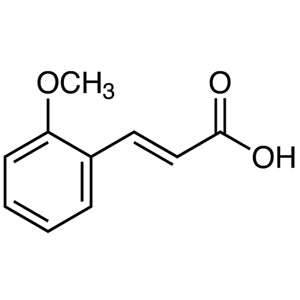
Trans-2-Methoxycinnamic Acid is a chemical compound widely used in laboratory settings for the synthesis of complex molecules. It serves as a key building block in organic chemistry, enabling the creation of various functional compounds with specific structural features. This compound is particularly valued for its versatility in chemical reactions, making it a fundamental tool in both academic and industrial research. Its role in the laboratory extends beyond mere synthesis, as it is integral to the development of compounds with specific biological activities.
The compound's stability and reactivity under controlled conditions make it a preferred choice for researchers. It exhibits good solubility in organic solvents such as ethyl acetate and ethanol, which facilitates its use in purification and reaction processes. These properties ensure that it remains effective in a wide range of experimental applications. Its molecular structure also allows for easy modification, which is crucial in the design of new compounds with desired properties.
In Indonesian laboratories, Trans-2-Methoxycinnamic Acid is commonly used in research related to organic chemistry and pharmacology. Scientists and students rely on this compound for experiments that require precise structural components, whether in basic research or applied industrial settings. Its consistent performance and reliability make it a staple in the chemical laboratories of Indonesia.
Related TCI products
- Synthesis of Antitumor Compounds: This compound is ideal for creating molecules with potential anti-cancer properties due to its structural versatility and reactivity.
- Development of Antioxidant Molecules: Its chemical properties make it suitable for synthesizing compounds that neutralize free radicals and protect cells from oxidative damage.
- Organic Chemistry Research: It is frequently used in studies that require the synthesis of complex organic molecules with specific functional groups.
- Pharmacological Studies: Researchers use it to develop and test new drugs, leveraging its ability to form active pharmaceutical ingredients.
- Structural Analysis Experiments: Its stable molecular structure makes it a reliable component in experiments that require precise chemical modifications.
| Brand | TCI |
|---|---|
| CAS number | 1011-54-7 |
| Molecular formula | — |
| Purity | — |
| Category | Chemistry > Building Blocks > Non-Heterocyclic Building Blocks |
| Pack sizes | Available in various quantities as per standard laboratory supply |
| Physical form | Solid |
| Storage | Store in a cool, dry place away from light and moisture |
Trans-2-Methoxycinnamic Acid should be stored in a cool, dry environment to maintain its chemical integrity. It is recommended to keep it in a sealed container to prevent exposure to moisture and air, which could affect its stability. The compound should be stored away from direct sunlight and heat sources to avoid degradation. In laboratory settings, it is important to handle the material with appropriate personal protective equipment, such as gloves and safety goggles, to ensure safety. Proper ventilation should be maintained when working with this compound to minimize inhalation risks. Its solid form makes it easy to handle, but care should be taken to avoid contamination during use.
—
Produk Terkait
-
trans-4-MethoxycinnamicAcid TCI M0576
Regular price Rp 1.724.100,00Regular price -
cis-2-MethoxycinnamicAcid TCI M0761
Regular price From Rp 2.147.250,00Regular price -
3-MethoxycinnamicAcid TCI M0444
Regular price From Rp 2.809.800,00Regular price -
3-Hydroxy-4-methoxycinnamicAcid TCI H0524
Regular price From Rp 1.538.250,00Regular price -
2,3,4-TrimethoxycinnamicAcid TCI T2016
Regular price From Rp 875.700,00Regular price -
2,4,5-TrimethoxycinnamicAcid TCI T1393
Regular price Rp 2.094.750,00Regular price -
(E)-3,4,5-TrimethoxycinnamicAcid TCI T1104
Regular price Rp 2.597.700,00Regular price -
4-EthoxycinnamicAcid TCI E0856
Regular price Rp 1.298.850,00Regular price