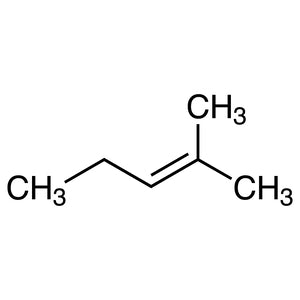
2-Methyl-2-pentene is an organic compound widely used in chemical reactions to construct complex molecules. It serves as a fundamental building block in the synthesis of aromatic and aliphatic compounds, playing a crucial role in laboratory settings. This compound is commonly utilized in substitution and addition reactions, contributing to the development of more intricate molecular structures. Its stable chemical properties and controlled reactivity make it a popular choice for various chemical experiments.
The compound's non-heterocyclic nature ensures molecular stability, making it ideal for reactions requiring structural integrity. Its aliphatic structure with a single alkene group allows participation in key chemical reactions such as addition and substitution. The compound's versatility and reliability have made it a staple in both academic and industrial research environments. Its availability in multiple packaging options further enhances its usability across different experimental scales.
In Indonesian laboratories, 2-Methyl-2-pentene is extensively used for pure chemical research, product development, and educational purposes at both university and high school levels. Its consistent performance and broad applicability make it an essential component of chemical laboratories in Indonesia, supporting both teaching and research activities.
- Organic synthesis applications benefit from 2-Methyl-2-pentene due to its ability to participate in addition and substitution reactions, enabling the creation of complex molecular structures.
- It is widely used in the development of aromatic and aliphatic compounds, providing a stable and reliable starting material for synthetic pathways.
- Educational institutions utilize this compound for teaching fundamental chemical reactions, offering students hands-on experience with key organic chemistry principles.
- Research laboratories rely on 2-Methyl-2-pentene for the synthesis of novel compounds, supporting both academic and industrial innovation.
- It is also employed in the formulation of specialty chemicals, contributing to the production of various commercial products through controlled chemical processes.
| Brand | TCI |
|---|---|
| CAS number | 625-27-4 |
| Molecular formula | — |
| Purity | — |
| Category | Chemistry > Building Blocks > Non-Heterocyclic Building Blocks |
| Pack sizes | Available in multiple packaging options to suit different experimental needs |
| Physical form | Liquid |
| Storage | Store in a cool, dry place away from direct sunlight |
2-Methyl-2-pentene should be stored in a cool, dry environment, away from direct sunlight and sources of heat. It is recommended to use airtight containers made of materials such as glass or polyethylene to prevent contamination and evaporation. Due to its flammable nature, it should be kept in a well-ventilated area, away from any potential ignition sources. Proper labeling of containers is essential for safety and identification. Laboratory personnel should always wear appropriate personal protective equipment, including gloves and safety goggles, when handling this compound. Regular monitoring of storage conditions ensures the compound remains stable and safe for use in chemical experiments.
—
Produk Terkait
-
2,3,4-Trimethyl-2-pentene TCI T1080
Regular price Rp 1.246.350,00Regular price -
2,4,4-Trimethyl-2-pentene TCI T0780
Regular price From Rp 4.743.900,00Regular price -
2,4,4-Trimethyl-1-pentene TCI T0665
Regular price From Rp 1.405.950,00Regular price -
trans-2-Pentene TCI P0635
Regular price Rp 6.599.250,00Regular price -
1-Pentene TCI P0316
Regular price From Rp 955.500,00Regular price -
cis-2-Pentene TCI P0065
Regular price Rp 5.644.800,00Regular price -
2-Pentene(cis-andtrans-mixture) TCI P0064
Regular price From Rp 1.035.300,00Regular price -
3-Methyl-1-pentene TCI M0575
Regular price From Rp 1.405.950,00Regular price