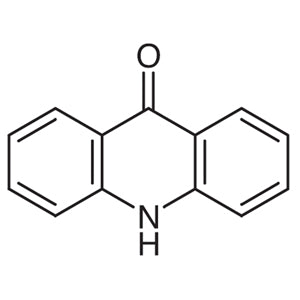
10-Methyl-9(10H)-acridone is a tricyclic heterocyclic compound derived from acridone, in which the nitrogen atom at position 10 has been methylated. In the laboratory it serves both as a building block and as a core chromophore, and it is widely used by researchers working in organic chemistry, photochemistry, and materials science. The rigid, fully conjugated acridone framework makes it a practical starting point for constructing functional molecules, ranging from fluorescent dyes and analytical probes to organic photocatalysts. This TCI product, catalogue code M0792, is supplied in laboratory packaging so that it can be conveniently weighed, dissolved, and reacted at research scale as well as during method development work.
The characteristics that lead researchers to select this compound lie in its extended pi-electron system, conjugated across two aromatic rings with a carbonyl group at the centre. This arrangement gives rise to attractive light absorption and emission behaviour, which is why the acridone framework is so often adopted as the basis for electron donor–acceptor molecules in studies of photoinduced charge transfer. Methylation at the nitrogen atom removes the N–H hydrogen, so the structure becomes more clearly defined and its behaviour easier to predict in subsequent chemistry, without the complications that a free N–H group can introduce into reactions and spectroscopic measurements.
In Indonesian laboratories, this material is typically found in university research groups, government research institutes, and industrial R&D units that work on organic synthesis, fluorescence-based analysis, and functional materials. It is normally ordered in laboratory pack sizes suited to bench-scale experiments rather than production, supporting exploratory synthesis, photophysical characterisation, and the preparation of reference or intermediate compounds for further study. The TCI catalogue code makes reordering and documentation straightforward for laboratories that maintain formal chemical inventories.
- Heterocyclic building block for organic synthesis, providing a rigid preformed acridone core that saves researchers from building the tricyclic framework from simpler precursors.
- Fluorescent dye development, where the extended conjugated pi-system and central carbonyl group give the light absorption and emission behaviour that dye chemistry requires.
- Preparation of analytical probes, since the well-defined N-methylated structure behaves predictably and can be elaborated into molecules designed for detection and sensing work.
- Photoinduced charge transfer studies, because the acridone framework is a established basis for electron donor–acceptor molecules used in photochemical investigations of charge separation.
- Organic photocatalyst research, in which the conjugated chromophore core serves as a starting scaffold for constructing light-absorbing catalysts for organic transformations.
| Brand | TCI (Tokyo Chemical Industry) |
|---|---|
| CAS number | 719-54-0 |
| Molecular formula | — |
| Purity | — |
| Category | Chemistry > Building Blocks > Heterocyclic Building Blocks |
| Pack sizes | supplied in laboratory pack sizes suitable for research-scale weighing and reactions |
| Physical form | — |
| Storage | store according to the manufacturer's instructions on the product label and safety data sheet |
- Catalogue code: M0792
Store the container tightly closed in a cool, dry, and well-ventilated place, away from direct sunlight and from sources of heat or ignition, following the storage conditions stated on the product label and safety data sheet. Keep the material in its original supplier container, or in a clean, well-sealed glass container that is clearly labelled with the compound name and CAS number. Handle the solid in a fume hood to avoid generating or inhaling dust, and wear appropriate personal protective equipment including safety glasses, gloves, and a laboratory coat. Use clean, dry spatulas when weighing to avoid contamination or moisture uptake, close the container promptly after use, and consult the safety data sheet before first use and before disposal of any residue.
—
Produk Terkait
-
9(10H)-Acridone TCI A0133
Regular price From Rp 795.900,00Regular price -
10-Phenyl-9(10H)-acridone TCI P2537
Regular price From Rp 2.782.500,00Regular price -
10-(4-Bromophenyl)-9(10H)-acridone TCI B5536
Regular price Rp 3.312.750,00Regular price