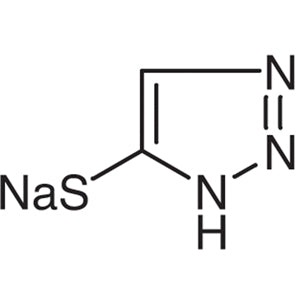
5-Mercapto-1H-1,2,3-triazole Sodium Salt is the sodium salt form of a mercapto-substituted triazole, a five-membered heterocyclic compound containing three consecutive nitrogen atoms and a sulfur group at the 5-position. As a salt, the material exists as an ionic solid that is generally easier to handle and more soluble in aqueous media than its free thiol counterpart. In the laboratory, it serves as a heterocyclic building block, a metal-complexing ligand, and a reagent in surface chemistry studies. This TCI product, catalogue code M0847, is supplied in 5 g and 25 g pack sizes.
The characteristic that makes this compound a preferred choice is that its thiolate group is already present in the deprotonated form, so it acts as a strong nucleophile directly without requiring the prior addition of a base. This simplifies reaction procedures considerably, particularly in alkylation reactions used to form thioethers. The 1,2,3-triazole ring itself is recognised as a motif that is stable toward hydrolysis as well as metabolic conditions, and it is highly popular in modern chemistry because of its close relationship to click chemistry approaches. Its capacity to donate through either the sulfur atom or the ring nitrogen atoms makes the compound flexible in molecular design.
In Indonesian laboratories, this material is typically used in synthetic organic chemistry research groups, materials chemistry work, and coordination chemistry studies at universities and research institutes. The availability of 5 g and 25 g pack sizes suits both exploratory small-scale trials and repeated preparative work across a research programme. Because it is supplied as a salt rather than a free thiol, it fits well into laboratory workflows where straightforward handling and aqueous compatibility are practical advantages.
Related TCI products
- TCI A1455 16691-43-3 3-Amino-5-mercapto-1,2,4-triazole
- TCI A0956 1750-12-5 4-Amino-3-hydrazino-5-mercapto-1,2,4-triazole [for Determination of Aldehydes]
- TCI M1224 24854-43-1 3-Mercapto-4-methyl-4H-1,2,4-triazole
- TCI M0814 3179-31-5 3-Mercapto-1,2,4-triazole
- TCI A0425 2349-67-9 2-Amino-5-mercapto-1,3,4-thiadiazole
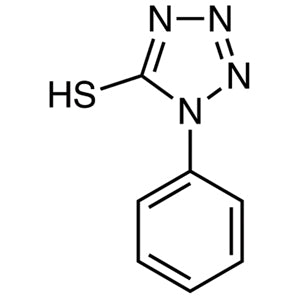
- TCI P0640 86-93-1 5-Mercapto-1-phenyl-1H-tetrazole
- Heterocyclic building block synthesis — the intact 1,2,3-triazole ring with a reactive sulfur handle allows chemists to construct larger target molecules without needing to build the heterocycle themselves.
- Thioether formation by S-alkylation — because the thiolate is already deprotonated, it reacts directly with alkylating agents, removing the extra base-addition step from the procedure.
- Metal complexation and ligand chemistry — the compound can donate through the sulfur atom or through the ring nitrogen atoms, giving coordination chemists flexibility in designing complexes with varied binding modes.
- Surface chemistry studies — the sulfur functionality makes this reagent suitable as a probe or modifier in investigations of how thiol-bearing species interact with surfaces.
- Click chemistry-related molecular design — the 1,2,3-triazole motif is central to click chemistry approaches, making this salt a convenient entry point for designing triazole-containing structures.
| Brand | TCI, catalogue code M0847 |
|---|---|
| CAS number | 59032-27-8 |
| Molecular formula | — |
| Purity | — |
| Category | Chemistry > Building Blocks > Heterocyclic Building Blocks |
| Pack sizes | 5 g and 25 g |
| Physical form | ionic solid (sodium salt) |
| Storage | keep containers tightly closed and follow the storage conditions stated on the manufacturer's label and safety data sheet |
Store the material in its original tightly closed container, kept in a cool, dry and well-ventilated area away from moisture and incompatible substances, and follow the specific storage conditions indicated on the manufacturer's label and safety data sheet. Because the compound bears a reactive thiolate group, transfers should be carried out promptly to limit exposure to air and humidity, using clean and dry spatulas and glass or otherwise chemically compatible containers. Weighing and handling are best performed in a fume hood with appropriate personal protective equipment, including safety glasses, gloves and a laboratory coat. Label all secondary containers clearly, and consult the safety data sheet before use and before disposal of residues.
—
Produk Terkait
-
3-Amino-5-mercapto-1,2,4-triazole TCI A1455
Regular price From Rp 980.700,00Regular price -
4-Amino-3-hydrazino-5-mercapto-1,2,4-triazole[forDeterminationofAldehydes] TCI A0956
Regular price From Rp 1.670.550,00Regular price -
3-Mercapto-4-methyl-4H-1,2,4-triazole TCI M1224
Regular price Rp 1.510.950,00Regular price -
3-Mercapto-1,2,4-triazole TCI M0814
Regular price From Rp 1.510.950,00Regular price -
2-Amino-5-mercapto-1,3,4-thiadiazole TCI A0425
Regular price From Rp 769.650,00Regular price -
5-Mercapto-1-phenyl-1H-tetrazole TCI P0640
Regular price From Rp 875.700,00Regular price -
2-Mercapto-6-nitrobenzothiazole TCI N0326
Regular price From Rp 2.016.000,00Regular price -
(5-Mercapto-1,3,4-thiadiazol-2-ylthio)aceticAcid TCI M2100
Regular price From Rp 1.458.450,00Regular price

![1750-12-5 4-Amino-3-hydrazino-5-mercapto-1,2,4-triazole [for Determination of Aldehydes] - AMI Scientific](http://amiscientific.com/cdn/shop/files/TCI2510A0956.jpg?v=1767080402&width=533)