

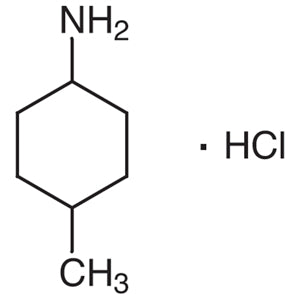
TCI M0957 4-Methylcyclohexylamine Hydrochloride is the hydrochloride salt of an alicyclic amine bearing a methyl group at the para position of the cyclohexane ring. As a non-heterocyclic building block, this compound supplies a saturated amine fragment that is rigid yet still conformationally flexible, a characteristic widely sought in the design of modern active molecules. The salt form makes the material a solid that is far easier to weigh, store, and handle than the corresponding free amine, which is volatile and tends to absorb carbon dioxide from the air.
The characteristic that makes it a preferred choice is its stability and ease of handling without sacrificing reactivity. The free amine can be liberated again simply with base whenever a reaction requires it, so users obtain purity and practicality at the same time. The methyl-substituted cyclohexane ring contributes three-dimensional volume as well as lipophilic character that is useful for tuning the physicochemical properties of a target molecule, particularly in medicinal chemistry research that seeks to shift molecular character away from flat aromatics toward saturated frameworks. The primary amine group on this material is ready to be carried into subsequent bond-forming steps.
In Indonesian laboratories, this building block is typically used in university and institutional synthetic chemistry groups, in medicinal chemistry and drug discovery research, and in process development work where a well-defined saturated amine fragment is needed. Its solid salt form suits local conditions well, since warm and humid ambient air makes volatile free amines difficult to store and dispense accurately. Researchers preparing amide, sulfonamide, urea, and related derivative libraries commonly keep it as a standard shelf reagent.
Related TCI products
- TCI B4014 37942-69-1 4-Butylcyclohexylamine (cis- and trans- mixture)
- TCI B4004 25834-93-9 4-sec-Butylcyclohexylamine (cis- and trans- mixture)
- TCI B1084 5400-88-4 4-tert-Butylcyclohexylamine (cis- and trans- mixture)
- TCI A2609 202256-86-8 4-(2-Aminoethyl)cyclohexylamine (cis- and trans- mixture)
- TCI A0891 3312-60-5 N-(3-Aminopropyl)cyclohexylamine
- TCI T0601 15901-42-5 3,3,5-Trimethylcyclohexylamine (cis- and trans- mixture)
- Medicinal chemistry scaffold construction — the saturated methylcyclohexyl amine fragment adds three-dimensional character and lipophilicity, helping researchers move target molecules away from flat aromatic frameworks during lead design.
- Amide and sulfonamide derivative synthesis — the primary amine, once liberated from the salt with base, couples readily with acid chlorides, activated esters, and sulfonyl chlorides in routine bench procedures.
- Urea and carbamate preparation — the accessible primary amine reacts with isocyanates and chloroformates, giving conformationally defined products useful for structure–activity relationship studies in drug discovery programs.
- Reductive amination and alkylation studies — the amine functionality serves as a nucleophilic partner for aldehydes and ketones, allowing secondary and tertiary amine analogues to be built systematically.
- Compound library and intermediate stock preparation — the stable, easily weighed hydrochloride salt allows accurate and reproducible dispensing when parallel synthesis campaigns require many small, precisely measured portions.
| Brand | TCI (Tokyo Chemical Industry) |
|---|---|
| CAS number | 100959-19-1 |
| Molecular formula | — |
| Purity | — |
| Category | Chemistry > Building Blocks > Non-Heterocyclic Building Blocks |
| Pack sizes | available in standard TCI research-scale packaging; please confirm the currently offered sizes when ordering |
| Physical form | solid (hydrochloride salt) |
| Storage | keep in a tightly closed container, protected from moisture |
- Product code: M0957
Store the container tightly closed in a cool, dry, and well-ventilated area, away from moisture and from incompatible materials such as strong acids and oxidizing agents. Amine hydrochloride salts are hygroscopic in character, so exposure to humid air should be minimized; reseal the original container promptly after each use and consider a desiccator for opened stock. Handle the solid in a fume hood using safety goggles, nitrile gloves, and a laboratory coat, and avoid generating dust during weighing. Transfer with clean, dry spatulas to prevent contamination, label all secondary containers clearly, and consult the manufacturer's safety data sheet before use and for disposal guidance.
—
Produk Terkait
-
4-Butylcyclohexylamine(cis-andtrans-mixture) TCI B4014
Regular price From Rp 3.392.550,00Regular price -
4-sec-Butylcyclohexylamine(cis-andtrans-mixture) TCI B4004
Regular price Rp 3.232.950,00Regular price -
4-tert-Butylcyclohexylamine(cis-andtrans-mixture) TCI B1084
Regular price From Rp 1.193.850,00Regular price -
4-(2-Aminoethyl)cyclohexylamine(cis-andtrans-mixture) TCI A2609
Regular price From Rp 3.180.450,00Regular price -
N-(3-Aminopropyl)cyclohexylamine TCI A0891
Regular price From Rp 1.881.600,00Regular price -
3,3,5-Trimethylcyclohexylamine(cis-andtrans-mixture) TCI T0601
Regular price Rp 2.121.000,00Regular price -
cis-4-Methylcyclohexylamine TCI M2949
Regular price Rp 4.108.650,00Regular price -
3-Methylcyclohexylamine(cis-andtrans-mixture) TCI M2105
Regular price From Rp 7.129.500,00Regular price


