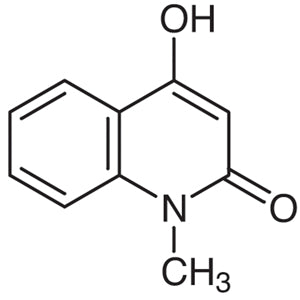
4-Hydroxy-1-methyl-2-quinolone with CAS number 1677-46-9 is a heterocyclic building block from TCI built on the quinolinone framework, a fused ring system combining a benzene ring with a pyridinone ring. The molecule carries a hydroxy group on the heterocyclic ring together with a methyl group on the nitrogen atom. The quinolinone skeleton is widely recognised as a structural core appearing in a range of alkaloids and bioactive compounds, which makes this material a valuable starting point for laboratories engaged in the synthesis of nitrogen heterocycles and in medicinal chemistry work.
The property that drives its selection is the presence of a hydroxy system conjugated with a carbonyl group, which produces tautomeric behaviour and at the same time confers mild acidity on the hydroxy proton. This character allows the compound to act as a nucleophile at either the carbon or the oxygen position depending on the reaction conditions chosen, giving researchers the freedom to direct the outcome of a synthesis. The methyl group on the nitrogen blocks reaction at that position, so reaction selectivity is more easily controlled than with unsubstituted analogues. Its solid form is stable under ordinary storage conditions.
In Indonesian laboratories, this building block is typically handled in university research groups, pharmaceutical research units, and synthetic chemistry laboratories developing new nitrogen heterocyclic compounds. It is normally used on a research and development scale rather than in production, weighed out in small portions for exploratory reaction screening, then scaled up once a route has been established. Because it is supplied as a stable solid, it suits laboratories that store reagents over extended periods between experimental campaigns.
Related TCI products
- TCI A1470 732304-23-3 4-Amino-6-hydroxy-2-methylpyrimidine Hydrate
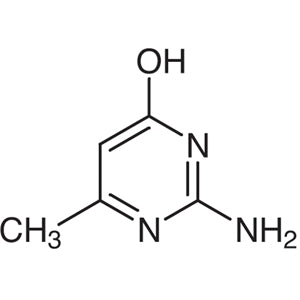
- TCI A1204 3977-29-5 2-Amino-4-hydroxy-6-methylpyrimidine
- TCI A0791 1004-40-6 4-Amino-6-hydroxy-2-mercaptopyrimidine
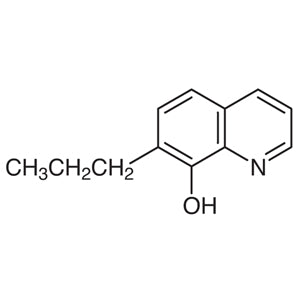
- TCI P0531 58327-60-9 8-Hydroxy-7-propylquinoline
- TCI M2716 5118-06-9 Methyl 3-Hydroxy-2-thiophenecarboxylate
- TCI M0673 118-71-8 3-Hydroxy-2-methyl-4-pyrone
- Heterocyclic synthesis research, where the intact quinolinone core saves several construction steps and lets chemists begin work directly at the functionalisation stage.
- Medicinal chemistry exploration, because the quinolinone motif recurs in bioactive compounds and provides a structurally relevant scaffold for building and screening candidate analogues.
- Selective alkylation and acylation studies, since the compound can react at either carbon or oxygen depending on conditions, making it a useful probe of reaction selectivity.
- Alkaloid-related synthetic work, as the fused benzene and pyridinone ring system corresponds to the structural core found across numerous naturally occurring alkaloid families.
- Methodology development for nitrogen heterocycles, where the nitrogen-methylated position removes one competing reactive site and simplifies interpretation of experimental reaction outcomes.
| Brand | TCI |
|---|---|
| CAS number | 1677-46-9 |
| Molecular formula | — |
| Purity | — |
| Category | Chemistry > Building Blocks > Heterocyclic Building Blocks |
| Pack sizes | available in standard TCI research-scale packaging; please confirm the size options when ordering |
| Physical form | solid |
| Storage | store under ordinary conditions as a stable solid, kept closed and protected from moisture |
Store the material in a tightly closed original container in a cool, dry place away from direct sunlight and sources of heat. Glass containers with well-sealing caps are appropriate, and the container should be returned to storage promptly after weighing to limit exposure to atmospheric moisture. Handle the solid in a fume hood or a well-ventilated area to avoid inhalation of dust, and wear gloves, safety glasses, and a laboratory coat throughout. Use clean, dry spatulas to prevent contamination, label all working portions clearly, and consult the manufacturer's safety data sheet before first use and before disposal of any residues.
—
Produk Terkait
-
4-Amino-6-hydroxy-2-methylpyrimidineHydrate TCI A1470
Regular price From Rp 743.400,00Regular price -
2-Amino-4-hydroxy-6-methylpyrimidine TCI A1204
Regular price From Rp 928.200,00Regular price -
4-Amino-6-hydroxy-2-mercaptopyrimidine TCI A0791
Regular price Rp 1.140.300,00Regular price -
8-Hydroxy-7-propylquinoline TCI P0531
Regular price From Rp 4.877.250,00Regular price -
Methyl3-Hydroxy-2-thiophenecarboxylate TCI M2716
Regular price From Rp 1.035.300,00Regular price -
3-Hydroxy-2-methyl-4-pyrone TCI M0673
Regular price From Rp 928.200,00Regular price -
5-Hydroxy-1-methyl-1H-pyrazole TCI H1695
Regular price From Rp 955.500,00Regular price -
4-Hydroxy-6-methylpyrimidine TCI H1675
Regular price Rp 1.696.800,00Regular price