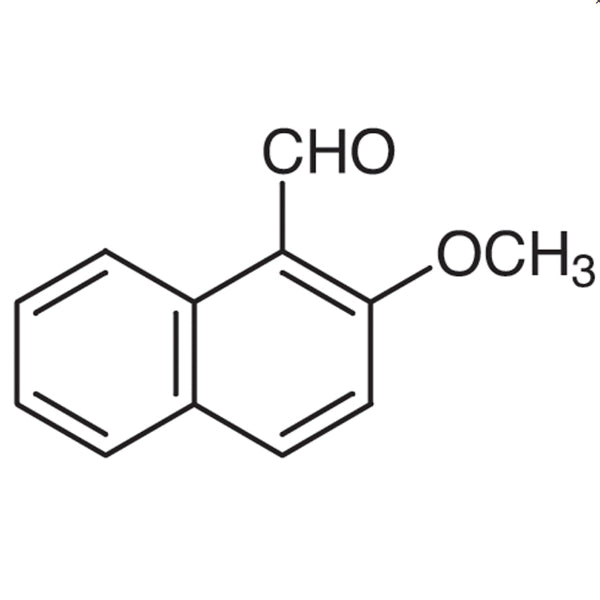
TCI M1040 2-Methoxy-1-naphthaldehyde, bearing CAS number 5392-12-1, is an aromatic aldehyde built on a naphthalene framework, with the aldehyde group at position one and the methoxy group at the directly adjacent position two. This extensively conjugated two-ring aromatic system gives the compound its distinctive photophysical character, so that in addition to serving as an ordinary synthetic building block, it is also widely used as a starting material for the preparation of fluorescent compounds. In the laboratory, its aldehyde group is the primary entry point for condensation reactions, while the naphthalene framework contributes optical properties that simple benzene aldehydes do not possess.
The property that makes this material so sought after is the readiness with which the aldehyde group reacts with primary amines to form stable Schiff bases, combined with the neighbouring methoxy position, which can be demethylated to a hydroxy group in order to produce naphthol-based salicylaldimine-type ligands. This combination makes the compound a reliable material in the design of chemosensors for metal ion detection, because the resulting compounds frequently display colour changes or luminescence that are visible to the naked eye. Its solid form at room temperature makes precise weighing straightforward and simplifies routine handling on the bench.
In Indonesian laboratories, this building block is typically encountered in university and institutional research settings where synthetic organic chemistry, coordination chemistry, and sensor development are pursued. It supports work in which small quantities are weighed out for condensation reactions and subsequent ligand preparation, and its behaviour as a room-temperature solid suits the practical realities of local laboratory work, where accurate gravimetric dispensing and uncomplicated storage on standard chemical shelving are valued.
- Schiff base synthesis — the aldehyde group reacts readily with primary amines to give stable imines, making this a dependable starting point for imine-based synthetic routes.
- Chemosensor development for metal ion detection — derived compounds frequently exhibit colour or luminescence changes visible to the naked eye, allowing straightforward qualitative recognition of target ions.
- Preparation of fluorescent compounds — the extensively conjugated two-ring naphthalene system provides the photophysical character required in starting materials intended for luminescent products.
- Naphthol-based salicylaldimine ligand preparation — the methoxy group adjacent to the aldehyde can be demethylated to a hydroxy group, giving the arrangement needed for this ligand class.
- General non-heterocyclic building block work — as a naphthalene-framework aldehyde, it introduces optical properties into target molecules that simple benzene aldehydes cannot contribute.
| Brand | TCI |
|---|---|
| CAS number | 5392-12-1 |
| Molecular formula | — |
| Purity | — |
| Category | Chemistry > Building Blocks > Non-Heterocyclic Building Blocks |
| Pack sizes | available in the standard TCI catalogue pack sizes for this item |
| Physical form | solid at room temperature |
| Storage | keep in a closed container under the conditions stated on the supplier label and safety data sheet |
Store the material in its original tightly closed container, kept in a cool, dry and well-ventilated area away from direct sunlight, moisture and ignition sources. Amber glass or the supplier's original packaging is suitable for maintaining product integrity, and containers should be resealed immediately after each use to limit exposure to air and humidity. As an aromatic aldehyde, it should be kept separate from strong oxidising agents and from primary amines with which it readily reacts. Handle in a fume hood using safety goggles, gloves and a laboratory coat, weigh the solid carefully to avoid generating dust, and consult the supplier safety data sheet before use and for waste disposal guidance.
—
Produk Terkait
-
6-Methoxy-2-naphthaldehyde TCI M1090
Regular price From Rp 980.700,00Regular price -
4-Methoxy-1-naphthaldehyde TCI M1049
Regular price Rp 3.367.350,00Regular price -
1-Bromo-2-naphthaldehyde TCI B1647
Regular price From Rp 1.696.800,00Regular price -
2-Naphthaldehyde TCI N0003
Regular price From Rp 1.008.000,00Regular price -
1-Naphthaldehyde TCI N0002
Regular price From Rp 769.650,00Regular price -
1-Hydroxy-2-naphthaldehyde TCI H0839
Regular price From Rp 5.009.550,00Regular price -
2-Hydroxy-1-naphthaldehyde TCI H0275
Regular price From Rp 1.829.100,00Regular price -
2-Ethoxy-1-naphthaldehyde TCI E0794
Regular price Rp 5.512.500,00Regular price