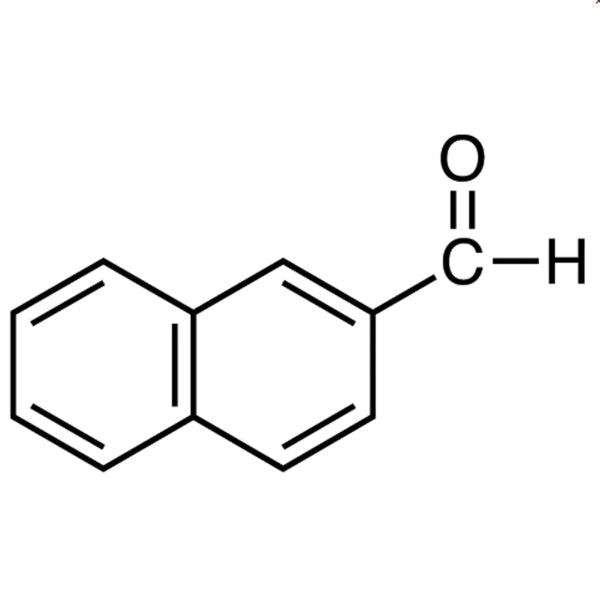
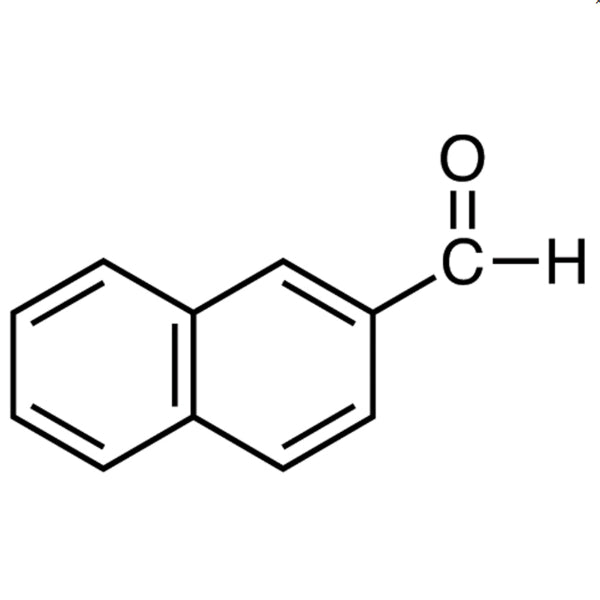
2-Naphthaldehyde with CAS number 66-99-9 is an aromatic aldehyde in which a formyl group is attached at the two position, also known as the beta position, of the naphthalene nucleus. The compound is an isomer of 1-naphthaldehyde, and both serve as dependable aromatic building blocks in organic synthesis laboratories. The aldehyde group acts as the reactive centre for condensation, nucleophilic addition, oxidation and reduction, allowing researchers to convert it into imines, alcohols, carboxylic acids or conjugated compounds according to the requirements of the synthetic design being pursued.
The property that makes this isomer a preferred choice is the substitution geometry at the beta position, which is far less sterically congested than the alpha position. Without peri hindrance, the formyl group sits in the same plane as the aromatic ring, so conjugation proceeds more effectively and condensation reactions generally run more smoothly with cleaner results. Derivative products tend to be solids that are easy to purify by recrystallisation, a practical advantage for laboratories that do not always have access to large-scale column chromatography. The naphthalene framework also contributes an intrinsic fluorescence character that underlies many applications.
In Indonesian laboratories, this building block is typically used in university and institutional organic synthesis work, where researchers prepare derivatives step by step from commercially available aromatic starting materials. Its handling as a manageable solid-forming reagent and the ease of purifying its products by recrystallisation suit laboratories that plan around limited instrument availability. It is commonly requested for graduate research, methodology development and preparation of conjugated intermediates for further study.
TCI brochures (PDF)
- Building Blocks for Organic Semiconductor 2026-03-24 · p. 8
- Condensation reaction substrate: the unhindered beta formyl group reacts readily with active methylene compounds and amines, giving cleaner conversions than the sterically crowded alpha isomer.
- Imine and Schiff base preparation: nucleophilic addition of primary amines to the aldehyde carbonyl proceeds directly, producing naphthalene-bearing imine ligands and intermediates for further synthetic elaboration.
- Alcohol and carboxylic acid synthesis: reduction of the formyl group affords the corresponding alcohol, while oxidation delivers the carboxylic acid for downstream functional group interconversion work.
- Conjugated compound construction: planar alignment of the formyl group with the aromatic ring supports effective conjugation, making it useful for building extended conjugated molecular systems.
- Fluorescence-based studies: the naphthalene framework carries intrinsic fluorescence character, so derivatives prepared from this aldehyde serve as a basis for fluorescence-related investigations in the laboratory.
| Brand | TCI |
|---|---|
| CAS number | 66-99-9 |
| Molecular formula | — |
| Purity | — |
| Category | Chemistry > Building Blocks > Non-Heterocyclic Building Blocks |
| Pack sizes | available in the standard TCI catalogue pack sizes; please confirm the packaging option when ordering |
| Physical form | — |
| Storage | keep in a tightly closed original container in a cool, dry, well-ventilated place away from light and heat |
- Product code: N0003
Store the material in its tightly closed original container, kept in a cool, dry and well-ventilated area away from direct sunlight, heat sources and ignition sources. Keep it separated from strong oxidising agents and strong bases. Aromatic aldehydes are susceptible to slow air oxidation, so minimise the time the container stays open and close it firmly after each use. Handle the compound inside a fume hood, and wear safety glasses, chemical-resistant gloves and a laboratory coat. Avoid inhalation of dust or vapour and avoid contact with skin and eyes. Always consult the manufacturer safety data sheet before use, and dispose of residues and contaminated material through the laboratory chemical waste system.
—
Produk Terkait
-
1-Naphthaldehyde TCI N0002
Regular price From Rp 769.650,00Regular price -
1-Bromo-2-naphthaldehyde TCI B1647
Regular price From Rp 1.696.800,00Regular price -
6-Methoxy-2-naphthaldehyde TCI M1090
Regular price From Rp 980.700,00Regular price -
4-Methoxy-1-naphthaldehyde TCI M1049
Regular price Rp 3.367.350,00Regular price -
2-Methoxy-1-naphthaldehyde TCI M1040
Regular price From Rp 769.650,00Regular price -
1-Hydroxy-2-naphthaldehyde TCI H0839
Regular price From Rp 5.009.550,00Regular price -
2-Hydroxy-1-naphthaldehyde TCI H0275
Regular price From Rp 1.829.100,00Regular price -
2-Ethoxy-1-naphthaldehyde TCI E0794
Regular price Rp 5.512.500,00Regular price