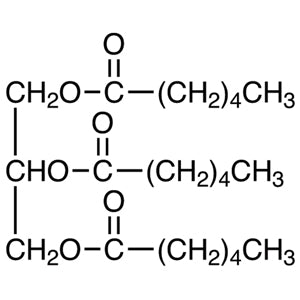
TCI M1071 is Monocaprylin, a monoglyceride composed of glycerol esterified with a single molecule of caprylic acid, an eight-carbon fatty acid. The compound belongs to the simple lipid class and carries an amphiphilic structure: the glycerol portion is polar because it retains two free hydroxyl groups, while the fatty acyl chain is nonpolar. In life science laboratories, monoacylglycerols of this type serve as test substances for antimicrobial activity studies, as components of model membrane systems, as emulsifiers during formulation work, and as reference compounds in lipid profiling by chromatography.
The most distinctive property of this material is its medium acyl chain length. A C8 chain produces a hydrophilic–lipophilic balance that differs from that of long-chain monoglycerides, so monocaprylin tends to disperse more readily in aqueous systems and displays a characteristic surface activity. This behaviour is precisely what draws researchers to its antimicrobial properties, since medium-chain monoglycerides are known to interact with the lipid membranes of microorganisms. The presence of two free hydroxyl groups on the glycerol backbone additionally opens routes for chemical derivatisation, such as acylation.
In Indonesian laboratories, monocaprylin is typically handled in academic biochemistry and microbiology groups, food and pharmaceutical technology research units, and analytical facilities that build lipid reference libraries. It is commonly weighed out on an analytical balance, dispersed or dissolved in an appropriate solvent system, and carried forward into membrane, emulsion, or antimicrobial screening experiments. Supplied under the TCI brand, it fits routine bench-scale research work where a defined medium-chain monoacylglycerol standard is required.
- Antimicrobial activity screening: the medium-chain acyl group interacts with microbial lipid membranes, making this monoglyceride a suitable test compound for evaluating inhibitory effects against microorganisms in the laboratory.
- Model membrane studies: its amphiphilic structure, combining a polar glycerol head and a nonpolar C8 tail, allows it to be incorporated into lipid assemblies used as simplified membrane models.
- Emulsifier in formulation preparation: the surface activity arising from its hydrophilic–lipophilic balance lets researchers use monocaprylin to stabilise dispersed phases during experimental formulation development work.
- Chromatographic lipid profiling: as a defined monoacylglycerol, it serves as a comparison or reference compound when identifying and characterising lipid species within chromatographic separation and analysis workflows.
- Chemical derivatisation substrate: the two free hydroxyl groups on the glycerol backbone provide reactive positions for synthetic modification, for example acylation, in preparative organic and lipid chemistry investigations.
| Brand | TCI (Tokyo Chemical Industry) |
|---|---|
| CAS number | 26402-26-6 |
| Molecular formula | — |
| Purity | — |
| Category | Life Science > Biochemicals and Reagents > Lipids |
| Pack sizes | supplied in standard TCI catalogue packaging; please confirm the available pack size when ordering |
| Physical form | — |
| Storage | keep in the original closed container under the conditions stated on the manufacturer's label and safety data sheet |
- Chemical class: monoacylglycerol (monoglyceride) of caprylic acid, a medium-chain C8 fatty acid
Store monocaprylin in its original tightly closed container, protected from moisture, direct sunlight, and heat sources, and follow the storage temperature stated by the manufacturer on the product label and safety data sheet. Glass containers with chemically resistant closures are generally suitable, and the container should be resealed promptly after each use to limit exposure to atmospheric moisture. Handle the material in a well-ventilated area or fume hood, wear a laboratory coat, safety glasses, and appropriate gloves, and avoid direct contact with skin and eyes. Use clean, dry spatulas when weighing to prevent cross-contamination of the stock, and consult the safety data sheet before any new procedure.
—
Product Categories
Produk Terkait
-
1-Monocaprin TCI M1072
Regular price From Rp 2.625.000,00Regular price -
Tripalmitin TCI T3096
Regular price From Rp 1.458.450,00Regular price -
Trielaidin TCI T1392
Regular price Rp 3.683.400,00Regular price -
Tribehenin TCI T1391
Regular price From Rp 2.094.750,00Regular price -
Triarachidin TCI T1389
Regular price From Rp 2.809.800,00Regular price -
Trilinolein TCI T1388
Regular price From Rp 6.493.200,00Regular price -
Tricaproin TCI T0441
Regular price From Rp 2.916.900,00Regular price -
Tricaprin TCI T0413
Regular price From Rp 2.571.450,00Regular price