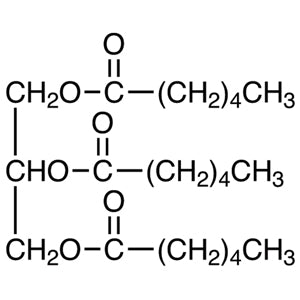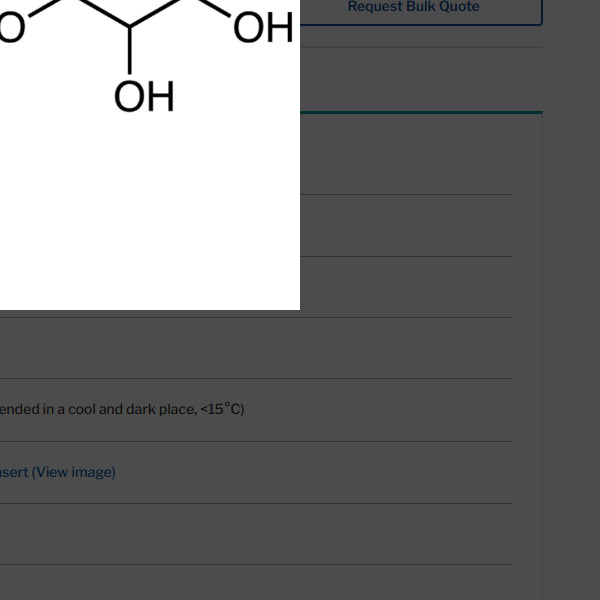
TCI M1072 is 1-Monocaprin, a monoglyceride formed from glycerol and a single ten-carbon capric acid molecule esterified at the one position. As a member of the medium-chain monoacylglycerol family, the compound has an amphiphilic structure with a polar glycerol head and a nonpolar acyl tail. In life science laboratories, materials of this type are used to study lipid interactions with biological membranes, as analytical reference points in the determination of lipid composition, and as test substances in research on antimicrobial activity and the formulation of lipid-based preparations.
The characteristic properties of 1-monocaprin arise from the combination of the C10 chain length and the specific site of acylation at the first carbon of glycerol. This defined regiochemistry matters because the one-position and two-position isomers can display different physical behaviour and different susceptibility to enzymatic action, so research that demands structural precision requires material with an unambiguous acyl position. The ten-carbon chain length gives a hydrophilic-lipophilic balance that leaves the compound sufficiently active at interfaces while remaining manageable as a solid. The two free hydroxyl groups on the glycerol backbone contribute further to its interfacial behaviour and to the chemistry available on the molecule.
In Indonesian laboratories, this grade of monoacylglycerol is typically used in university and institutional research groups working on lipid biochemistry, food and pharmaceutical science, and applied microbiology. It serves as a defined starting material or comparison standard in work where the identity and acyl position of the lipid must be established rather than assumed. Laboratories carrying out analytical profiling of lipid mixtures also keep such single-component materials on hand to support peak assignment and method development.
- Membrane interaction studies: the amphiphilic structure, with a polar glycerol head and nonpolar C10 tail, allows controlled investigation of how medium-chain monoacylglycerols associate with and perturb biological membranes.
- Analytical reference material for lipid composition: as a single, structurally defined monoacylglycerol, it supports identification and comparison work when the components of a lipid mixture are being assigned.
- Antimicrobial activity research: monoglycerides of this chain length are studied as test substances in laboratory investigations of antimicrobial behaviour, where a defined acyl position is needed for interpretable results.
- Lipid-based formulation development: the hydrophilic-lipophilic balance conferred by the ten-carbon chain makes it useful as a model component when studying lipid-based preparations and their interfacial behaviour.
- Regiochemistry and enzyme susceptibility studies: because one-position and two-position isomers differ in physical behaviour and enzymatic susceptibility, this defined 1-isomer serves research comparing positional effects directly.
| Brand | TCI |
|---|---|
| CAS number | 2277-23-8 |
| Molecular formula | — |
| Purity | — |
| Category | Life Science > Biochemicals and Reagents > Lipids |
| Pack sizes | please refer to the packaging options listed for this catalogue number |
| Physical form | solid at ordinary handling conditions |
| Storage | store according to the conditions stated on the manufacturer's label and safety data sheet |
- Catalogue number: M1072
- Chemical name: 1-Monocaprin (monoacylglycerol of capric acid, esterified at the 1-position)
Store the container tightly closed in a cool, dry place away from direct sunlight, heat sources, and strong oxidising agents, following the storage conditions stated on the manufacturer's label and safety data sheet. Keep the material in its original container or in a comparable tightly sealed glass or chemically compatible vessel, clearly labelled and protected from moisture. Handle in a well-ventilated area or fume hood, wearing a laboratory coat, safety glasses, and suitable gloves. Avoid generating dust when weighing the solid, and return the container promptly to storage after use. Allow refrigerated material to reach room temperature before opening to limit condensation. Consult the safety data sheet before first use and dispose of residues in accordance with institutional chemical waste procedures.
—
Produk Terkait
-
Monocaprylin TCI M1071
Regular price From Rp 4.056.150,00Regular price -
Tripalmitin TCI T3096
Regular price From Rp 1.458.450,00Regular price -
Trielaidin TCI T1392
Regular price Rp 3.683.400,00Regular price -
Tribehenin TCI T1391
Regular price From Rp 2.094.750,00Regular price -
Triarachidin TCI T1389
Regular price From Rp 2.809.800,00Regular price -
Trilinolein TCI T1388
Regular price From Rp 6.493.200,00Regular price -
Tricaproin TCI T0441
Regular price From Rp 2.916.900,00Regular price -
Tricaprin TCI T0413
Regular price From Rp 2.571.450,00Regular price