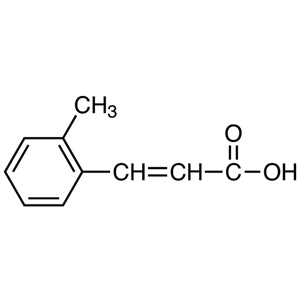
2-Methylcinnamic Acid is a chemical compound widely used in organic synthesis reactions within laboratory settings. It serves as a building block for the creation of aromatic compounds and their derivatives, playing a crucial role in both pure chemical research and applied chemistry. Its molecular structure, containing a cinnamic acid group and a methyl substituent, makes it highly versatile for various chemical transformations. This compound is particularly valued for its ability to participate in substitution and addition reactions, allowing chemists to explore new synthetic pathways and functional group modifications.
The chemical properties of 2-Methylcinnamic Acid contribute to its popularity among researchers. It exhibits a stable molecular structure that allows for long-term storage under appropriate conditions, while still maintaining reactivity when required. The presence of a carbonyl group and aromatic ring enhances its compatibility with a wide range of reaction conditions, making it suitable for both routine and specialized laboratory applications. Its moderate reactivity ensures that it can be used in controlled environments without excessive degradation or unwanted side reactions.
In Indonesian laboratories, 2-Methylcinnamic Acid is commonly used in pure chemical and organic synthesis research. It is a preferred choice for its reliability, stability, and adaptability in various chemical processes. Researchers in Indonesia rely on this compound to advance their studies in pharmaceutical development, material science, and industrial chemistry. Its availability and consistent performance make it a valuable resource for both academic and industrial research settings.
- Organic synthesis research utilizes 2-Methylcinnamic Acid for its ability to participate in substitution and addition reactions, enabling the creation of complex aromatic derivatives.
- Pharmaceutical development benefits from this compound due to its structural similarity to known bioactive molecules, aiding in the design of new drug candidates.
- Material science applications leverage its chemical stability and reactivity to develop new polymers and functional materials with specific properties.
- Analytical chemistry laboratories use it as a reference standard for identifying and quantifying aromatic compounds in various samples.
- Industrial chemical processes incorporate it as a precursor in the production of specialty chemicals and intermediates for downstream applications.
| Brand | TCI |
|---|---|
| CAS number | 2373-76-4 |
| Molecular formula | — |
| Purity | — |
| Category | Chemistry > Building Blocks > Non-Heterocyclic Building Blocks |
| Pack sizes | Available in various quantities as per supplier specifications |
| Physical form | Solid, crystalline appearance |
| Storage | Store in a cool, dry place away from direct sunlight and moisture |
2-Methylcinnamic Acid should be stored in a cool, dry environment to maintain its chemical stability and prevent degradation. It is recommended to keep the compound in a sealed container to protect it from moisture and air exposure. Due to its moderate reactivity, it should be handled in a well-ventilated laboratory setting to minimize any potential chemical interactions. Avoid contact with incompatible substances such as strong oxidizing agents. When working with this compound, it is advisable to use appropriate personal protective equipment, including gloves and safety goggles, to ensure safe handling. Proper storage and handling practices help preserve the compound’s integrity and ensure its effectiveness in laboratory applications.
—
Produk Terkait
-
(E)-alpha-MethylcinnamicAcid TCI M1336
Regular price From Rp 795.900,00Regular price -
3-MethylcinnamicAcid TCI M1298
Regular price From Rp 2.016.000,00Regular price -
4-MethylcinnamicAcid TCI M0715
Regular price Rp 1.829.100,00Regular price -
2,4-Dimethoxy-beta-methylcinnamicAcid TCI D5047
Regular price From Rp 1.431.150,00Regular price -
Methyl4-Methylcinnamate TCI M2825
Regular price From Rp 717.150,00Regular price -
alpha-Methylcinnamaldehyde TCI M0584
Regular price From Rp 1.060.500,00Regular price -
2,3,4-TrimethoxycinnamicAcid TCI T2016
Regular price From Rp 875.700,00Regular price -
2,4,5-TrimethoxycinnamicAcid TCI T1393
Regular price Rp 2.094.750,00Regular price