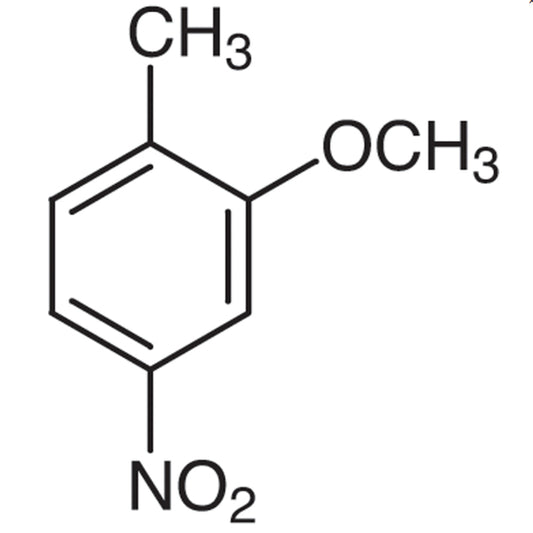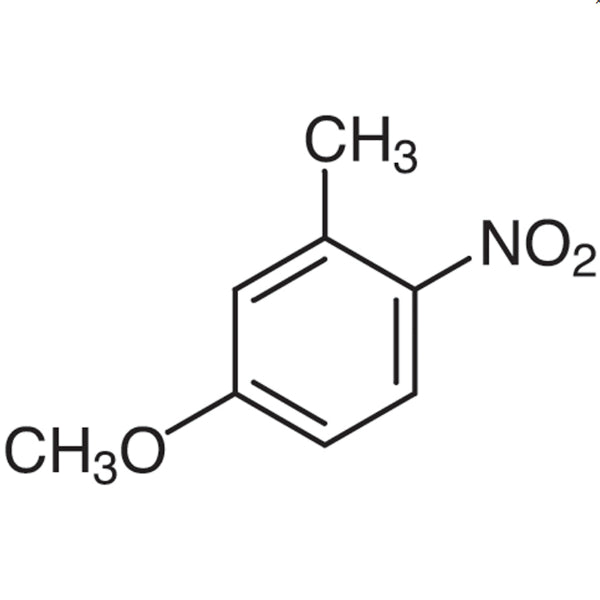
5-Methoxy-2-nitrotoluene is a chemical compound widely used in organic laboratory reactions. It serves as a key building block in the synthesis of complex molecules, offering versatility in chemical transformations. This compound is particularly valuable for researchers aiming to explore substitution reactions or oxidation processes. Its unique molecular structure provides a foundation for various synthetic pathways, making it an essential reagent in modern chemical research.
The compound's chemical properties, including the presence of both nitro and methoxy groups, contribute to its reactivity and functional versatility. These groups enable it to participate in both electrophilic and nucleophilic reactions, expanding its applicability in synthetic chemistry. Its stability under controlled conditions ensures reliable performance in laboratory settings, while its reactivity allows for targeted chemical modifications. This combination of stability and reactivity makes it a preferred choice for chemists working on diverse synthetic projects.
In Indonesian laboratories, 5-Methoxy-2-nitrotoluene is commonly utilized in organic chemistry research, especially in the synthesis of aromatic compounds and their derivatives. Its availability and chemical properties make it a go-to material for researchers seeking to develop new compounds or study reaction mechanisms. The compound's role in both academic and industrial research underscores its importance in the chemical sciences.
- Organic synthesis applications benefit from 5-Methoxy-2-nitrotoluene's ability to undergo substitution reactions, providing a versatile starting point for complex molecule creation.
- It is ideal for oxidation studies due to its nitro group, which can be reduced or modified in various chemical environments, offering insights into redox mechanisms.
- In the development of aromatic derivatives, its structure supports the synthesis of compounds with specific functional groups, enhancing the range of available chemical tools.
- The compound is frequently used in research focused on electrophilic activation, where its molecular structure facilitates targeted chemical transformations.
- It supports the study of nucleophilic reactions by offering a stable yet reactive platform for exploring reaction pathways and mechanisms.
| Brand | TCI |
|---|---|
| CAS number | 5367-32-8 |
| Molecular formula | — |
| Purity | — |
| Category | Chemistry > Building Blocks > Non-Heterocyclic Building Blocks |
| Pack sizes | — |
| Physical form | — |
| Storage | Store in a cool, dry place away from direct sunlight and incompatible materials |
5-Methoxy-2-nitrotoluene should be stored in a cool, dry location, away from direct sunlight and sources of heat. It is recommended to use airtight containers made of materials that are chemically inert to prevent degradation or contamination. Due to its chemical reactivity, it should be handled with care, using appropriate personal protective equipment such as gloves and safety goggles. It is important to avoid contact with incompatible substances like strong oxidizing agents or strong bases. Proper ventilation should be maintained in the laboratory to minimize exposure to vapors. Always follow standard laboratory safety protocols when working with this compound to ensure a safe and controlled environment.
—
Produk Terkait
-
2-Methoxy-4-nitrotoluene TCI M1681
Regular price From Rp 1.140.300,00Regular price -
2-Methoxy-6-nitrotoluene TCI M1416
Regular price From Rp 1.115.100,00Regular price -
4-Methoxy-3-nitrotoluene TCI M1205
Regular price Rp 477.750,00Regular price -
3-Methoxy-2-nitrotoluene TCI M1196
Regular price From Rp 1.246.350,00Regular price -
2-Iodo-3-nitrotoluene TCI I0799
Regular price From Rp 2.650.200,00Regular price -
2-Bromo-3-nitrotoluene TCI B3712
Regular price Rp 1.565.550,00Regular price -
2-Bromo-6-nitrotoluene TCI B1878
Regular price From Rp 1.008.000,00Regular price -
2-Bromo-5-nitrotoluene TCI B1853
Regular price From Rp 848.400,00Regular price