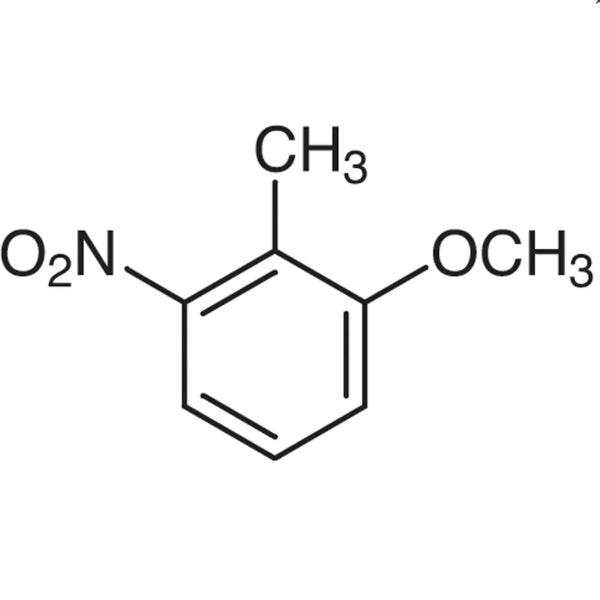
2-Methoxy-6-nitrotoluene is a chemical compound widely used in organic synthesis reactions, particularly in the development of complex molecules requiring specific aromatic structures with functional groups. As a key building block, it plays a crucial role in the construction of more intricate molecular frameworks, enabling flexible chemical modifications. This compound is commonly found in the synthesis of pharmaceuticals, industrial chemicals, and precursors for electrophilic substitution reactions. Its utility in laboratory settings is due to its ability to participate in a variety of chemical transformations, making it a versatile reagent for synthetic chemists.
The compound exhibits stable chemical properties under controlled conditions, yet it remains highly reactive in various chemical processes such as reduction, substitution, and nucleophilic reactions. Its aromatic structure remains intact, allowing for predictable reactivity in laboratory environments. This combination of stability and reactivity makes it a preferred choice for researchers seeking a reliable and adaptable starting material. The compound’s ability to maintain structural integrity while engaging in multiple reaction pathways enhances its value in synthetic chemistry applications.
In Indonesian laboratories, 2-Methoxy-6-nitrotoluene is extensively used in both fundamental and applied chemical research. It is a common reagent in academic and industrial settings, supporting the development of new compounds and materials. Its availability and reliability make it a staple in the chemical supply chain, facilitating a wide range of experimental and production processes.
- Organic synthesis reactions benefit from 2-Methoxy-6-nitrotoluene due to its ability to participate in electrophilic substitution and nucleophilic reactions, making it ideal for creating complex molecular structures.
- Pharmaceutical research utilizes this compound as a precursor in the development of new drugs, leveraging its reactivity and structural versatility for compound modification.
- Industrial chemical production relies on this compound for the synthesis of various chemical intermediates, supporting the manufacturing of specialty chemicals and materials.
- Academic research in chemical sciences frequently employs this reagent for teaching and experimentation, demonstrating its role in both theoretical and practical studies.
- Environmental chemistry studies may use this compound to investigate the behavior of aromatic compounds in different reaction conditions, aiding in the understanding of chemical degradation processes.
| Brand | TCI |
|---|---|
| CAS number | 4837-88-1 |
| Molecular formula | — |
| Purity | — |
| Category | Chemistry > Building Blocks > Non-Heterocyclic Building Blocks |
| Pack sizes | Available in various quantities as per standard laboratory supply |
| Physical form | Solid or liquid, depending on the specific product variant |
| Storage | Store in a cool, dry place away from direct sunlight and incompatible substances |
This compound should be stored in a cool, dry environment, away from direct sunlight and sources of heat. It is recommended to use airtight containers made of materials that are chemically inert, such as glass or stainless steel, to prevent contamination and degradation. Due to its reactivity, it should be handled in a well-ventilated area, preferably under a fume hood, to minimize exposure. Personal protective equipment, including gloves, goggles, and lab coats, should be worn at all times when handling this material. Proper disposal procedures should follow local regulations to ensure environmental safety. Regular monitoring of storage conditions is advised to maintain the compound’s stability and effectiveness in laboratory applications.
—
Produk Terkait
-
2-Methoxy-4-nitrotoluene TCI M1681
Regular price From Rp 1.140.300,00Regular price -
5-Methoxy-2-nitrotoluene TCI M1369
Regular price Rp 1.696.800,00Regular price -
4-Methoxy-3-nitrotoluene TCI M1205
Regular price Rp 477.750,00Regular price -
3-Methoxy-2-nitrotoluene TCI M1196
Regular price From Rp 1.246.350,00Regular price -
2-Iodo-3-nitrotoluene TCI I0799
Regular price From Rp 2.650.200,00Regular price -
2-Bromo-3-nitrotoluene TCI B3712
Regular price Rp 1.565.550,00Regular price -
2-Bromo-6-nitrotoluene TCI B1878
Regular price From Rp 1.008.000,00Regular price -
2-Bromo-5-nitrotoluene TCI B1853
Regular price From Rp 848.400,00Regular price