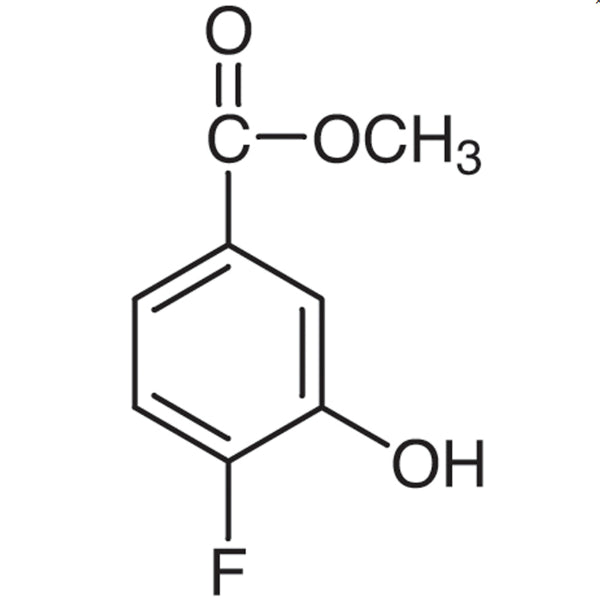
Methyl 4-Fluoro-3-hydroxybenzoate (TCI M1919) is the methyl ester of benzoic acid whose aromatic ring carries two substituents at once: a fluorine atom at the four position and a hydroxyl group at the three position. The material is classified as a fluorinated building block because its function is to serve as a raw material for inserting a fluorine-bearing aromatic ring into more complex molecules. In organic synthesis and medicinal chemistry laboratories, doubly substituted compounds of this kind are highly valued because they provide two distinct reaction points on a single aromatic framework whose substitution positions are already fixed and well defined.
The advantage that makes this compound a preferred choice is the orthogonality of its functional groups. The phenolic hydroxyl group can be alkylated, acylated, converted into a triflate for cross-coupling reactions, or used as an anchoring point for a protecting group. The methyl ester group can be hydrolysed to the carboxylic acid, converted to an amide, or reduced to the benzylic alcohol. The fluorine atom, meanwhile, contributes its own characteristic electronic influence: it increases metabolic stability, tunes lipophilicity, and modulates the acidity of the neighbouring phenol. The combination of these three elements allows a single molecule to be directed down several different synthetic routes.
In Indonesian laboratories, this building block is typically used in university and institutional research groups working on organic synthesis, medicinal chemistry, and the preparation of fluorinated intermediates. It suits bench-scale exploratory work where a chemist needs a pre-functionalised aromatic core rather than building one from scratch. Research and development laboratories in pharmaceutical and fine-chemical settings also draw on such materials when developing synthetic routes, preparing reference compounds, or training postgraduate students in multi-step sequences.
TCI brochures (PDF)
- Fluorination Reagents, Fluorinated Building Blocks 2026-03-18 · p. 20
Related TCI products
- TCI B5213 537050-14-9 2-Bromo-4'-fluoro-3'-(trifluoromethyl)acetophenone
- TCI B5074 749927-69-3 4-Bromo-2-fluoro-N-methylbenzamide
- TCI B4872 10472-88-5 2-Bromo-4-fluoro-6-nitroaniline
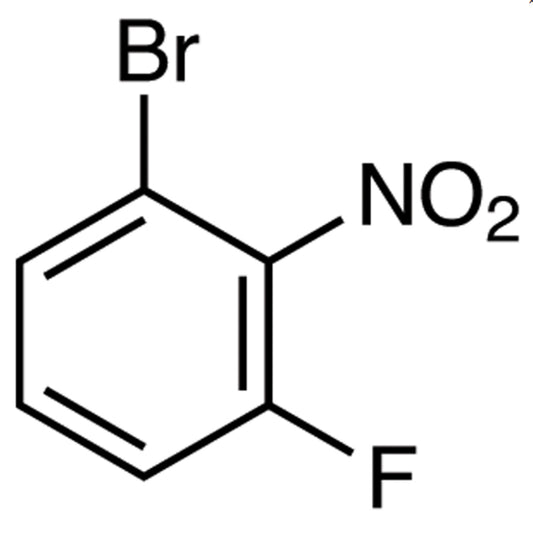
- TCI B4842 886762-70-5 1-Bromo-3-fluoro-2-nitrobenzene
- TCI B4237 362670-07-3 N2-(tert-Butoxycarbonyl)-4-fluoro-1,2-phenylenediamine
- TCI B4236 579474-47-8 N1-(tert-Butoxycarbonyl)-4-fluoro-1,2-phenylenediamine
- Medicinal chemistry intermediate synthesis: the fixed fluorine and hydroxyl positions give chemists a reliable aromatic core for building candidate molecules without the uncertainty of late-stage regioselective substitution.
- Cross-coupling precursor preparation: the phenolic hydroxyl can be converted into a triflate, turning the ring into an electrophilic partner for palladium-catalysed carbon–carbon and carbon–heteroatom bond formation.
- Selective functional group manipulation studies: the orthogonal phenol and methyl ester allow students and researchers to practise protecting group strategy and stepwise transformation on one well-behaved substrate.
- Carboxylic acid and amide derivative preparation: hydrolysis of the methyl ester gives the free acid, which can then be coupled to amines to generate libraries of related amide analogues.
- Structure–property relationship investigations: the fluorine substituent lets researchers study how metabolic stability, lipophilicity, and phenol acidity shift relative to non-fluorinated analogues of the same scaffold.
| Brand | TCI (Tokyo Chemical Industry), product code M1919 |
|---|---|
| CAS number | 214822-96-5 |
| Molecular formula | — |
| Purity | — |
| Category | Chemistry > Building Blocks > Fluorinated Building Blocks |
| Pack sizes | available in standard research-scale catalogue pack sizes; please confirm the current listing when ordering |
| Physical form | — |
| Storage | keep in the tightly closed original container in a cool, dry, well-ventilated place away from light |
- Chemical name: Methyl 4-Fluoro-3-hydroxybenzoate
Store the product in its original tightly closed container in a cool, dry, well-ventilated area, protected from direct sunlight and away from heat sources, strong oxidising agents, and strong bases. Amber glass or the manufacturer's supplied packaging is suitable; ensure the cap is resealed promptly after each use to limit moisture uptake. Handle the compound in a fume hood using nitrile gloves, safety goggles, and a laboratory coat, and avoid generating or inhaling dust. Weigh out only the quantity needed and return the remainder to storage immediately. Consult the manufacturer's safety data sheet before first use, and dispose of residues and contaminated consumables through the laboratory's chemical waste stream in accordance with institutional procedures.
—
Produk Terkait
-
2-Bromo-4'-fluoro-3'-(trifluoromethyl)acetophenone TCI B5213
Regular price From Rp 505.050,00Regular price -
4-Bromo-2-fluoro-N-methylbenzamide TCI B5074
Regular price From Rp 1.035.300,00Regular price -
2-Bromo-4-fluoro-6-nitroaniline TCI B4872
Regular price Rp 1.140.300,00Regular price -
1-Bromo-3-fluoro-2-nitrobenzene TCI B4842
Regular price From Rp 1.273.650,00Regular price -
N2-(tert-Butoxycarbonyl)-4-fluoro-1,2-phenylenediamine TCI B4237
Regular price From Rp 980.700,00Regular price -
N1-(tert-Butoxycarbonyl)-4-fluoro-1,2-phenylenediamine TCI B4236
Regular price From Rp 1.326.150,00Regular price -
1-Bromo-3-fluoro-4-(trifluoromethoxy)benzene TCI B3808
Regular price From Rp 689.850,00Regular price -
4-Bromo-2-fluoro-1-nitrobenzene TCI B3062
Regular price From Rp 1.538.250,00Regular price