

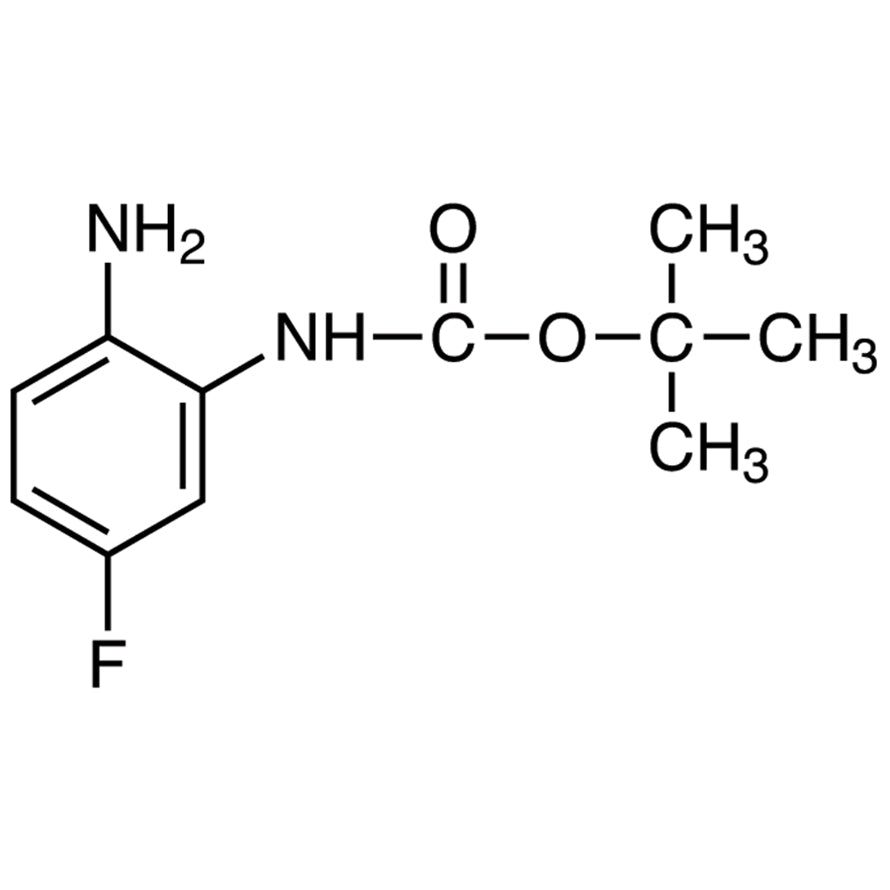
N2-(tert-Butoxycarbonyl)-4-fluoro-1,2-phenylenediamine is a chemical compound widely used as a building block in the synthesis of complex molecules. This compound plays a crucial role in laboratory settings where precise chemical reactions and molecular modifications are required. It is commonly employed in research involving substitution reactions and functional group transformations, making it an essential tool for chemists working on advanced synthetic pathways. Its unique structure and reactivity make it a versatile component in the development of new compounds with specific chemical properties.
The compound's structure includes both a fluoro group and a tert-butoxycarbonyl group, which contribute to its reactivity and stability under various reaction conditions. These properties make it a preferred choice for chemists aiming to achieve controlled and predictable outcomes in their experiments. The presence of the fluoro group enhances its utility in pharmaceutical and organic chemistry applications, while the tert-butoxycarbonyl group provides additional stability during synthetic processes. This combination of features ensures that the compound remains effective in a wide range of chemical reactions.
In Indonesian laboratories, this compound is frequently used in scientific research and product development, particularly in the fields of pharmacy and organic chemistry. Many research institutions and universities rely on it as a foundational material for experiments requiring fluorinated compounds. Its role in synthesizing complex molecules makes it an important resource for both academic and industrial research activities in the region.
TCI brochures (PDF)
- Fluorination Reagents, Fluorinated Building Blocks 2026-03-18 · p. 24
Related TCI products
- TCI B4236 579474-47-8 N1-(tert-Butoxycarbonyl)-4-fluoro-1,2-phenylenediamine
- TCI F0794 6264-67-1 4-Fluoro-1,3-phenylenediamine
- TCI D3726 367-31-7 4-Fluoro-1,2-phenylenediamine
- TCI T2969 364-13-6 2-(Trifluoromethyl)-1,4-phenylenediamine
- TCI T2060 321182-37-0 2,4,5-Trifluoro-1,3-phenylenediamine
- TCI D3729 76179-40-3 4,5-Difluoro-1,2-phenylenediamine
- Fluorinated Compound Synthesis: This compound is ideal for creating fluorinated molecules due to its fluoro group, which is essential in pharmaceutical and organic chemistry applications.
- Molecular Modification Studies: Its reactivity and structural complexity make it suitable for research focused on modifying molecular structures through substitution reactions.
- Organic Chemistry Research: It serves as a key building block in the development of new organic compounds, supporting a wide range of synthetic pathways.
- Pharmaceutical Development: The compound's properties are valuable in the synthesis of drug candidates, especially those requiring specific functional groups.
- Academic Research: It is commonly used in university laboratories for teaching and research purposes, providing students with hands-on experience in advanced chemical synthesis.
| Brand | TCI |
|---|---|
| CAS number | 362670-07-3 |
| Molecular formula | — |
| Purity | — |
| Category | Chemistry > Building Blocks > Fluorinated Building Blocks |
| Pack sizes | Available in various quantities as per supplier specifications |
| Physical form | Solid powder |
| Storage | Store in a cool, dry place away from light and moisture |
This compound should be stored in a cool, dry environment to maintain its chemical integrity and prevent degradation. It is recommended to use airtight containers to protect it from moisture and air exposure. Due to its reactivity, it should be handled with care in a well-ventilated laboratory setting. Proper personal protective equipment, such as gloves and safety goggles, should be worn when handling the compound. It is important to avoid direct contact with skin and eyes, and to ensure that spillage is promptly cleaned up using appropriate safety protocols. The compound should not be stored near incompatible materials to prevent unwanted chemical reactions.
—
Produk Terkait
-
N1-(tert-Butoxycarbonyl)-4-fluoro-1,2-phenylenediamine TCI B4236
Regular price From Rp 1.378.650,00Regular priceRp 979.650,00Sale price From Rp 1.378.650,00 -
4-Fluoro-1,3-phenylenediamine TCI F0794
Regular price Rp 4.957.050,00Regular priceRp 3.466.050,00Sale price Rp 4.957.050,00 -
4-Fluoro-1,2-phenylenediamine TCI D3726
Regular price Rp 6.704.250,00Regular priceRp 4.688.250,00Sale price Rp 6.704.250,00 -
2-(Trifluoromethyl)-1,4-phenylenediamine TCI T2969
Regular price Rp 1.829.100,00Regular priceRp 1.278.900,00Sale price Rp 1.829.100,00 -
2,4,5-Trifluoro-1,3-phenylenediamine TCI T2060
Regular price From Rp 2.332.050,00Regular priceRp 1.646.400,00Sale price From Rp 2.332.050,00 -
4,5-Difluoro-1,2-phenylenediamine TCI D3729
Regular price Rp 2.571.450,00Regular priceRp 1.797.600,00Sale price Rp 2.571.450,00 -
N-(tert-Butoxycarbonyl)-1,2-phenylenediamine TCI B4238
Regular price From Rp 2.252.250,00Regular priceRp 1.590.750,00Sale price From Rp 2.252.250,00 -
N-(tert-Butoxycarbonyl)-1,3-phenylenediamine TCI B4222
Regular price From Rp 1.378.650,00Regular priceRp 979.650,00Sale price From Rp 1.378.650,00


