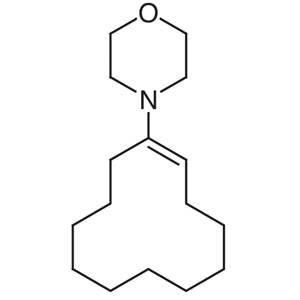
1-Morpholino-1-cyclododecene is a cyclic enamine formed by the condensation of cyclododecanone with morpholine, combining a twelve-membered macrocyclic carbon ring with a heterocyclic secondary amine group. In the organic synthesis laboratory, this compound functions as a masked carbon nucleophile: the beta carbon atom of the enamine double bond carries high electron density, allowing it to attack electrophiles without the need for a strong base. This role makes it an important intermediate for constructing macrocyclic carbon frameworks that are difficult to reach through conventional enolate routes.
The characteristic that leads researchers to select this material is its combination of selective and controlled reactivity. Unlike metal enolates, which are strongly basic and prone to side reactions such as unwanted aldol condensation, morpholino enamines react under milder conditions and deliver good regioselectivity. The morpholine group is also readily hydrolyzed back to the ketone once the alkylation step is complete, so researchers obtain the functionalized product through a compact sequence of protection and deprotection steps. This balance of reactivity and recoverability keeps the synthetic route short and predictable.
In Indonesian laboratories, this building block is typically used in university research groups and institutional chemistry facilities working on organic synthesis and macrocyclic chemistry. It suits bench-scale preparative work where a ketone equivalent with tempered reactivity is required, and it is handled as part of the standard heterocyclic building block inventory kept for multi-step synthesis projects, method development, and postgraduate research programmes in synthetic and medicinal chemistry.
Related TCI products
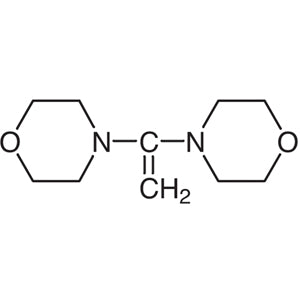
- TCI B1180 14212-87-4 1,1-Bis(morpholino)ethylene
- TCI E0784 20120-24-5 Ethyl 3-(Morpholino)propionate
- TCI B6410 1468-28-6 Morpholino(phenyl)methanone
- TCI M2537 168425-64-7 2-Morpholino-4H-pyrimido[2,1-a]isoquinolin-4-one
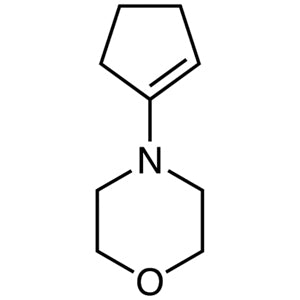
- TCI C1040 936-52-7 1-Morpholino-1-cyclopentene
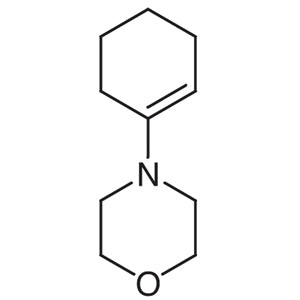
- TCI C0956 670-80-4 1-Morpholino-1-cyclohexene
- Enamine alkylation chemistry: the electron-rich beta carbon attacks alkyl halides and related electrophiles directly, giving alpha-substituted ketones after hydrolysis without requiring strongly basic enolate conditions.
- Macrocyclic framework construction: the twelve-membered cyclododecene ring provides a large carbocyclic scaffold that is otherwise difficult to functionalize selectively through conventional enolate-based synthetic routes.
- Acylation of ketone equivalents: the masked nucleophile reacts with acylating agents under mild conditions, producing 1,3-dicarbonyl type products while avoiding the polyalkylation common to metal enolate chemistry.
- Regioselective functionalization studies: morpholino enamines give reliable regiochemical outcomes, making this compound useful for teaching and investigating selectivity principles in carbonyl alpha-substitution reactions.
- Multi-step synthesis intermediates: the group is hydrolyzed back to the parent ketone after the key bond-forming step, allowing compact protection and deprotection sequences within longer synthetic pathways.
| Brand | TCI |
|---|---|
| CAS number | 3725-39-1 |
| Molecular formula | — |
| Purity | — |
| Category | Chemistry > Building Blocks > Heterocyclic Building Blocks |
| Pack sizes | available in standard TCI research-scale packaging; please confirm the currently offered size when ordering. |
| Physical form | — |
| Storage | keep in a tightly closed original container under the conditions stated on the manufacturer label. |
- Product code: M1939
Store the container tightly closed in a cool, dry, and well-ventilated area away from direct sunlight, heat sources, and ignition sources, following the conditions printed on the manufacturer label. Enamines are moisture sensitive and hydrolyze back to the parent ketone on contact with water, so keep the original container sealed and consider handling under an inert atmosphere for critical work. Use amber glass or the supplied original packaging rather than transferring to unsuitable containers. Handle inside a functioning fume hood, wear chemical-resistant gloves, safety goggles, and a laboratory coat, and avoid inhalation of vapours or contact with skin and eyes. Keep the compound separate from strong acids and strong oxidizing agents, and consult the manufacturer safety data sheet before use and disposal.
—
Produk Terkait
-
1,1-Bis(morpholino)ethylene TCI B1180
Regular price Rp 4.399.500,00Regular price -
Ethyl3-(Morpholino)propionate TCI E0784
Regular price From Rp 980.700,00Regular price -
Morpholino(phenyl)methanone TCI B6410
Regular price From Rp 1.644.300,00Regular price -
2-Morpholino-4H-pyrimido[2,1-a]isoquinolin-4-one TCI M2537
Regular price From Rp 955.500,00Regular price -
1-Morpholino-1-cyclopentene TCI C1040
Regular price Rp 3.392.550,00Regular price -
1-Morpholino-1-cyclohexene TCI C0956
Regular price From Rp 1.246.350,00Regular price -
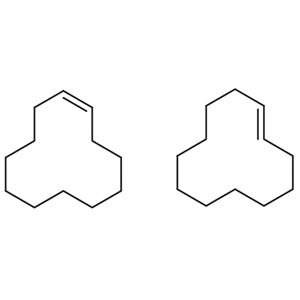
Cyclododecene(cis-andtrans-mixture) TCI C0464
Regular price Rp 2.094.750,00Regular price -
2,4-Dichloro-6-morpholino-1,3,5-triazine TCI D4814
Regular price From Rp 689.850,00Regular price


![168425-64-7 2-Morpholino-4H-pyrimido[2,1-a]isoquinolin-4-one - AMI Scientific](http://amiscientific.com/cdn/shop/files/TCI2510M2537.jpg?v=1767126769&width=533)