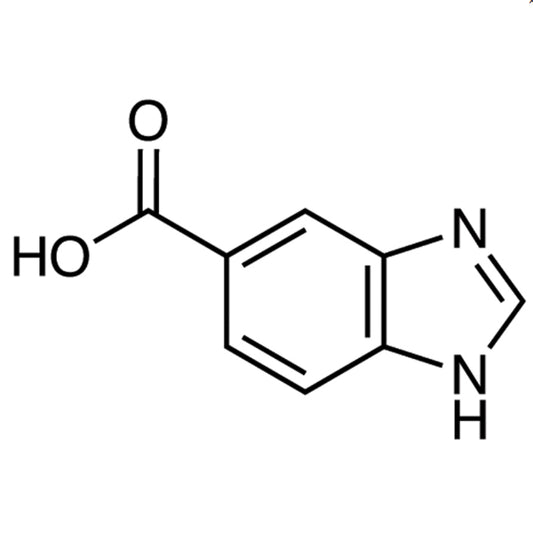
4-Methyl-2-propyl-6-benzimidazolecarboxylic Acid, CAS number 152628-03-0, is a heterocyclic compound built on a benzimidazole core that carries a methyl group, a propyl chain, and a carboxylic acid group at substituted positions. The benzimidazole core is a fusion of a benzene ring with an imidazole ring, a motif encountered very frequently in bioactive molecules. In the laboratory this compound serves as a heterocyclic building block, that is, a fully substituted starting material that shortens synthetic routes because its complex substitution pattern is already in place from the outset and does not need to be constructed step by step.
The characteristic that makes this material valuable is the presence of the carboxylic acid group as a highly flexible attachment point. This group can be activated to an acid chloride, an ester, or an amide, so that the benzimidazole fragment can be joined to other parts of a molecule through common and reliable coupling reactions. Meanwhile, the nitrogen on the imidazole ring can be alkylated to broaden structural variation, and the methyl and propyl substituents contribute lipophilic character that influences both the solubility and the binding behaviour of the final compound. It is this specific substitution pattern that gives the material its particular value to synthetic chemists.
In Indonesian laboratories, a building block of this type is typically used in organic synthesis and medicinal chemistry groups at universities and research institutes, as well as in the research and development units of pharmaceutical companies. It is ordered in the modest quantities appropriate to exploratory synthesis and method development work, where having a pre-formed, correctly substituted heterocyclic fragment on hand saves a considerable number of preparative steps and conserves laboratory time.
Related TCI products
- Heterocyclic building block in multi-step organic synthesis, supplying a complete benzimidazole substitution pattern so that chemists can begin a route from an advanced intermediate rather than constructing the ring system themselves.
- Amide bond formation through activation of the carboxylic acid group, allowing the benzimidazole fragment to be coupled to amine-bearing partners using standard and well-established coupling chemistry familiar to most synthesis laboratories.
- Esterification chemistry, where the carboxylic acid is converted to the corresponding ester to modify polarity, protect the acid function during subsequent steps, or prepare derivatives for further transformation.
- Acid chloride preparation as an activated intermediate, giving a reactive handle that couples efficiently with a broad range of nucleophiles in routine benchtop synthetic work.
- N-alkylation studies on the imidazole ring nitrogen, enabling systematic structural variation around a fixed benzimidazole scaffold for medicinal chemistry programmes exploring structure-activity relationships.
| Brand | TCI |
|---|---|
| CAS number | 152628-03-0 |
| Molecular formula | — |
| Purity | — |
| Category | Chemistry > Building Blocks > Heterocyclic Building Blocks |
| Pack sizes | available in standard research-scale pack sizes; please confirm the current options when ordering |
| Physical form | — |
| Storage | store in a cool, dry place in a tightly closed container, following the instructions on the manufacturer's label |
- Product code: M2000
Store the material in a cool, dry area away from direct sunlight, moisture, and incompatible chemicals, keeping the original tightly closed container wherever possible so that the contents are not exposed to humid air during storage. Transfer only into clean, dry, chemically compatible containers that are clearly labelled with the compound name and CAS number. Handle in a fume hood using safety glasses, gloves, and a laboratory coat, and avoid generating dust when weighing out solid material. Close the container immediately after use, and always consult the manufacturer's safety data sheet for the definitive handling, first aid, and disposal instructions before beginning work.
—
Produk Terkait
-
5-BenzimidazolecarboxylicAcid TCI B1763
Regular price From Rp 1.829.100,00Regular price -
1-Methyl-4-imidazolecarboxylicAcid TCI M2272
Regular price From Rp 2.254.350,00Regular price -
2-ImidazolecarboxylicAcid TCI I1008
Regular price From Rp 1.696.800,00Regular price -
4-ImidazolecarboxylicAcid TCI I0607
Regular price From Rp 1.193.850,00Regular price -
Ethyl4-Imidazolecarboxylate TCI E1042
Regular price From Rp 848.400,00Regular price -
Ethyl2-Imidazolecarboxylate TCI E0952
Regular price From Rp 1.115.100,00Regular price -
5-BenzotriazolecarboxylicAcid TCI B3869
Regular price From Rp 2.094.750,00Regular price -
Ethyl4-Oxazolecarboxylate TCI O0289
Regular price From Rp 1.060.500,00Regular price