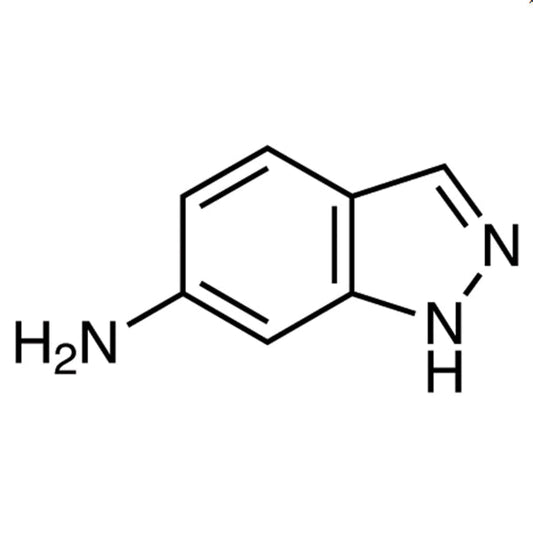
TCI M2358 3-Methyl-6-nitroindazole is a heterocyclic compound built on the indazole framework, a bicyclic ring system that fuses a benzene ring with a pyrazole ring. In this particular molecule, a methyl group occupies position three while a nitro group sits at position six. The material belongs to the heterocyclic building block class, serving as a starting scaffold in organic synthesis. In laboratory practice, substituted indazole compounds are widely used by chemists as entry points toward more complex target molecules, particularly in projects that require a nitrogen-rich heterocyclic core.
The characteristic that makes this material a preferred choice is the presence of the nitro group, which serves a dual function. Beyond withdrawing electrons and influencing the reactivity of the aromatic ring, the nitro group can be reduced to a primary amine, opening pathways toward the formation of amides, ureas, and sulfonamides, as well as subsequent coupling reactions. The methyl group at position three provides a fixed substitution pattern while also influencing the steric properties and lipophilicity of the molecule. The nitrogen atom on the pyrazole ring can likewise be selectively alkylated, adding one more useful point of modification for synthetic chemists.
Organic chemistry and medicinal chemistry research laboratories in Indonesia typically use materials of this kind at the scale of exploratory synthesis and route development work. The compound is generally handled in university research laboratories, government research institutions, and industrial research and development units carrying out multi-step synthesis. Its role as an intermediate building block means it is ordered in quantities appropriate to bench-scale reactions rather than production volumes, with usage tied to specific synthetic programmes.
- Heterocyclic scaffold construction, where the indazole core provides a ready-made nitrogen-rich bicyclic framework that saves chemists several steps compared with building the ring system from simpler precursors.
- Nitro group reduction chemistry, in which the six-position nitro substituent is converted to a primary aromatic amine that then serves as the handle for further functionalisation of the molecule.
- Amide and sulfonamide library synthesis, since the amine generated from nitro reduction reacts readily with acyl chlorides, anhydrides, and sulfonyl chlorides to produce structurally diverse analogues.
- Selective N-alkylation studies on the pyrazole nitrogen, giving synthetic chemists an additional and independent point of modification for exploring structure-property relationships across a compound series.
- Medicinal chemistry route development, where the fixed methyl substitution pattern and adjustable lipophilicity make this building block useful for preparing intermediates toward more complex target molecules.
| Brand | TCI (Tokyo Chemical Industry) |
|---|---|
| CAS number | 6494-19-5 |
| Molecular formula | — |
| Purity | — |
| Category | Chemistry > Building Blocks > Heterocyclic Building Blocks |
| Pack sizes | available in standard research and laboratory-scale packaging; please refer to the manufacturer's catalogue listing for the options offered |
| Physical form | — |
| Storage | store according to the conditions stated on the manufacturer's label and safety data sheet |
- Chemical Name: 3-Methyl-6-nitroindazole
- Product Code: M2358
Store this building block in its original tightly closed container, kept in a cool, dry, and well-ventilated area away from direct sunlight, heat sources, and incompatible materials. Follow the specific storage conditions printed on the manufacturer's label and in the accompanying safety data sheet, as these take precedence over general guidance. Handle the compound inside a functioning fume hood and wear appropriate personal protective equipment, including safety glasses, chemical-resistant gloves, and a laboratory coat. Avoid generating dust, avoid inhalation and skin contact, and transfer the material using clean, dry spatulas to prevent contamination. Reseal the container promptly after each use and keep it clearly labelled. As with all nitroaromatic compounds, consult the safety data sheet before use and dispose of residues and contaminated materials through your institution's approved chemical waste procedures.
—
Produk Terkait
-
6-Nitroindazole TCI N0399
Regular price From Rp 1.060.500,00Regular price -
5-Nitroindazole TCI N0398
Regular price Rp 903.000,00Regular price -
3-Iodo-6-nitroindazole TCI I1004
Regular price From Rp 2.279.550,00Regular price -
7-Nitroindazole TCI N0827
Regular price From Rp 955.500,00Regular price -
6-Aminoindazole TCI A0798
Regular price Rp 2.199.750,00Regular price -
5-Aminoindazole TCI A0797
Regular price From Rp 1.378.650,00Regular price -
5-Nitroindoline TCI N0893
Regular price From Rp 1.724.100,00Regular price -
7-Nitroindole TCI N0685
Regular price From Rp 1.035.300,00Regular price