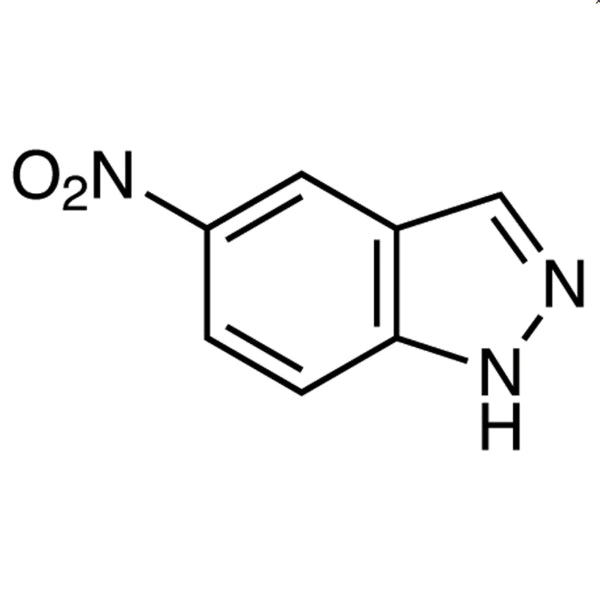
5-Nitroindazole is a chemical compound widely used in organic synthesis reactions within laboratory settings. It serves as a key building block for the creation of complex heterocyclic compounds, playing a vital role in the development of pharmaceuticals and industrial chemicals. Its unique molecular structure allows for various chemical transformations, including substitution and ring-opening reactions, making it an essential reagent in synthetic chemistry. This compound is particularly valued for its versatility in supporting a wide range of chemical modifications, which is crucial for advancing research in medicinal and material sciences.
The chemical properties of 5-Nitroindazole make it a preferred choice in laboratory applications. It exhibits stability under normal conditions but is sensitive to high temperatures and UV light exposure. The presence of the nitro group enhances its reactivity, enabling it to interact effectively with amines, acids, and heavy metals. These characteristics allow it to participate in complex substitution and ring-opening reactions, making it a versatile tool for chemists. Its ability to undergo multiple chemical transformations also supports its use in the synthesis of diverse molecular structures, enhancing its value in both academic and industrial research.
In Indonesian laboratories, 5-Nitroindazole is commonly used in organic chemistry research, particularly in the development of pharmaceutical compounds and industrial chemicals. It is also utilized in studies focused on molecular structure and the reactivity of heterocyclic compounds. Its role in synthetic pathways is critical for advancing research in drug discovery and chemical innovation, making it a fundamental component in the chemical toolkit of Indonesian scientific institutions.
- Organic synthesis of pharmaceutical compounds using 5-Nitroindazole as a core structural element due to its ability to undergo substitution reactions.
- Development of industrial chemicals through ring-opening and substitution reactions facilitated by the compound’s reactivity.
- Research on molecular structure and reactivity of heterocyclic compounds, leveraging the compound’s unique chemical properties.
- Synthesis of complex heterocyclic frameworks for drug discovery applications, benefiting from its stability and reactivity.
- Support for advanced chemical modifications in medicinal chemistry, enabling the creation of novel therapeutic agents.
| Brand | TCI |
|---|---|
| CAS number | 5401-94-5 |
| Molecular formula | — |
| Purity | — |
| Category | Chemistry > Building Blocks > Heterocyclic Building Blocks |
| Pack sizes | Available in standard laboratory quantities |
| Physical form | Solid |
| Storage | Store in a cool, dark place away from heat and UV light |
5-Nitroindazole should be stored in a cool, dark environment to prevent degradation due to heat and UV exposure. It is recommended to use airtight containers made of glass or high-density polyethylene to maintain its chemical integrity. The compound is sensitive to high temperatures, so it should be kept in a controlled temperature setting, ideally below 25°C. Proper labeling and secure storage are essential to avoid accidental exposure. Laboratory personnel should wear appropriate personal protective equipment when handling this compound to ensure safety during experiments. Regular monitoring of storage conditions is advised to maintain the compound’s stability and effectiveness in research applications.
—
Produk Terkait
-
6-Nitroindazole TCI N0399
Regular price Rp 1.113.000,00Regular priceRp 793.800,00Sale price Rp 1.113.000,00 -
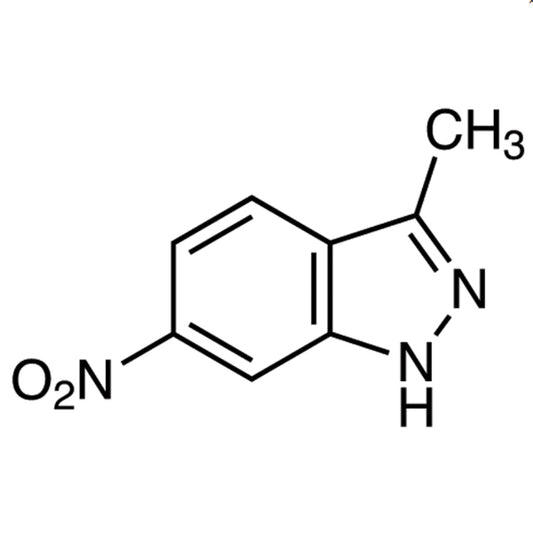
3-Methyl-6-nitroindazole TCI M2358
Regular price Rp 822.150,00Regular priceRp 590.100,00Sale price Rp 822.150,00 -
3-Iodo-6-nitroindazole TCI I1004
Regular price Rp 2.332.050,00Regular priceRp 1.646.400,00Sale price Rp 2.332.050,00 -
7-Nitroindazole TCI N0827
Regular price Rp 1.008.000,00Regular priceRp 720.300,00Sale price Rp 1.008.000,00 -
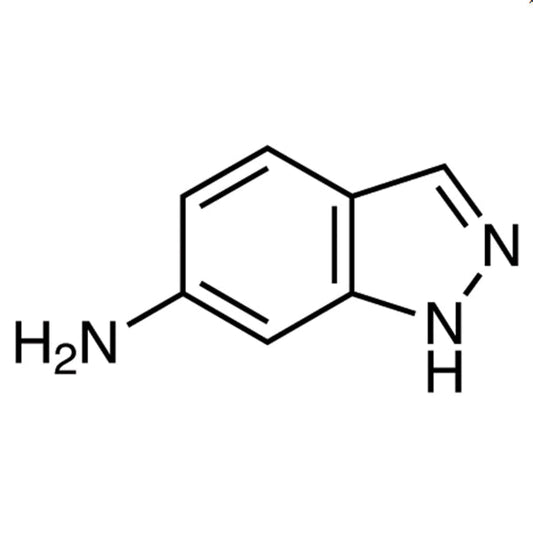
6-Aminoindazole TCI A0798
Regular price Rp 2.252.250,00Regular priceRp 1.590.750,00Sale price Rp 2.252.250,00 -
5-Aminoindazole TCI A0797
Regular price Rp 1.431.150,00Regular priceRp 1.016.400,00Sale price Rp 1.431.150,00 -
5-Nitroindoline TCI N0893
Regular price Rp 1.776.600,00Regular priceRp 1.257.900,00Sale price Rp 1.776.600,00 -
7-Nitroindole TCI N0685
Regular price Rp 1.087.800,00Regular priceRp 775.950,00Sale price Rp 1.087.800,00