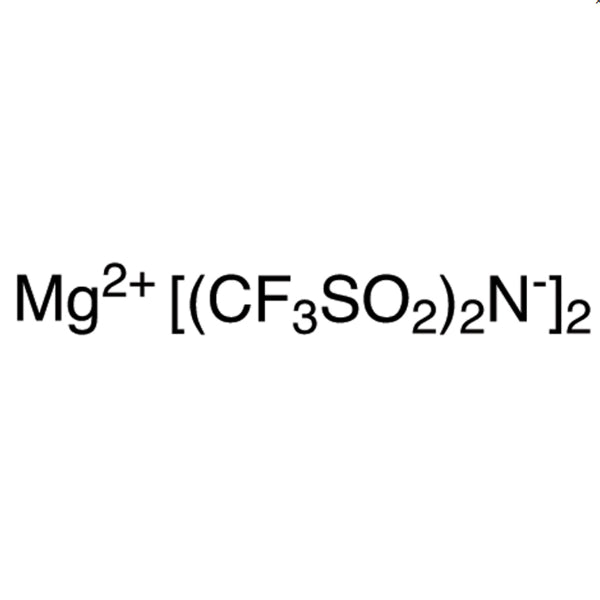
Magnesium(II) Bis(trifluoromethanesulfonyl)imide is a chemical compound widely used in catalytic and organic reactions within laboratory settings. It belongs to the class of ionic compounds known as imides, and its unique structure allows it to act as an effective catalyst or reagent in various synthetic processes. This compound is particularly valuable in reactions that require high reactivity and stability under demanding conditions. Its role is crucial in advancing research in organic chemistry and catalysis, where precise control over reaction pathways is essential.
The compound is favored for its exceptional stability and ability to function as an ion transporter in chemical reactions. Its non-volatile nature ensures that it remains consistent throughout the reaction process, minimizing unwanted side reactions or loss of material. Additionally, its high reactivity in catalytic environments makes it a reliable choice for laboratories seeking efficiency and reproducibility. The compound's chemical stability also reduces the risk of degradation, making it suitable for long-term use in a variety of experimental setups.
In Indonesian laboratories, this compound is commonly used in organic synthesis, catalytic reactions, and the production of complex chemical compounds. Researchers in Indonesia rely on its stability and effectiveness to achieve consistent results in both small-scale and large-scale experiments. Its application is particularly prominent in academic and industrial research settings where high-performance reagents are required. The compound's versatility and reliability make it a preferred choice among scientists working in the field of inorganic and organic chemistry.
- Organic synthesis of complex compounds requires a stable and reactive catalyst, making this compound ideal for promoting efficient reaction pathways.
- Catalytic reactions under vacuum or pressure conditions benefit from the compound's stability and ability to maintain reactivity in extreme environments.
- The compound is well-suited for use in industrial-scale chemical processes due to its non-volatile nature and consistent performance.
- Research in inorganic chemistry often utilizes this material for its unique ionic structure and ability to facilitate ion transfer in chemical reactions.
- It is frequently employed in the development of new materials, where its chemical stability and reactivity contribute to the synthesis of advanced compounds.
| Brand | TCI |
|---|---|
| CAS number | 133395-16-1 |
| Molecular formula | — |
| Purity | — |
| Category | Chemistry > Catalysis and Inorganic Chemistry > Main-group Elements |
| Pack sizes | Available in various quantities as per standard laboratory supply |
| Physical form | Solid powder |
| Storage | Store in a cool, dry place away from moisture and direct sunlight |
This compound should be stored in a cool, dry environment to maintain its chemical stability and prevent degradation. It is recommended to use airtight containers made of materials such as glass or polyethylene to minimize exposure to moisture and air. Due to its non-volatile nature, it is less prone to evaporation, but proper sealing is still essential. Laboratory personnel should handle the compound with care, ensuring that it is kept away from incompatible substances. Regular monitoring of storage conditions is advised to ensure optimal performance and safety during use.
—
Produk Terkait
-
TCI B5774 5,10-Bis(4,4,5,5-tetramethyl-1,3,2-dioxaborolan-2-yl)naphtho[1,2-c:5,6-c']bis([1,2,5]oxadiazole)
Regular price Rp 10.255.350,00Regular price -
Dihydroiodide TCI B6569
Regular price From Rp 1.936.200,00Regular price -
Trifluoromethanesulfonate TCI B7003
Regular price From Rp 1.936.200,00Regular price
![5,10-Bis(4,4,5,5-tetramethyl-1,3,2-dioxaborolan-2-yl)naphtho[1,2-c:5,6-c']bis([1,2,5]oxadiazole) - TCI B5774 - AMI Scientific](http://amiscientific.com/cdn/shop/files/TCI2510B5774.jpg?v=1769180228&width=533)