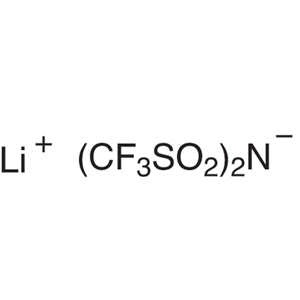
Sodium Bis(trifluoromethanesulfonyl)imide (NaTf₂) is an inorganic compound widely used in chemical reactions and catalytic processes within laboratory settings. It serves as a versatile reagent due to its strong ionic properties and ability to function as an ionic liquid or catalyst in various chemical reactions. This compound is particularly valuable in environments where non-aqueous media are required, as it exhibits excellent solubility in organic solvents. Its stability and reactivity make it a preferred choice for researchers seeking to optimize reaction conditions and enhance chemical process efficiency.
The compound’s strong ionic nature and high boiling point contribute to its effectiveness in both catalytic and non-aqueous reaction systems. It remains stable under a wide range of conditions, which enhances its reliability in laboratory applications. Additionally, its non-volatile nature simplifies handling and reduces the risk of evaporation during prolonged experiments. These properties make Sodium Bis(trifluoromethanesulfonyl)imide a reliable and efficient reagent for a variety of chemical processes, especially in advanced research settings.
In Indonesian laboratories, Sodium Bis(trifluoromethanesulfonyl)imide is commonly used in inorganic chemistry, catalysis, and organic synthesis. Its ability to act as a catalyst or medium in non-aqueous reactions makes it a key component in research focused on developing new chemical processes and materials. The compound’s stability and reactivity ensure that it remains a preferred choice for researchers aiming to achieve precise and efficient chemical outcomes.
TCI brochures (PDF)
- Sodium Electrolytes 2025-09-19 · p. 1
- Solar Cell Materials 2026-04-21 · p. 10
- Metallic Salts 2025-11-06 · p. 13
Related TCI products
- TCI Z0027 168106-25-0 Zinc(II) Bis(trifluoromethanesulfonyl)imide
- TCI L0295 192998-62-2 Lithium (Fluorosulfonyl)(trifluoromethanesulfonyl)imide
- TCI C3263 165324-09-4 Calcium(II) Bis(trifluoromethanesulfonyl)imide
- TCI B2542 90076-65-6 Lithium Bis(trifluoromethanesulfonyl)imide
- TCI L0267 132843-44-8 Lithium Bis(pentafluoroethanesulfonyl)imide
- TCI B5171 168106-22-7 Barium(II) Bis(trifluoromethanesulfonyl)imide
- Organic synthesis: Sodium Bis(trifluoromethanesulfonyl)imide is used as a catalyst in organic synthesis to enhance reaction efficiency and yield.
- Inorganic chemistry research: Its strong ionic properties make it suitable for studying inorganic reactions and ion behavior in non-aqueous environments.
- Catalytic processes: It functions as a catalyst in various chemical reactions, improving reaction rates and reducing energy requirements.
- Non-aqueous reaction media: The compound’s solubility in organic solvents makes it ideal for reactions that require a non-aqueous environment.
- Advanced material development: It is used in the synthesis of new materials due to its stability and reactivity under various conditions.
| Brand | TCI |
|---|---|
| CAS number | 91742-21-1 |
| Molecular formula | — |
| Purity | — |
| Category | Chemistry > Catalysis and Inorganic Chemistry > Main-group Elements |
| Pack sizes | Available in various quantities as per standard laboratory supply |
| Physical form | Solid powder |
| Storage | Store in a cool, dry place away from moisture and direct sunlight |
Sodium Bis(trifluoromethanesulfonyl)imide should be stored in a cool, dry place, away from moisture and direct sunlight to maintain its stability and effectiveness. It is recommended to use airtight containers to prevent exposure to humidity, which could affect its performance. Due to its ionic nature, it should be handled with care to avoid contamination. In laboratory settings, it is important to ensure proper ventilation when working with the compound to minimize inhalation risks. Always use appropriate personal protective equipment, such as gloves and safety goggles, when handling this material to ensure safe laboratory practices.
—
Product Categories
Produk Terkait
-
Zinc(II)Bis(trifluoromethanesulfonyl)imide TCI Z0027
Regular price From Rp 1.618.050,00Regular priceRp 1.146.600,00Sale price From Rp 1.618.050,00 -
Lithium(Fluorosulfonyl)(trifluoromethanesulfonyl)imide TCI L0295
Regular price From Rp 2.809.800,00Regular priceRp 1.980.300,00Sale price From Rp 2.809.800,00 -
Calcium(II)Bis(trifluoromethanesulfonyl)imide TCI C3263
Regular price From Rp 1.961.400,00Regular priceRp 1.387.050,00Sale price From Rp 1.961.400,00 -
LithiumBis(trifluoromethanesulfonyl)imide TCI B2542
Regular price From Rp 1.483.650,00Regular priceRp 1.053.150,00Sale price From Rp 1.483.650,00 -
LithiumBis(pentafluoroethanesulfonyl)imide TCI L0267
Regular price From Rp 2.650.200,00Regular priceRp 1.869.000,00Sale price From Rp 2.650.200,00 -
Barium(II)Bis(trifluoromethanesulfonyl)imide TCI B5171
Regular price From Rp 1.961.400,00Regular priceRp 1.387.050,00Sale price From Rp 1.961.400,00 -
Potassium(Fluorosulfonyl)(trifluoromethanesulfonyl)imide TCI P2410
Regular price From Rp 2.041.200,00Regular priceRp 1.442.700,00Sale price From Rp 2.041.200,00 -
Magnesium(II)Bis(trifluoromethanesulfonyl)imide TCI M2861
Regular price From Rp 1.351.350,00Regular priceRp 960.750,00Sale price From Rp 1.351.350,00