

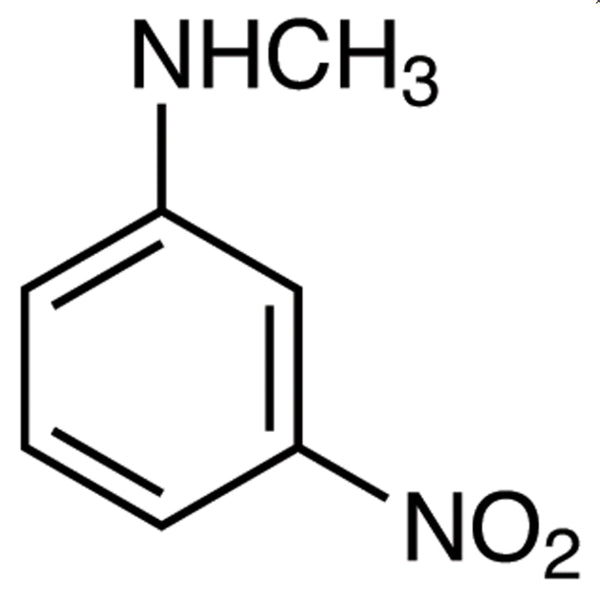
TCI M3042 N-Methyl-3-nitroaniline is an aniline derivative carrying a nitro group at the meta position of the benzene ring and a methyl group on the amine nitrogen. The compound belongs to the group of non-heterocyclic building blocks, that is, simple starting materials used to construct more complex molecules. Its role in the laboratory is to supply an aromatic framework that already has two functional groups installed at a defined relative position, so that researchers can proceed directly to the transformation stage without first having to carry out nitration or methylation steps of their own.
The characteristics that make this compound a preferred choice are its meta substitution pattern and the secondary amine functionality it carries. The nitro group is a strong electron-withdrawing substituent and can be selectively reduced to an amino group, giving a substituted phenylenediamine derivative that serves as an important precursor to many heterocyclic compounds and dyes. Meanwhile, the secondary amine nitrogen still retains one hydrogen atom that can be further acylated, sulfonylated, or alkylated. The meta arrangement also avoids direct resonance interaction between the two groups, so the reactivity of each is more predictable than in the ortho or para isomers.
In Indonesian laboratories, this building block is typically used in university and institutional research groups working on organic synthesis, in medicinal chemistry programmes that build candidate scaffolds step by step, and in materials or dye chemistry work. It is ordered as a bench-scale starting material for multi-step routes, where having the substitution pattern already fixed shortens the synthetic sequence and reduces the number of reactions that have to be optimised in-house.
- Selective nitro reduction to substituted phenylenediamine derivatives, because the meta-positioned nitro group can be converted to an amino group while the N-methyl amine remains intact as a handle.
- Heterocycle construction, where the reduced diamine product serves as a precursor for building ring systems that require two nitrogen centres in a defined relative arrangement.
- Dye and colourant chemistry research, since substituted phenylenediamine intermediates derived from this compound are long-established precursors in the synthesis of coloured aromatic products.
- Acylation, sulfonylation, and further alkylation studies at the secondary amine nitrogen, which still bears one replaceable hydrogen atom available for derivatisation reactions.
- Medicinal chemistry scaffold preparation, as the pre-installed meta substitution pattern lets researchers enter a multi-step route without performing their own nitration or methylation stages.
| Brand | TCI (Tokyo Chemical Industry) |
|---|---|
| CAS number | 619-26-1 |
| Molecular formula | — |
| Purity | — |
| Category | Chemistry > Building Blocks > Non-Heterocyclic Building Blocks |
| Pack sizes | available in the standard research-scale pack sizes listed for this catalogue item; storage in the closed original container is recommended |
| Physical form | — |
| Storage | — |
- Catalogue number: M3042
- Chemical class: nitro-substituted aromatic secondary amine (non-heterocyclic building block)
Store the material in its original tightly closed container in a cool, dry, well-ventilated area away from direct sunlight, heat sources, and incompatible chemicals such as strong oxidising and reducing agents. Keep the container sealed when not in use to limit exposure to air and moisture, and return it promptly to its designated storage location after weighing. All handling, weighing, and transfer operations should be carried out in a functioning fume hood by trained personnel wearing a laboratory coat, chemically resistant gloves, and safety goggles. Avoid inhalation of dust and any contact with skin or eyes, and consult the manufacturer's safety data sheet before first use for the complete hazard classification, disposal route, and emergency measures applicable to this compound.
—
Produk Terkait
-
2-Iodo-4-nitroaniline TCI I0878
Regular price From Rp 1.246.350,00Regular price -
4-Bromo-3-nitroaniline TCI B4876
Regular price From Rp 637.350,00Regular price -
2-Bromo-4-nitroaniline TCI B4873
Regular price From Rp 1.220.100,00Regular price -
4-Bromo-2-methyl-6-nitroaniline TCI B3730
Regular price From Rp 717.150,00Regular price -
4-Bromo-2-nitroaniline TCI B3033
Regular price From Rp 689.850,00Regular price -
2-Bromo-6-chloro-4-nitroaniline TCI B1771
Regular price Rp 477.750,00Regular price -
2-Bromo-4,6-dinitroaniline TCI B0814
Regular price From Rp 717.150,00Regular price -
2-Methyl-4-nitroaniline TCI N0529
Regular price Rp 1.644.300,00Regular price


