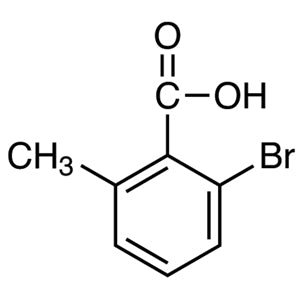
TCI M3208 2-Methoxy-6-methylbenzoic Acid, bearing CAS number 6161-65-5, is a substituted benzoic acid carrying a methoxy group at position two and a methyl group at position six, that is, on both sides flanking the carboxylate group. The compound serves as an aromatic building block in organic synthesis laboratories, meaning a starting material that supplies a benzene ring skeleton with a specific substitution pattern. A double ortho substitution pattern of this kind is not easily constructed directly from simple benzene, so its availability as a ready-made material saves researchers a considerable number of working steps.
The property that makes this compound attractive is the steric hindrance surrounding the carboxylate group created by the two substituents flanking it. This condition forces the carboxylate group slightly out of the plane of the ring and produces a characteristic reactivity, which is why the compound is frequently used as a test substrate when researchers assess the strength of an acid activation method or an amide coupling method. Its methoxy group can be demethylated to a phenol to open new cyclization routes, while its methyl group can be functionalized further. This pair of substituents is also a motif commonly encountered in synthetic work.
In Indonesian laboratories, the material is typically handled within organic synthesis groups at universities and research institutes, as well as in method development work where a demanding substrate is needed to benchmark a reaction protocol. Supplied under the TCI brand within the TCI product category, it is ordinarily kept on the shelf as a standing reference compound for route scouting, coupling trials, and derivatization exercises that require a reliably characterized aromatic acid.
Related TCI products
- TCI M2780 6245-57-4 4-Methoxy-2-methylbenzoic Acid
- TCI M2728 6880-04-2 4-Methoxy-3-methylbenzoic Acid
- TCI M2217 55289-06-0 3-Methoxy-2-methylbenzoic Acid
- TCI M1426 7151-68-0 3-Methoxy-4-methylbenzoic Acid
- TCI T2323 652-32-4 2,3,5,6-Tetrafluoro-4-methylbenzoic Acid
- TCI B4145 6967-82-4 2-Bromo-5-methylbenzoic Acid
- Aromatic building block in multi-step organic synthesis, supplying a pre-formed benzene ring with a specific ortho substitution pattern that would otherwise demand several additional preparative steps.
- Benchmark substrate for amide coupling method development, since the steric hindrance around its carboxylate group makes it a demanding test of how effectively a coupling reagent performs.
- Test substrate for carboxylic acid activation studies, where researchers evaluate whether an activation protocol can overcome the hindrance imposed by the two flanking substituents.
- Precursor for demethylation chemistry, because the methoxy group can be converted to a phenol and thereby open new cyclization routes toward more elaborate ring systems.
- Starting material for side-chain functionalization work, as the methyl group at position six can be functionalized further to extend the molecular framework in subsequent transformations.
| Brand | TCI |
|---|---|
| CAS number | 6161-65-5 |
| Molecular formula | — |
| Purity | — |
| Category | TCI |
| Pack sizes | available in standard TCI catalogue pack sizes; please confirm the required packing when ordering |
| Physical form | — |
| Storage | store according to the conditions stated on the manufacturer's label and safety data sheet |
- Chemical name: 2-Methoxy-6-methylbenzoic Acid
- Product code: M3208
Store the container tightly closed in a cool, dry, and well-ventilated area, away from direct sunlight, moisture, and incompatible materials, following the conditions stated on the manufacturer's label and safety data sheet. Keep the material in its original supplier container, or in a clean, chemically resistant, well-sealed container that is clearly labelled with the compound name and CAS number. Handle the solid in a fume hood to avoid dust formation and inhalation, and wear suitable personal protective equipment including safety goggles, gloves, and a laboratory coat. Avoid contact with skin and eyes, and wash hands thoroughly after handling. Dispose of residues and contaminated packaging in accordance with applicable institutional and local chemical waste regulations.
—
Produk Terkait
-
4-Methoxy-2-methylbenzoicAcid TCI M2780
Regular price From Rp 955.500,00Regular price -
4-Methoxy-3-methylbenzoicAcid TCI M2728
Regular price Rp 557.550,00Regular price -
3-Methoxy-2-methylbenzoicAcid TCI M2217
Regular price From Rp 505.050,00Regular price -
3-Methoxy-4-methylbenzoicAcid TCI M1426
Regular price From Rp 1.458.450,00Regular price -
2,3,5,6-Tetrafluoro-4-methylbenzoicAcid TCI T2323
Regular price Rp 1.803.900,00Regular price -
2-Bromo-5-methylbenzoicAcid TCI B4145
Regular price From Rp 1.510.950,00Regular price -
2-Bromo-6-methylbenzoicAcid TCI B4097
Regular price From Rp 1.431.150,00Regular price -
2-Bromo-4-methylbenzoicAcid TCI B3879
Regular price From Rp 795.900,00Regular price