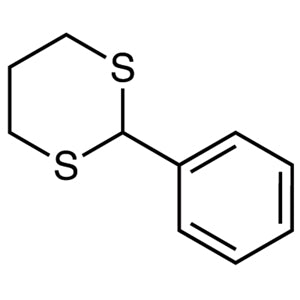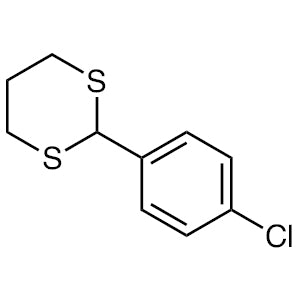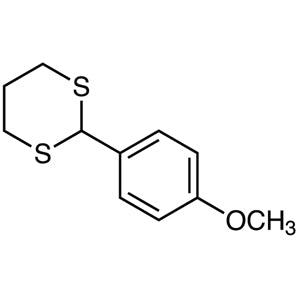
2-(4-Methoxyphenyl)-1,3-dithiane is a chemical compound widely used in organic reactions for the synthesis of heterocyclic compounds. This material plays a crucial role in laboratory settings where the construction of complex molecular structures is required. Its unique structure, featuring two sulfur atoms, makes it a valuable building block in chemical research. The compound is particularly useful for creating heterocyclic frameworks, which are essential in pharmaceutical and materials science applications.
The compound's reactivity stems from its dithiane structure, which allows it to participate in various chemical reactions, including nucleophilic and electrophilic substitutions. These properties make it a preferred choice for researchers aiming to develop new compounds with specific functional groups. Its stability under certain conditions also enhances its usability, ensuring consistent results in experimental processes. This reliability is especially important in academic and industrial laboratories where reproducibility is key.
In Indonesian laboratories, 2-(4-Methoxyphenyl)-1,3-dithiane is commonly used in chemical research, particularly in the synthesis of heterocyclic compounds. It is a staple in university research labs and research institutions, where it supports studies on organic reactivity and molecular design. Its application extends to drug development and material science, making it a versatile tool for chemists working on complex synthesis projects.
- Heterocyclic Compound Synthesis: This compound is ideal for creating complex ring structures, which are essential in pharmaceutical research and development.
- Organic Reaction Studies: Its reactivity and structural versatility make it suitable for exploring nucleophilic and electrophilic substitution reactions in laboratory experiments.
- Molecular Design and Modification: Researchers use it to build and modify molecular frameworks, supporting advancements in material science and chemical engineering.
- Drug Development: It is frequently employed in the synthesis of bioactive compounds, aiding in the discovery of new therapeutic agents.
- Academic Research: Universities and research institutions rely on it for teaching and experimental work in organic chemistry courses and advanced research projects.
| Brand | TCI |
|---|---|
| CAS number | 24588-72-5 |
| Molecular formula | — |
| Purity | — |
| Category | Chemistry > Building Blocks > Heterocyclic Building Blocks |
| Pack sizes | Available in various quantities as per standard chemical supply practices |
| Physical form | Solid or liquid, depending on specific product formulation |
| Storage | Store in a cool, dry place away from direct sunlight and incompatible materials |
This compound should be stored in a cool, dry environment to maintain its stability and reactivity. It is recommended to keep it in a sealed container to prevent exposure to moisture and air, which could affect its chemical integrity. Suitable containers include glass or high-density polyethylene vessels that are resistant to chemical degradation. In laboratory settings, it should be handled with appropriate personal protective equipment, such as gloves and safety goggles, to ensure safe usage. Proper ventilation is also essential when working with this material to minimize inhalation risks. Regular monitoring of storage conditions helps maintain the compound's effectiveness and safety for research applications.
—
Produk Terkait
-
2-(p-Tolyl)-1,3-dithiane TCI T3887
Regular price Rp 1.431.150,00Regular price -
2-Trimethylsilyl-1,3-dithiane TCI T1514
Regular price From Rp 4.081.350,00Regular price -
2-Phenyl-1,3-dithiane TCI P2660
Regular price From Rp 1.326.150,00Regular price -
2-Methyl-1,3-dithiane TCI M3590
Regular price From Rp 2.518.950,00Regular price -
2,5-Dihydroxy-1,4-dithiane TCI D1761
Regular price From Rp 823.200,00Regular price -
Ethyl1,3-Dithiane-2-carboxylate TCI D1648
Regular price From Rp 1.035.300,00Regular price -
1,3-Dithiane TCI D0119
Regular price From Rp 1.936.200,00Regular price -
2-(4-Chlorophenyl)-1,3-dithiane TCI C3649
Regular price From Rp 795.900,00Regular price