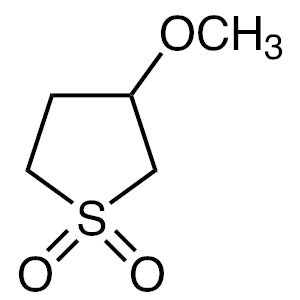
3-Methoxytetrahydrothiophene 1,1-Dioxide is a chemical compound widely used in advanced chemical experiments. It plays a crucial role in laboratory settings as a reagent or auxiliary material in reactions requiring high reactivity and the ability to form complex structures. This compound is particularly valuable in the synthesis of heterocyclic compounds and organosulfur derivatives, where its unique chemical properties enable the formation of intricate molecular frameworks. Its versatility makes it a key component in various synthetic pathways, especially in research involving the development of new compounds or structural modifications.
The compound's chemical stability under specific conditions and its ability to participate in substitution and oxidation reactions are key factors that make it a preferred choice for researchers. Its complex molecular structure allows it to interact effectively with a wide range of other reagents in chemical systems, making it ideal for reactions that demand precision and controlled conditions. These characteristics ensure that it remains a reliable and efficient material in both academic and industrial research environments.
In Indonesian laboratories, 3-Methoxytetrahydrothiophene 1,1-Dioxide is commonly used in organic chemistry research, particularly in higher education institutions and research organizations. It is a staple in laboratories focused on synthetic chemistry, where its properties support the development of new compounds and the refinement of existing molecular structures. Its consistent performance and reliability make it an essential tool for chemists working on advanced chemical projects.
Advantages (TCI brochure)
- Excellent chemical and physical properties, thermal stability
- Good electrochemical properties
- Enables preparation of 1 mol/L LiTFSI solution
- Purity >99.0%, water content <1000ppm
TCI brochures (PDF)
Related TCI products
- TCI T0115 126-33-0 Tetrahydrothiophene 1,1-Dioxide
- TCI T0114 110-01-0 Tetrahydrothiophene
- TCI C3688 39929-21-0 Chloro(tetrahydrothiophene)gold(I)
- TCI U0148 7446-09-5 Sulfur Dioxide (ca. 2.5% in Dichloromethane, ca. 0.5 mol/L)
- TCI U0147 7446-09-5 Sulfur Dioxide (ca 8% in Tetrahydrofuran, ca 12 mol/L)
- TCI U0113 2098851-56-8 Sulfur Dioxide 1-Methylpyrrolidine Adduct
- Organic synthesis of heterocyclic compounds due to its ability to form complex molecular structures.
- Oxidation and substitution reactions where high reactivity and structural versatility are required.
- Research in organosulfur chemistry for the development of new compounds and functional groups.
- Structural modification of molecules in synthetic pathways requiring precise chemical control.
- Advanced chemical experiments in academic and research laboratories focusing on molecular innovation.
From the TCI brochure
- Electrolyte solvent
| Brand | TCI |
|---|---|
| CAS number | 20627-66-1 |
| Molecular formula | — |
| Purity | — |
| Category | Chemistry > Solvents > Solvents (Others) |
| Pack sizes | Available in various quantities as per standard supplier offerings |
| Physical form | Liquid |
| Storage | Store in a cool, dry place away from direct sunlight and incompatible materials |
Data from the TCI brochure
| Melting Point | -19 °C |
|---|---|
| Heat Generation Temperature | 449 °C |
| Vapor Pressure | 7.2 Pa (373K) |
| Potential Window | 6.9 V (1 mol/L LiPF6 solution) |
| Electric Resistance | 8521 Ω·cm (1 mol/L LiPF6 solution, -20°C) |
| Electric Resistance | 221 Ω·cm (1 mol/L LiPF6 solution, 20°C) |
Source: TCI brochure FF104 (2025-06-10)
This compound should be stored in a cool, dry environment, away from direct sunlight and sources of heat. It is recommended to use sealed containers made of materials compatible with its chemical nature, such as glass or high-density polyethylene. Proper ventilation is essential when handling the material to minimize exposure to vapors. Avoid contact with incompatible substances like strong oxidizers or acids. Always use appropriate personal protective equipment, including gloves and safety goggles, when working with this compound. Ensure that storage areas are well-ventilated and free from potential ignition sources to maintain a safe laboratory environment.
References cited in the TCI brochure
- V. S. Kolosnitsyn. Electroconduction of Lithium Perchlorate Solutions in Sulfones Russian Journal of Electrochemistry, 2001. doi:10.1023/a:1016666517462
- V. S. Kolosnitsyn. Cycling a Sulfur Electrode: Effect of Physicochemical Properties of Electrolyte Systems Russian Journal of Electrochemistry, 2003. doi:10.1023/a:1026123504203
Product Categories
Produk Terkait
-
Tetrahydrothiophene1,1-Dioxide TCI T0115
Regular price From Rp 477.750,00Regular price -
Tetrahydrothiophene TCI T0114
Regular price From Rp 769.650,00Regular price -
Chloro(tetrahydrothiophene)gold(I) TCI C3688
Regular price Rp 12.772.200,00Regular price -
SulfurDioxide(ca.2.5%inDichloromethane,ca.0.5mol/L) TCI U0148
Regular price From Rp 1.908.900,00Regular price -
SulfurDioxide(ca8%inTetrahydrofuran,ca12mol/L) TCI U0147
Regular price From Rp 1.458.450,00Regular price -
SulfurDioxide1-MethylpyrrolidineAdduct TCI U0113
Regular price From Rp 2.094.750,00Regular price -
Tetrahydrothiopyran-4-one1,1-Dioxide TCI T3320
Regular price From Rp 1.644.300,00Regular price -
Thiomorpholine1,1-Dioxide TCI T2193
Regular price From Rp 4.559.100,00Regular price